Clothing manufacturer in Bangladesh for Omani brands
Oman is a small market, 5.4 million people, but in 2026 it is the easiest Gulf country to ship to. Its container ports face the Arabian Sea and the Gulf of Oman, so cargo from Chattogram does not pass the Strait of Hormuz. The rules are familiar GCC ones, a 5% duty and 5% VAT, with one new competitive fact: since 1 June 2026 Indian clothing enters Oman duty-free. Facts and sources below, checked 28 September 2026. CMB Sourcing Ltd. is a buying house in Narayanganj, Dhaka: audited partner factories make your order, and we manage sampling, quality checks and shipping.
- Import duty
- 5% of CIF value under the GCC tariff; WTO clothing average 5.0%, no duty-free lines
- VAT
- 5% since 16 April 2021, collected by Customs; deferrable for VAT-registered importers
- Conformity certificate
- None for clothing today; textiles are listed for a later stage of Oman’s scheme, with no date set
- Labels
- Arabic, or Arabic and English; origin and composition, hard to remove
- Importer
- Omani commercial registration, Chamber membership and Bayan customs registration
- Competing origins
- India duty-free on all 945 textile and apparel lines since 1 June 2026; US goods duty-free under the FTA
- Apparel imports
- US$421m in 2025, up 15%; UAE 53%, China 33%, Bangladesh direct 0.7% (UN Comtrade)
- Bangladeshis in Oman
- 621,048 in June 2025, the largest expatriate nationality (NCSI)
- Shipping now
- Salalah and Sohar open to bookings (Maersk, 23 Sep 2026); Salalah exempt from the emergency surcharge
- Minimum order
- From 500 pieces per style and colour; some categories start higher, confirmed on your quote
In short
Oman charges the GCC tariff of 5% on the CIF value of clothing, then 5% VAT, which a VAT-registered importer can defer to its return. No conformity certificate applies to garments today, although textiles are listed for a later stage of Oman’s conformity scheme. Labels must be in Arabic, or Arabic and English. While the Strait of Hormuz is closed, Oman is the Gulf market ships reach most directly: Salalah and Sohar lie outside the strait and were taking bookings on 23 September 2026.
Duty: 5% at the border, and two origins that pay nothing
Oman applies the GCC common external tariff: 5% of the CIF value on goods from outside the Gulf, collected by the Directorate General of Customs of the Royal Oman Police through its Bayan single-window system. The WTO’s tariff profile for 2025 shows an applied average of exactly 5.0% on clothing, a maximum of 5% and no duty-free lines, against a bound ceiling of 15%. There is no preference scheme for least developed countries, so Bangladeshi garments pay the same 5% as Chinese or Turkish ones, and Bangladesh’s graduation from LDC status in November 2026 changes nothing on the tariff line.
Two outside origins now pay nothing. Under the US–Oman Free Trade Agreement, in force since 2009, virtually all American goods enter duty-free. And the India–Oman Comprehensive Economic Partnership Agreement, signed on 18 December 2025, came into force on 1 June 2026 with immediate duty-free access for all 945 textile and apparel tariff lines. Bangladesh has no trade agreement with Oman and none under negotiation that we could find; the two foreign ministers met in Muscat on 23 April 2026 and discussed food security, transport and investment. On a like-for-like quote, Indian goods therefore land five points cheaper on duty, which is why we show the duty as its own line.
VAT: 5%, collected at the border with the duty
Oman introduced VAT at 5% on 16 April 2021 under Royal Decree 121/2020, and the Tax Authority’s guide to imports explains how it works at the border: Customs collects the VAT through the Bayan portal together with the duty, whether or not the importer is registered for VAT. An importer that is registered can apply to the Tax Authority to defer import VAT to its VAT return, which removes the cash-flow cost on each container; the authority decides within 30 days. Registration is compulsory above OMR 38,500 of annual supplies. Excise tax covers tobacco, alcohol, pork, energy drinks and sweetened drinks, not clothing, so the border cost is the 5% duty and 5% VAT plus clearance.
Conformity: no certificate for garments today, but textiles are on the list
Standards sit with the Directorate General for Specifications and Metrology at the Ministry of Commerce, Industry and Investment Promotion. Oman generally enforces GSO standards, and the US Commercial Service reports that non-food products enter on a manufacturer’s declaration of conformity with a test report verified by the directorate; uncertified goods can be released temporarily while samples are tested. Oman also runs a conformity scheme under Ministerial Decision 190/2021, enforced since 5 June 2022. In December 2024 it notified the WTO of the product categories to be brought in, textiles among them, in three stages.
The first stage, from 1 March 2025, covered electrical and gas appliances, food-contact materials, detergents, paints, building materials, lubricants, batteries, tobacco, cosmetics and personal protective equipment, not textiles, and dates for the later stages had not been announced when we checked. So clothing needs no certificate today, but it may later. Two practical notes: protective workwear sold as PPE already falls in the first stage, and the Omani dishdasha has had a national specification, including fabric quality, since February 2017. Ask your importer to confirm the position with the directorate before the first shipment.
Labelling
Labels must be in Arabic only, or in Arabic and English, according to the US Commercial Service’s Oman guide. The consumer protection regulations, Decision 77/2017, add that information on the origin, nature, composition and components of a product must appear on the item or its packaging, be clear and readable, be hard to erase or lose, and use Arabic as one of its languages. The GCC’s own standard for textile labels, GSO 863 of 1997, covers ready-made garments and sets out the fibre content and identification fields. In practice we put fibre percentages, country of origin, care symbols and size on the sewn label, with your importer’s details where it asks for them. We add the Arabic content at sampling, and you approve it on the pre-production sample.
Selling in Oman? Get a landed-cost quote
Documents and the importer of record
Clearance needs a registered Omani business. The importer needs a commercial registration, a certificate of membership of the Oman Chamber of Commerce and Industry and a customs registration in Bayan, which since the move to a paperless supply chain issues electronic delivery and release orders. The shipment needs a commercial invoice, the bill of lading or air waybill and, where a preference is claimed, a certificate of origin; Bangladeshi goods claim none, but we supply a chamber certificate of origin with the standard documents anyway. A brand without its own Omani company therefore imports through a distributor or agent that holds these registrations.
Oman’s foreign ministry attests commercial invoices and certificates of origin for a fee, from OMR 50 on an invoice up to US$10,000 to OMR 150 above US$100,000, and OMR 20 for a certificate of origin, now through Oman Post. Its electronic attestation service, which avoids a visit to an Omani mission, has included Bangladesh since May 2026. Ask your importer at the start whether Customs will want the documents attested, so we issue them in that form.
The market: US$421 million of imported clothing, most of it through the UAE
Oman had 5.40 million residents at the end of June 2026, 43% of them expatriates. It imported US$421 million of clothing in 2025 on UN Comtrade figures, US$272 million knitted and US$149 million woven, up 15% on 2024. The UAE supplied US$222 million of it, 53%, a share that reflects its role as the Gulf’s distribution hub more than its own factories, and China US$138 million; India followed with US$26 million. The largest single line was knitted babies’ garments at US$90 million, then other knitted garments at US$35 million, t-shirts at US$31 million and women’s woven suits, dresses, skirts and trousers at US$30 million.
Shopping in Oman centres on the malls of Muscat. Mall of Oman, developed by Majid Al Futtaim and inaugurated in February 2023 after a soft launch in September 2021, has 260 retail outlets; the group says it has invested OMR 705 million in the country, including Carrefour hypermarkets. Oman Avenues Mall, opened in May 2015, belongs to the Lulu Group. The international chains in both malls buy centrally; independent and modest-fashion labels, uniform buyers and value retailers serving the expatriate communities buy direct, and they are the buyers this page is written for.
Trade with Bangladesh
Oman’s recorded clothing imports from Bangladesh are small and volatile: US$12.9 million in 2024, US$7.7 million knitted and US$5.2 million woven, out of US$36.2 million of all goods, then US$3.0 million in 2025. The figures very likely understate what Omanis wear from Bangladesh, because much clothing reaches Oman from UAE distributors and shows up in the UAE’s 53% share. That channel runs through Jebel Ali, whose volumes fell 90% in the second quarter of 2026, which is a practical argument for shipping direct to an Omani port now.
Bangladeshis are Oman’s largest expatriate nationality: 637,152 at the end of 2024 and 621,048 in June 2025, according to the National Centre for Statistics and Information, the fall following Oman’s restrictions on new Bangladeshi work visas since October 2023. That community is a market in its own right for value basics and modest wear, and a source of Omani importers with ties to Bangladesh.
Shipping: normal routes, the position in September 2026, and air
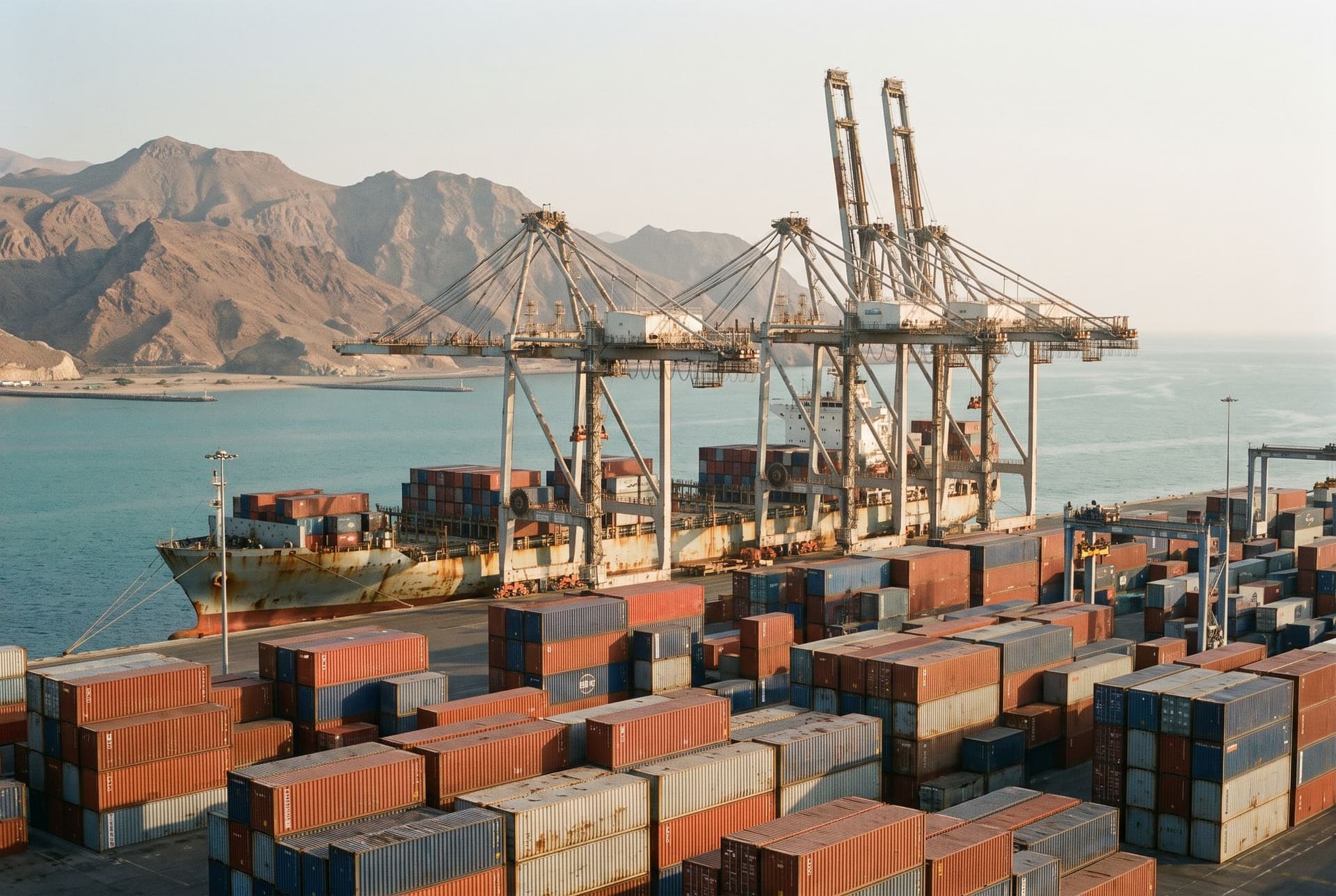
In normal conditions the fastest sea route is Chattogram to Salalah: Fluent Cargo’s schedule data shows 13 days 19 hours with one change of ship and sailings every one to two weeks. Muscat’s own port stopped handling commercial cargo on 1 September 2014, so containers for the capital go through Sohar, north of Muscat, or Salalah, about 1,000 km and 11 hours away by road.
The difference in 2026 is geography. Salalah faces the Arabian Sea and Sohar the Gulf of Oman, so neither needs a ship to pass the Strait of Hormuz, closed since 28 February 2026. Maersk’s update of 23 September 2026 accepts bookings to both, uses Salalah as its transhipment hub for Gulf cargo and trucks from Salalah to inland Oman. Its emergency rate, US$1,800 per 20-foot and US$3,000 per 40-foot dry container, applies to Oman except Salalah, so Sohar pays it. Expeditors reported both ports operational on 2 September with minimal clearance delays. Volumes rose in the first half: Salalah 2.33 million containers (TEU), up 15%, and Sohar 545,000, up 40%.
The risks are real. Drones hit Duqm in early March and Salalah on 11 and 28 March, suspending work for days; dwell times at Salalah and Sohar more than tripled in the spring; and ships in the region were still being attacked in September. Air avoids the sea: Dhaka to Muscat takes about 4 hours 50 minutes, and Oman Air has flown it daily since 1 May 2026 with up to 14 tonnes of cargo on wide-body aircraft. Check both the week you book.
Selling in Oman? Get a landed-cost quote
What sells, and what that means for production
Oman’s national dress shapes a large part of the market. Omani men wear the dishdasha, a long robe from neck to ankle, white for formal and government settings and coloured informally, and a February 2017 decision set a national specification for it, including five regional styles and fabric quality. For women, the counterpart is the abaya and the modest dress. Around those sit the categories Comtrade shows Oman buying most: knitted babies’ garments, t-shirts and women’s woven dresses and trousers.
For production that means woven robes and abayas where the fabric decides the minimum, and cotton knitwear at volume. Our orders start at 500 pieces per style and colour, t-shirts at 1,000 and woven shirts and workwear at 2,000. For a dishdasha, send the specification your Omani customer works to, and we match the fabric and neck embroidery to it at sampling.
Working with us from Oman
Oman is two hours behind Bangladesh, and we reply within one working day. We quote FOB Chattogram, CIF Salalah or Sohar, or DDP to your importer’s warehouse, in US dollars, and name the port, routing and any emergency surcharge on the quote; ask for the 5% duty and 5% VAT as their own lines, and approve the Arabic label before production starts.
- Factory named before production, with its address, audit report and Accord status
- Arabic, or Arabic and English, label with fibre content, origin, care symbols and size, approved on the pre-production sample
- Invoice, packing list and chamber certificate of origin, issued in the form your importer needs for attestation
- Your importer’s confirmation from the standards directorate that no conformity certificate applies to the product
- Quality checks on the line and the AQL final inspection report, then invoice, packing list, transport document and origin documents
Sources
Checked . Rules and figures change, so confirm anything that affects your pricing.
- WTO — Tariff profile, Oman (2025 applied rates: clothing average 5.0%, maximum 5%, no duty-free lines; bound average 15.0%) (opens in a new tab)
- PwC Worldwide Tax Summaries — Oman, other taxes (5% customs duty on CIF for non-GCC goods; VAT 5% from 16 April 2021; excise scope; reviewed 7 July 2026) (opens in a new tab)
- International Trade Administration — Oman import tariffs (US–Oman FTA duty-free access; ROP Customs; VAT 5%; GCC membership; 18 December 2025) (opens in a new tab)
- Press Information Bureau, Government of India — India–Oman CEPA in force 1 June 2026; duty-free access on all 945 textile and apparel lines (3 June 2026) (opens in a new tab)
- Oman Ministry of Foreign Affairs — Foreign minister meets Bangladeshi counterpart in Muscat (23 April 2026) (opens in a new tab)
- Oman Tax Authority — VAT Taxpayer Guide: Imports and Exports (collection through Bayan; deferment of import VAT; June 2023) (opens in a new tab)
- International Trade Administration — Oman standards for trade (DGSM; GSO standards; manufacturer’s declaration of conformity; 19 December 2025) (opens in a new tab)
- TÜV Rheinland — Oman product categories under the conformity scheme, Ministerial Decree 190/2021 (textiles listed; three stages from 1 March 2025; WTO G/TBT/N/OMN/550) (opens in a new tab)
- Product Compliance Institute — Oman regulated products under the conformity scheme (stage 1 and stage 2 lists; in force 5 June 2022; 19 December 2024) (opens in a new tab)
- Oman Observer — Understanding an Omani man’s national costume (dishdasha; February 2017 national specification; 23 October 2021) (opens in a new tab)
- International Trade Administration — Oman labeling and marking requirements (Arabic only or Arabic and English; 18 December 2025) (opens in a new tab)
- Public Authority for Consumer Protection — Executive Regulations of the Consumer Protection Law, Decision 77/2017 (Article 23: origin and composition on the commodity, with Arabic) (opens in a new tab)
- GSO — GSO 863:1997 Identification label for textile products (covers ready-made garments) (opens in a new tab)
- International Trade Administration — Oman import requirements and documentation (paperless supply chain, e-release orders; 18 December 2025) (opens in a new tab)
- export.gov — Oman import requirements and documentation (commercial registration, OCCI certificate, invoice, bill of lading, certificate of origin for preferential imports; 20 November 2018) (opens in a new tab)
- Oman Ministry of Foreign Affairs — Attestation of documents (trade invoices OMR 50 to 150; certificate of origin OMR 20; via Oman Post) (opens in a new tab)
- Oman Ministry of Foreign Affairs — Electronic attestation service extended to 28 countries including Bangladesh (12 May 2026) (opens in a new tab)
- UN Comtrade — Oman imports of HS 61 and 62 from all origins, 2025 (US$271.8m and US$149.5m) (opens in a new tab)
- UN Comtrade — Oman imports from Bangladesh, HS 61, 62 and all goods, 2024 and 2025 (opens in a new tab)
- The Arabian Stories (NCSI) — Oman’s population reaches 5.39 million by end-June 2026; 43.25% expatriates (11 August 2026) (opens in a new tab)
- Oman Observer (NCSI) — Oman sees a drop in some expatriate nationalities (Bangladeshis 637,152 and Indians 506,630 at end-2024, the two largest; 27 January 2025) (opens in a new tab)
- The Arabian Stories (NCSI) — Bangladeshis in Oman 637,152 in 2024 and 621,048 in June 2025; visa restrictions since October 2023 (21 July 2025) (opens in a new tab)
- Majid Al Futtaim — Mall of Oman officially inaugurated (260 retail outlets; OMR 705m invested in Oman; 7 February 2023) (opens in a new tab)
- Wikipedia — Oman Avenues Mall (Lulu Group; inaugurated May 2015) (opens in a new tab)
- Fluent Cargo — Chittagong to Salalah (sea 13 days 19 hours, one transfer, sailings every one to two weeks; timetable data; checked 28 September 2026) (opens in a new tab)
- Wikipedia — Port Sultan Qaboos (ceased commercial operations 1 September 2014; cargo moved to Sohar) (opens in a new tab)
- Rome2Rio — Muscat to Salalah by road (about 1,007 km, about 11 hours) (opens in a new tab)
- Maersk — Middle East Operational Update 49 (bookings accepted to Salalah and Sohar; Salalah transhipment; emergency freight rate for Oman except Salalah; 23 September 2026) (opens in a new tab)
- Expeditors — Middle East operational update (Sohar and Salalah operational; Oman clearance with minimal delays; Muscat airport open; 2 September 2026) (opens in a new tab)
- The Maritime Standard — Cargo volumes increase at Omani ports (Salalah 2.33m TEU in H1 2026, up 15%; Sohar 545,000 TEU, up 40%; 1 September 2026) (opens in a new tab)
- VIZION — Strait of Hormuz disruption shifts port congestion (dwell times at Sohar and Salalah; 24 March 2026) (opens in a new tab)
- Wikipedia — 2026 Iranian strikes on Oman (Duqm 1 and 3 March; Salalah 11 and 28 March; Sohar 13 March) (opens in a new tab)
- Wikipedia — 2026 Strait of Hormuz crisis (closure from 28 February; short-lived reopenings; closed again 8 July; attacks on ships through September) (opens in a new tab)
- Semafor — Gulf’s biggest port Jebel Ali waits for the war to end (Hormuz closed since 28 February 2026; Q2 volumes down 90%; 2 September 2026) (opens in a new tab)
- Bangladesh Monitor — Oman Air to operate daily Dhaka flights from 1 May 2026 (Dhaka 16:00, Muscat 18:50, about 4 hours 50 minutes; cargo up to 14 tonnes on wide-body; 21 April 2026) (opens in a new tab)
Popular products for brands selling in Oman.
Each category is made in factories that specialise in it. See every product category. What drives the price is broken down in our clothing cost guide.
Questions for brands selling in Oman.
How much duty and VAT do I pay on clothing from Bangladesh into Oman?
Five per cent customs duty on the CIF value, then 5% VAT. Oman applies the GCC common external tariff, and the WTO’s 2025 profile shows an applied average of 5.0% on clothing with no duty-free lines. Bangladeshi goods get no preference, so Bangladesh’s graduation from LDC status in November 2026 changes nothing. Both amounts are collected by the Royal Oman Police customs directorate through the Bayan system when the goods are cleared, but a VAT-registered importer can apply to the Tax Authority to defer the VAT to its return. There is no excise tax on clothing. The comparison to know is India: since 1 June 2026 its trade agreement with Oman has removed the 5% duty on all 945 textile and apparel lines, and US goods are duty-free under a separate agreement. Because duty is charged on CIF, a freight surcharge also raises the duty bill, so ask us for the duty and VAT as separate lines on the quote.
Is shipping to Oman affected by the Strait of Hormuz closure?
Less than anywhere else in the Gulf, but it is not normal. Oman’s container ports lie outside the strait: Salalah faces the Arabian Sea and Sohar the Gulf of Oman, so a ship from Chattogram reaches them without passing Hormuz. Maersk’s update of 23 September 2026 accepts bookings to both ports, uses Salalah as its hub for Gulf cargo and offers trucking from Salalah to inland Oman. Its emergency rate of US$1,800 per 20-foot and US$3,000 per 40-foot container applies to Oman except Salalah, so cargo to Sohar pays it and cargo to Salalah does not. The risks are congestion, because much of the Gulf’s cargo now passes through these ports, and security: drones struck Salalah and Duqm in March 2026, and ships in the region were still being attacked in September. We name the port, routing and surcharge on every quote and confirm them in the week of booking.
How long does shipping take from Bangladesh to Oman?
By sea, about two weeks to Salalah on a good connection: Fluent Cargo’s schedule data shows 13 days 19 hours from Chattogram with one change of ship, and sailings every one to two weeks. Muscat has no commercial container port since 2014, so cargo for the capital lands at Sohar or at Salalah, which is about 1,000 km and 11 hours from Muscat by road. In 2026 add time for congestion: dwell times at Salalah and Sohar more than tripled in the spring as cargo diverted from the upper Gulf, and delays change week to week, so plan from the transit the carrier confirms, not the schedule. By air, Dhaka to Muscat takes about 4 hours 50 minutes, and Oman Air flies the route daily with belly cargo. Production time comes first in either case: the ship date follows the approved pre-production sample and the fabric.
Do garments need a conformity certificate or an Arabic label for Oman?
No certificate today; an Arabic label, yes. Oman’s conformity scheme under Ministerial Decision 190/2021 lists textiles among the categories it will regulate, but the first stage, from 1 March 2025, covered appliances, building materials, cosmetics, PPE and similar goods, and the dates for later stages had not been announced when we checked in September 2026. Until then non-food goods enter on the manufacturer’s declaration, with test reports available if the standards directorate asks. Protective workwear sold as PPE is the exception, as it already falls in the first stage. Labels must be in Arabic, or Arabic and English, and the consumer protection regulations require origin and composition on the item, hard to erase, with Arabic as one of the languages. The GCC standard GSO 863 sets the textile label fields. We build the Arabic content in at sampling, and your importer confirms the certificate position before the first shipment.
Indian clothing enters Oman duty-free now. Does Bangladesh still make sense?
Often, yes, but the gap is real and we would rather you heard it from us. Since 1 June 2026 the India–Oman agreement has removed Oman’s 5% duty on all 945 textile and apparel tariff lines for Indian goods, so an Indian garment at the same factory price lands about five points cheaper on duty. Bangladesh has no agreement with Oman. Whether that decides the order depends on the product. Bangladesh is strongest in cotton knitwear and basics at volume, where factory price and capacity can outweigh five points of duty; on other products the Indian quote may win, and you should know that before you order. The honest way to compare is landed cost: FOB price, freight including any 2026 surcharge, 5% duty on the CIF value, 5% VAT and clearance. Send us your tech pack and target price, and we will give you an FOB and DDP figure you can set against an Indian quote.
Can you make abayas and modest wear for Omani brands, and what is the minimum?
Yes. Our partner factories make open and closed abayas, kaftans, long tunics and maxi dresses, and our own orders start at 500 pieces per style and colour. The fabric often sets the real minimum: nida, crepe and chiffon are not woven in Bangladesh, so they come from overseas mills with their own minimum per quality and colour, and black in a stock quality clears it most easily. Cotton, viscose and jersey made locally carry lower fabric minimums. There is no single starting price, because fabric, lining, embroidery and the number of lengths per size move the cost more than anything else, so we quote each style with its fabric named. For Oman the label is in Arabic, or Arabic and English, with fibre content, origin, care symbols and size, and no conformity certificate applies to garments at present. If you also sell dishdashas, send the specification your customer works to and we will quote them as a separate style.
Other markets in the Middle East
Guides on this topic
Selling in Oman? Get a landed price.
Send a tech pack, a sketch or a photo of a garment you like. We reply within one working day with questions or a first costing.
- A reply within one working day, from a founder
- Certificates and audit reports shared before production
- AQL final inspection report before you approve shipment
- NDA signed on request before you share designs