Jacket and outerwear manufacturer in Bangladesh
Quilting, down filling and seam taping need specialist lines, and we place jackets and outerwear only with audited partner woven factories in Bangladesh equipped for them. Shells come in nylon and polyester taffeta, ripstop, recycled polyester and cotton twill. The confirmed minimum is 2,000 pieces per style and colour; have waterproofing and fill weight tested before bulk.
- Typical fabric
- Taffeta, ripstop, softshell
- Price
- Quoted per style
- Minimum order
- 2,000 pieces per style and colour
In short
Outerwear is the most construction-heavy category we place: shells, linings, fill, zips and seam finishing all come from different suppliers. Our partner factories make puffers, parkas, bombers, softshells and windbreakers in nylon and polyester taffeta, ripstop, recycled polyester, cotton twill and coated fabrics. Each style is quoted from your tech pack, with the fill and trims costed line by line. CMB Sourcing Ltd. is a manufacturer and buying house: knitwear (such as T-shirts, polos and hoodies) and caps are made in our own factory, everything else in an audited partner factory, and we manage every order. The minimum order for jackets is 2,000 pieces per style and colour.
Minimum order and your quote
- Minimum order
- 2,000 pieces per style and colour
- Price
- Quoted per style, from your tech pack
- Shipping term
- FOB, CIF or DDP, stated on your quote
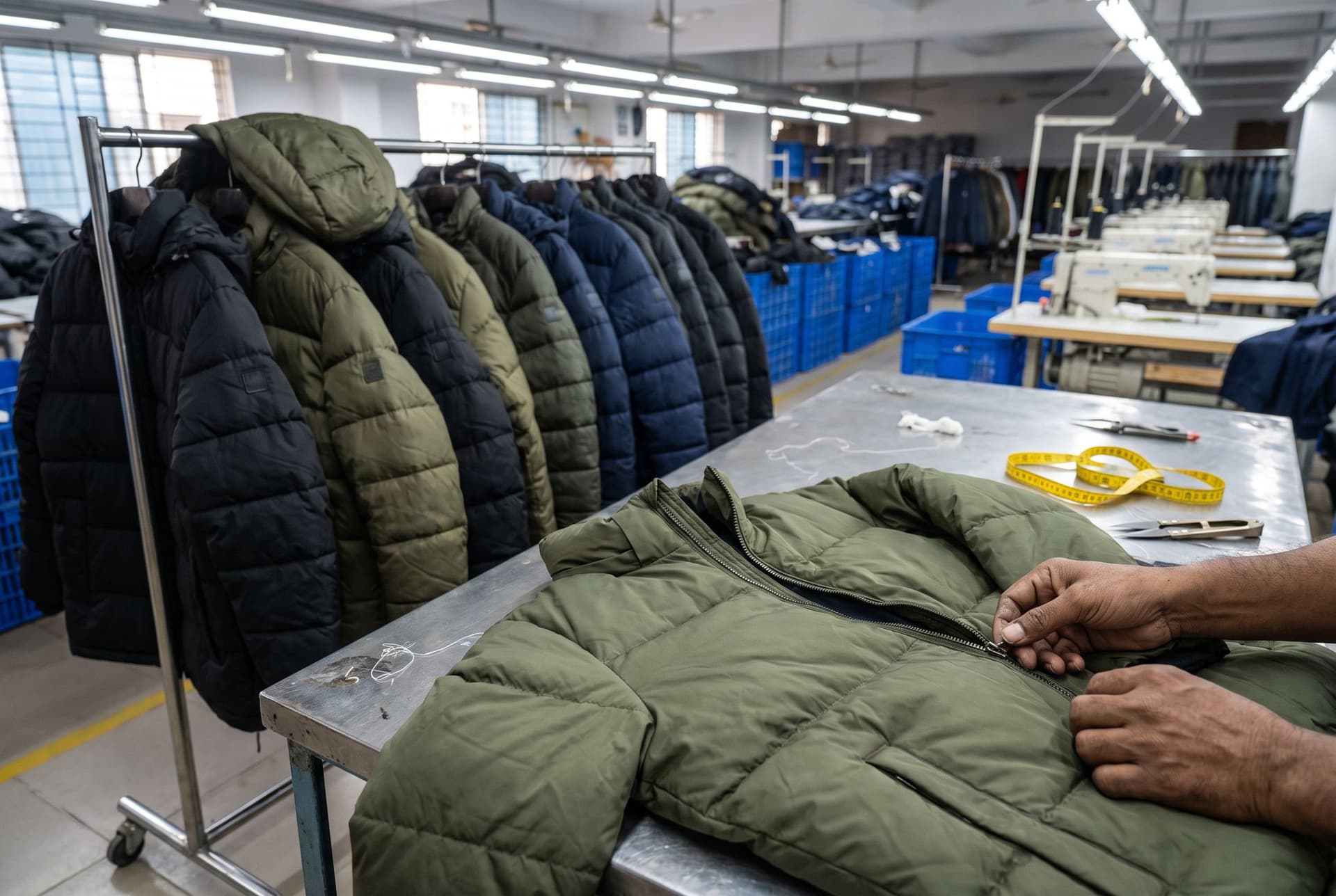
We quote jackets per style, from your tech pack or a reference garment, because fabric, weight, decoration, quantity and shipping terms set the price. Decoration, sampling and testing are costed as their own lines, and your quote states the shipping term (FOB, CIF or DDP).
The order cost estimator turns a price per piece into an order total and shows how it splits into fabric, trims and making. Once your quote states the shipping term, the landed cost calculator turns it into a delivered price for your market. Nothing you enter in either tool is sent anywhere.
The delivery date depends on the fabric, the decoration and the season, so it is confirmed in writing with your order, and payment terms are agreed with your quote. See how an order runs and our guide to payment terms in garment manufacturing.
Our sister factory does not take small runs of jackets, so there is no small-run route below our minimum of 2,000 pieces per style and colour. The minimum counts per style and colour: three colours of one style means 2,000 pieces of each.
Styles available
- Puffer and quilted jackets
- Parkas and long coats
- Bomber and varsity jackets
- Softshell and fleece-lined jackets
- Windbreakers and anoraks
- Raincoats and seam-sealed shells
- Gilets and vests
- Kids outerwear
Fabrics and weights
- Nylon and polyester taffeta and ripstop
- Recycled polyester shells (GRS)
- Cotton twill and canvas
- PU and TPU coated fabrics
- Softshell bonded fabrics
- Recycled polyester wadding and certified down (RDS)
Decoration and finishing
- Seam taping and welded seams
- DWR water-repellent finishes (PFC-free options)
- Quilting and box-wall construction
- Custom zips, snaps and toggles
- Reflective trims and printed linings
Specifying jackets and outerwear.
The detail below is what turns a sketch into a garment that arrives as you expected. Send what you have and we fill the gaps with you before sampling.
Put this in your tech pack
- Shell fabric and any coating or membrane, with the water column and breathability rating you need
- Insulation type and weight: down with fill power and origin, or synthetic wadding in grams per square metre
- Seam construction: whether seams are taped, welded or sewn, and which seams need sealing
- Full measurements per size, including chest, body length, sleeve length with arm raised, hood depth and opening
- Zips: brand, gauge, water-resistant or standard, plus storm flap, chin guard and puller details
- Pocket plan with opening sizes, mesh or taffeta bags, and internal pocket positions
- Care and content labelling, and any down certification such as RDS that your buyer requires
Free tech pack template: Excel, CSV or print, no email asked
What moves the price
- Shell fabric: coated polyester and nylon, membranes and recycled fabrics all sit at different price levels
- Insulation: certified down is far more expensive than synthetic wadding, and fill power changes the price again
- Seam sealing, because taping is a separate machine process charged per metre
- Zip brand and quantity, with branded water-resistant zips a significant per-piece cost
- Construction time: an outerwear jacket can take several times the sewing operations of a t-shirt
What goes wrong with jackets and outerwear, and how to prevent it.
Every category fails in its own way. These are the problems to plan against on this product, and the checks that catch them before your goods ship.
| Risk | How to prevent it |
|---|---|
| Water leaking through seams | Seam tape adhesion is tested on sample garments, and taped seams are spray-tested during production. |
| Down or fill migrating through the shell | Downproof fabric is specified and tested, and quilting line spacing is fixed on the approved sample. |
| Uneven fill weight between panels | Fill weight per panel is set in the specification, and garments are weighed during production against that standard. |
| Zips failing after repeated use | Zips are cycle-tested for durability, and slider and puller strength are checked at final inspection. |
Waterproof ratings: the test behind the number
A waterproof rating is a hydrostatic head: water is pressed against the fabric at rising pressure until it comes through. Under ISO 811:2018, which ISO last confirmed in 2025, the pressure rises at either 10 or 60 cm of water per minute, the water is at 20 °C or 27 °C, and the result is the pressure at which water appears in the third place. The standard warns that the two rates can give different results and that warmer water gives lower values, so the report must state both. AATCC TM127 is the US method for the same property, and AATCC notes that its results may not match rain or spray tests.
EN 343:2019, the European standard for protective clothing against rain, turns hydrostatic head into four classes. Class 1 needs at least 8,000 Pa on new fabric and seams. Class 4 needs 20,000 Pa on the fabric after each pre-treatment (abrasion, flexing, fuel and oil, and laundering) and on the seams after cleaning. At about 102 mm of water per 1,000 Pa, class 4 is roughly a 2,040 mm column. EN 343 is written for protective clothing, but its classes are a clear way to put a waterproof target into any jacket tech pack.
| Test | What it measures | Ask the report to state |
|---|---|---|
| ISO 811:2018 or AATCC TM127 (hydrostatic head) | How much water pressure the fabric, or a seam, holds before water comes through | The rate of pressure rise, the water temperature, and whether the specimen was washed first |
| EN 343:2019 classes | Water penetration of fabric and seams before and after pre-treatments, plus a breathability class | The class for water penetration and the class for water-vapour resistance, each with the results behind it |
| ISO 4920:2012 or AATCC TM22 (spray test) | Surface wetting: whether the water-repellent finish makes water bead | The spray rating before and after the number of washes you set; ISO says this test does not predict rain penetration |
| AATCC TM35 (rain test) | Water driven through the fabric by impact over 5 minutes, caught on a blotter behind it | The spray intensity used |
| EN 14360:2004 (rain tower) | Leaks in a finished garment, such as water wicking up the sleeves or pockets filling | Which parts of the garment leaked; the test is optional under EN 343 |
Breathability: Ret and MVTR are different numbers
Breathability is reported in different units from different tests, and a result from one test does not translate into another. Ret, the water-vapour resistance in square metre pascals per watt, comes from the sweating guarded-hotplate test in ISO 11092; a lower Ret means a more breathable fabric. ISO published a new edition, ISO 11092:2026, in May 2026, replacing the 2014 edition, and notes that its test conditions are not meant to represent particular comfort situations. The same apparatus measures thermal resistance (Rct) of fabrics and multilayer assemblies, so it can compare the warmth of two insulation builds. EN 343 uses Ret to give a breathability class from 1 to 4, with 4 the most breathable.
MVTR, the moisture vapour transmission rate, is measured with cups instead. JIS L 1099, last revised in 2021, includes a calcium chloride method (A-1) and a potassium acetate method (B-1), and ASTM E96/E96M-24a has a desiccant method and a water method. ASTM states that a result from one method, or from one set of test conditions, cannot be used to predict the result of another. A breathability figure from a mill can only be compared with another figure measured by the same method under the same conditions, so ask for the method and its letter with every number.
Down fill: fill power, composition and certification
Fill power is the volume a 30 g sample of down occupies in a cylinder under a light weighted plate, after conditioning. The International Down and Feather Bureau’s testing regulations (June 2023 version) make steam conditioning, Part 10-B, the official method, and the older tumble-dry method has been cancelled. Results are reported as a height in millimetres per 30 g and can be converted to cubic inches per 30 g (height divided by 0.252) or cubic centimetres per gram (height multiplied by 2.20). The report must also state the conditioning method and how long the sample was conditioned, which the regulations set at 48 to 72 hours. Two fill power figures are only comparable when the method and conditioning match.
In Europe, the standard for labelling the composition of down and feather fillings is EN 12934, a European Standard rather than a law. Its 2025 edition replaced the 1999 version, was due to be adopted nationally by August 2025, added a clause on fill power labelling, and raised the allowance for foreign matter from 0.5% to 2% because more recycled fillings are expected. The IDFB also publishes methods for net fill weight (Part 17) and for down given a durable water-repellent treatment (Part 18), and it recognises several down-proofness tests, which involve both the filling and the fabric, including EN 12132-1 (rubbing), EN 12132-2 (impact) and a rotating box method. Ask for fill power, composition and net fill weight on one report, from the lot that goes into your jackets.
Textile Exchange launched a broader Materials Matter Standard in December 2025, but down is not in its first version, so down claims continue under the Responsible Down Standard (RDS) and Textile Exchange’s claims policy.
Water-repellent finishes and PFAS: dates for 2026 and 2027 orders
In the EU, Commission Regulation (EU) 2024/2462 restricts PFHxA, its salts and PFHxA-related substances. From 10 October 2026, textiles in clothing and related accessories for the general public may not be placed on the market at or above 25 ppb for PFHxA and its salts, or 1,000 ppb for related substances, measured in homogeneous material; the regulation names rain jackets as an example of outdoor clothing in scope. Other consumer textiles follow from 10 October 2027, and certain category III personal protective equipment is exempt. Confirm how the date applies to your stock with your compliance adviser.
In California, Health and Safety Code section 108971 has banned the sale of new textile articles containing regulated PFAS since 1 January 2025. Regulated PFAS means PFAS intentionally added for a function, or total organic fluorine at or above 100 ppm, falling to 50 ppm from 1 January 2027. Outdoor apparel for severe wet conditions, defined as extreme-use gear such as offshore sailing and mountaineering outerwear that is not marketed for general consumer use, is exempt until 1 January 2028 but must carry the statement “Made with PFAS chemicals”, including online. Manufacturers must give sellers a signed certificate of compliance.
New York’s Environmental Conservation Law section 37-0121 has banned the sale of new apparel containing intentionally added PFAS since 1 January 2025; for outdoor apparel for severe wet conditions, the ban starts on 1 January 2028. Other states may have their own rules, so check each state you sell in with your compliance adviser.
For a jacket tech pack, that means naming a PFAS-free water-repellent finish, asking the fabric mill for a test report on the finished shell fabric against the limits of each market you sell in, and keeping any California certificate of compliance on file. Spray ratings after washing, from the table above, show whether a PFAS-free finish still performs.
Seams and zips: tests to ask for before bulk
EN 343 tests seams as well as fabric. Seams must hold 8,000 Pa for classes 1 and 2 and 13,000 Pa for class 3 before pre-treatment, and for class 4 they are tested after cleaning, at 20,000 Pa. Ask the laboratory to cut seam specimens from the pre-production sample, sealed on the same machine settings as bulk, and to wash them first if your care label allows washing.
For zips, ASTM D2061, reapproved in 2021, covers strength tests for zip chains and elements, stops, the separable unit of an open-ended zip, the slider lock and the pull; ASTM notes that no single test decides whether a zip suits an end use. In Europe, EN 16732, published in 2015 and based on the British standard BS 3084, sets performance levels for zips by end use and the test methods for them. Ask for the zip supplier’s report to one of these standards for the exact zip, size and slider in your bill of materials.
Jackets and outerwear: duty and tax by market
Duty depends on where the garment is sold, not on where it is made. Jackets, anoraks and outerwear from Bangladesh enter the UK, the EU, Canada, Australia and New Zealand at 0% under each market’s scheme for least developed countries, with a tax at import that a registered business recovers. The United States gives Bangladesh no preference, so a US buyer pays the normal rate for the tariff line plus the 10% Section 301 tariff on Bangladeshi goods that applies from 24 July 2026. The table gives the position on 25 September 2026; each market page sets out the rules of origin, the paperwork and the labelling in full, with sources.
The EU keeps its 0% rate for three years after Bangladesh leaves the least developed country category, now scheduled for 24 November 2029, so to about November 2032. The tax at import (VAT or GST) is charged on the goods’ import value plus any duty, and each market sets whether freight and insurance count in that value, so cost the landed price with it. Our own orders for jackets start at 2,000 pieces per style and colour. Your quote states the shipping term (FOB, CIF or DDP), and our landed cost calculator turns it into a delivered price for your market.
| Market | Import duty | Tax at import |
|---|---|---|
| United Kingdom | 0% under the Developing Countries Trading Scheme with proof of origin | Import VAT 20%, zero-rated on most children’s clothing |
| European Union | 0% under Everything But Arms with a REX statement, until about November 2032 (three years after graduation); the ordinary rate depends on the line and its additional code in TARIC; the garment lines we could check pay 12%, so confirm your jacket line with your broker | VAT at the member state’s rate |
| United States | Men’s cotton anoraks and windbreakers 9.4% (HTSUS 6201.30.50 or 6201.30.80) and women’s 8.9% (6202.30.50 or 6202.30.80), or 6.2% if water resistant (6201.30.40 or 6201.30.70; 6202.30.40 or 6202.30.70); man-made fibre anoraks and windbreakers 27.7% (6201.40.50 or 6201.40.75; 6202.40.50 or 6202.40.75), or 7.1% if water resistant (6201.40.45 or 6201.40.70; 6202.40.45 or 6202.40.70); man-made fibre padded sleeveless jackets 14.9% (6201.40.35 or 6201.40.60; 6202.40.35 or 6202.40.60); 4.4% where down is 10% or more of the weight; plus 10% Section 301 from 24 July 2026; no preference | No federal sales tax at import; merchandise processing fee applies |
| Canada | 0% under the Least Developed Country Tariff | 5% GST |
| Australia | 0% under the Australian System of Tariff Preferences (50% local-content rule) | GST 10% of the value of the taxable importation |
| New Zealand | 0% under New Zealand’s preference scheme for least developed countries | GST at import |
Sources
Checked . Rules and figures change, so confirm anything that affects your pricing.
Show all 29 sourcesHide the sources
- ISO 811:2018 Textiles: resistance to water penetration, hydrostatic pressure test (ISO page, confirmed 2025) (opens in a new tab)
- ISO 811:2018 preview: principle, pressure rates and water temperature (PDF) (opens in a new tab)
- AATCC TM127, water resistance: hydrostatic pressure test (opens in a new tab)
- SATRA: the EN 343:2019 protective clothing standard, water penetration classes and pre-treatments (opens in a new tab)
- ISO 4920:2012 Textile fabrics: resistance to surface wetting, spray test (ISO page, confirmed 2023) (opens in a new tab)
- AATCC TM22-2024, water repellency: spray test (opens in a new tab)
- AATCC TM35, water resistance: rain test (opens in a new tab)
- ISO 11092:2026 Textiles: thermal and water-vapour resistance, sweating guarded-hotplate test (published May 2026) (opens in a new tab)
- ASTM E96/E96M-24a, gravimetric determination of water vapour transmission rate (opens in a new tab)
- JIS L 1099:2021, test methods for water vapour permeability of textiles (ANSI webstore listing) (opens in a new tab)
- Testex: common test methods for water vapour permeability, JIS L 1099 A-1 and B-1 (23 July 2024) (opens in a new tab)
- International Down and Feather Bureau: Testing Regulations, June 2023 version (Part 10-B fill power, Part 17, Part 18, Annex B) (PDF) (opens in a new tab)
- EN 12934:2025 Feather and down: composition labelling, a European Standard (preview, foreword and changes from 1999) (opens in a new tab)
- Textile Exchange: Responsible Down Standard (and the Materials Matter Standard update) (opens in a new tab)
- Commission Regulation (EU) 2024/2462 restricting PFHxA, its salts and related substances (opens in a new tab)
- California Health and Safety Code section 108970: definitions for PFAS in textile articles (opens in a new tab)
- California Health and Safety Code section 108971: PFAS ban, outdoor apparel exemption and certificate of compliance (opens in a new tab)
- New York State Department of Environmental Conservation: PFAS in Apparel Law, ECL section 37-0121 (intentionally added PFAS in apparel banned from 1 January 2025; outdoor apparel for severe wet conditions from 1 January 2028) (opens in a new tab)
- ASTM D2061-07(2021), strength tests for zips (opens in a new tab)
- Intertek: CEN publishes EN 16732:2015 specification for slide fasteners (10 February 2016) (opens in a new tab)
- GOV.UK: Developing Countries Trading Scheme, product-specific rules of origin for least developed countries (opens in a new tab)
- GOV.UK: VAT on imports, acquisitions and purchases from abroad (opens in a new tab)
- USITC: Harmonized Tariff Schedule of the United States, 2026 Revision 20 (headings 6201 and 6202 checked 1 October 2026) (opens in a new tab)
- Federal Register 2026-15181: USTR notice of actions in the Section 301 investigations (10% on goods of Bangladesh from 24 July 2026) (opens in a new tab)
- Canada Border Services Agency: Guide to the Least Developed Country Tariff (opens in a new tab)
- Canada Border Services Agency: determining duties and taxes (5% GST at import) (opens in a new tab)
- Bangladesh Customs: DFQF Australia (Australian System of Tariff Preferences, rules of origin) (opens in a new tab)
- Australian Taxation Office: GST and imported goods (value of the taxable importation) (opens in a new tab)
- New Zealand Customs Service: Generalised System of Preferences, LDC and LLDC countries (opens in a new tab)
Standards for jackets and outerwear.
The standards buyers most often ask about in this category. A certificate belongs to the factory or fabric mill that holds it, so we send you the certificates and test reports for the factory and fabric used for your order. The last column says how to check each one yourself.
| Standard | What it proves | Type | How to verify |
|---|---|---|---|
| RWS, RDS and RAF animal fibre standards | Responsible Wool, Responsible Down and Responsible Animal Fiber (mohair, alpaca) standards cover animal welfare and land management, with chain of custody to the finished product. | Voluntary standard | Search the Textile Exchange certified sites database. |
| GRS — Global Recycled Standard | Verifies recycled content (at least 20% to be certified, 50% for an on-product label) and adds social, environmental and chemical requirements for every processing site. | Voluntary standard | Search the Textile Exchange certified sites database. |
| bluesign® | Controls chemical inputs before they reach production and assesses resource use, worker safety, and water and air emissions. | Voluntary standard | Check the system partner list on bluesign.com. |
| OEKO-TEX® STANDARD 100 | Every component of a product — fabric, thread, labels, buttons, prints — is tested for harmful substances. | Voluntary standard | Enter the certificate number from the label in Label Check on oeko-tex.com. |
| amfori BSCI | Audits working conditions against the amfori Code of Conduct: fair pay, working hours, freedom of association, no child or bonded labour, health and safety, and the management systems behind them. | Voluntary standard | Ask for the amfori audit ID. amfori members can open the full report on the amfori Sustainability Platform. |
Quality checks on every order.
Bulk fabric is tested against the approved swatch before cutting, quality is checked on the line, and a final AQL inspection is run on the finished goods. You get the report before you approve shipment. The order is placed and followed by our buying house in Narayanganj, Dhaka, from the first sample to shipment.
Before bulk, and if an inspection fails
- Before bulk: you approve a pre-production sample made in bulk fabric with bulk trims on the production line. It is sealed, and every inspection afterwards is judged against it.
- In writing before cutting: nothing is cut on a verbal go-ahead. The order confirmation you sign off fixes the price, the delivery date the factory has confirmed, the factory’s name and address, the measurement tolerances, and what happens if a date moves on either side.
- If the final inspection fails: nothing ships until you have seen the report and decided. The factory reworks the defective pieces and the lot is re-inspected; or the lot is sorted, so acceptable pieces ship and the rest are reworked or replaced; or, where the fault is fundamental, the goods are remade. Who pays depends on your terms with us and is agreed before production.
- A second check: your own inspector, or an independent firm such as QIMA, SGS, Intertek or Bureau Veritas, is welcome at any stage, and you can come yourself.
Jackets and outerwear: common questions.
Which countries let me import jackets from Bangladesh duty-free?
Jackets and outerwear made in Bangladesh enter the UK, the EU, Canada, Australia and New Zealand at 0% duty under their schemes for least developed countries, with the usual proof of origin. The United States gives no preference, and its rate swings with the shell and filling: a men’s cotton anorak or windbreaker pays 9.4% under HTSUS 6201.30.50 or 6201.30.80, a man-made fibre one 27.7% under 6201.40.50 or 6201.40.75, a man-made fibre padded sleeveless jacket 14.9%, and a jacket with 10% or more down by weight 4.4%, all plus the 10% Section 301 tariff from 24 July 2026. Bangladesh is scheduled to graduate from least developed country status on 24 November 2029, after the UN General Assembly extended its preparatory period by three years on 29 October 2026, and the EU keeps Everything But Arms for three years after that, to about November 2032. Send the shell, lining and filling with your enquiry so the line is right.
Can you make waterproof jackets?
Yes, with the right construction, because a jacket is only waterproof when the fabric, seams and closures all keep water out. That starts with a coated or laminated fabric, such as polyurethane or TPU, rated for water resistance. Every stitched seam creates needle holes, so seams are sealed with tape applied by heat, or welded without stitching on technical styles. Zips need water-resistant versions or storm flaps, and hoods, cuffs and hems are designed to stop water getting in. Water-repellent finishes help rain bead off the outer fabric, and PFC-free options are recommended for the EU market, where restrictions on these chemicals are tightening. Before bulk production, have samples tested for hydrostatic head and spray resistance at an accredited laboratory, so any waterproof claim on your label is backed by a report rather than an assumption.
Which insulation options are available for puffer jackets?
Puffer jackets can use down, synthetic wadding or loose synthetic fill. Down gives the best warmth for its weight and packs small, and for responsible sourcing it should be certified to the Responsible Down Standard, which covers animal welfare through the supply chain. Synthetic wadding, often made from recycled polyester, comes in sheets of set weights, stays warm when damp, and is easier to wash and cheaper to produce. Loose synthetic fills mimic the lofty feel of down and can be blown into baffles in a similar way. Construction affects warmth as well: sewn-through quilting is lighter and simpler, while box-wall baffles hold more insulation in place for colder conditions. We check fill weight and distribution during production, and ask for the certificates for any certified down or recycled material used in your order.
What is the minimum order for custom jackets, and what sets the price?
Our minimum for jackets is 2,000 pieces per style and colour. We publish no prices, because a jacket is several garments in one: a shell fabric, usually a lining, often a fill or wadding, and far more components than a knit top, such as zips, snaps, toggles, drawcords and hood adjusters. The lines that move the price most are the shell fabric and any coating or membrane; the insulation, where certified down costs far more than synthetic wadding and fill power changes the price again; seam sealing, a separate machine process charged per metre; and the brand and number of zips. Construction time matters too, because an outerwear jacket can take several times the sewing operations of a t-shirt. Send a reference jacket or a tech pack and we will price it line by line, so you can see which choices to keep.
What should be in a tech pack for a jacket?
More than for any other garment, because a jacket has more places to go wrong. Specify the shell fabric with its composition, weight and any coating, membrane or water-repellent finish, and the performance you need, such as a water column rating or breathability, if you will claim it. Specify the lining, and the fill by type and weight per square metre, with the certification for down. List every component: zip type, brand and length, snaps, toggles, drawcords, hood adjusters, and where each sits. Give a full measurement chart per size including sleeve length and hood, and state the seam construction: taped, welded or plain, and the quilting or baffle pattern. Add the print or embroidery placement and the label and packing instructions. Our free tech pack template covers all of it in the order a factory reads it, and we fill the gaps with you at the sampling stage, before the first proto.
What types of jackets can a jacket factory in Bangladesh make?
Puffers, parkas, bombers, softshells, windbreakers, rainwear and gilets are all made in Bangladesh, by woven factories equipped for outerwear. Our partner factories make puffer and quilted jackets, parkas and long coats, bomber and varsity jackets, softshell and fleece-lined jackets, windbreakers and anoraks, raincoats and seam-sealed shells, gilets and vests, and kids’ outerwear. Shells come in nylon and polyester taffeta and ripstop, recycled polyester, cotton twill and canvas, PU and TPU coated fabrics and bonded softshell, filled with recycled polyester wadding or down certified to the Responsible Down Standard. Each type needs its own set-up: quilting and box-wall construction for puffers, down filling rooms, and seam taping or welding for rainwear, so we place each style only with a factory that has that equipment, and you can ask for photos of those lines. Finishes include water-repellent treatments with PFAS-free options, custom zips, snaps and toggles, reflective trims and printed linings.
What counts as ‘water resistant’ for US import duty on jackets?
For US customs, a jacket is ‘water resistant’ only if it passes a set test: under a head pressure of 600 millimetres, not more than 1.0 gram of water may penetrate after two minutes when tested to AATCC Test Method 35, and the resistance must come from a rubber or plastics application to the outer shell, lining or inner lining. That definition is Additional US Note 2 to Chapter 62 of the Harmonized Tariff Schedule, and the duty gap makes it worth knowing. A man-made fibre anorak or windbreaker that meets it pays 7.1% (HTSUS 6201.40.45 or 6201.40.70 for men, 6202.40.45 or 6202.40.70 for women) against 27.7% for one that does not; in cotton the rates are 6.2% against 9.4% for men and 8.9% for women, all on 1 October 2026. The 10% Section 301 tariff on Bangladeshi goods is added either way. Have the bulk shell tested and ask your broker whether your construction qualifies.
What is the difference between fully taped and critically taped seams?
Fully taped means every seam on a jacket is sealed, while critically taped means only the seams most exposed to rain are sealed. The US tariff schedule gives a usable definition: sealed seams are covered by taping, gluing, bonding, cementing, fusing, welding or a similar process so that air and water cannot pass when tested to AATCC Test Method 35, and critically sealed seams on a jacket are those sealed at the front and back yokes, or at the shoulders, armholes, or both. The choice is a decision about cost and claim. Seam taping is a separate machine process charged per metre, so a fully taped shell costs more, and a jacket sold as waterproof needs every seam sealed, because each stitched seam is a line of needle holes. Write the seam list into the tech pack, and have seam specimens from the pre-production sample tested for hydrostatic head.
How do I specify how warm an insulated jacket should be?
The warmth of an insulated jacket is specified by the quality and the amount of its fill, not by its thickness or a temperature rating on the hangtag. For down, state two numbers: fill power, the volume a set weight of down occupies, and fill weight, the grams of down in the jacket; a high fill power with too little fill is still a cold jacket. For synthetic insulation, state the wadding weight in grams per square metre, separately for body, sleeves and hood where they differ. To compare two builds objectively, ask a laboratory for thermal resistance (Rct) on the sweating guarded-hotplate of ISO 11092, which can test multilayer assemblies. The US tariff schedule uses another unit: it defines insulation for cold weather protection as a minimum clo value of 1.5 under ASTM F2732. In production, garments are weighed against the fill weight per panel set in the specification.
Related products
Costs and market rules
Ways to work with us
This product is made by one of the clothing manufacturers in Bangladesh we work with as a buying house, and the factory is named to you in writing before production starts.
Guides on this topic
Planning an order of jackets and outerwear?
Send a tech pack, a sketch or a photo of a garment you like. We reply within one working day with questions or a first costing.
- A reply within one working day
- An enquiry, not an order: you are committed to an order only when you sign the written order confirmation
- Certificates and audit reports shared before production
- AQL final inspection report before you approve shipment
- Your patterns and artwork never shown to or reused for other buyers