Also inDeutschEspañolFrançaisNederlands
Denim and jeans manufacturer in Bangladesh
Bangladesh is a leading supplier of denim to Europe and the US, with vertical mills and wash plants investing heavily in laser, ozone and low-water finishing. Your wash standard is approved at sampling, and bulk is checked against it.
- Typical fabric
- Denim 9–14.5 oz
- Price
- Quoted per style
- Minimum order
- 2,000 pieces per style and colour
In short
Denim needs a factory with its own wash plant, because the wash decides the look, the shade and the shrinkage. We place five-pocket jeans, jackets, overshirts and skirts in rigid denim up to 14.5 oz, comfort stretch and lightweight chambray, including organic and recycled cotton. Each style is quoted from your tech pack, and the wash recipe is approved on a sample first. CMB Sourcing Ltd. is a manufacturer and buying house: knitwear (such as T-shirts, polos and hoodies) and caps are made in our own factory, everything else in an audited partner factory, and we manage every order. The minimum order for denim jeans is 2,000 pieces per style and colour.
Minimum order and your quote
- Minimum order
- 2,000 pieces per style and colour
- Price
- Quoted per style, from your tech pack
- Shipping term
- FOB, CIF or DDP, stated on your quote
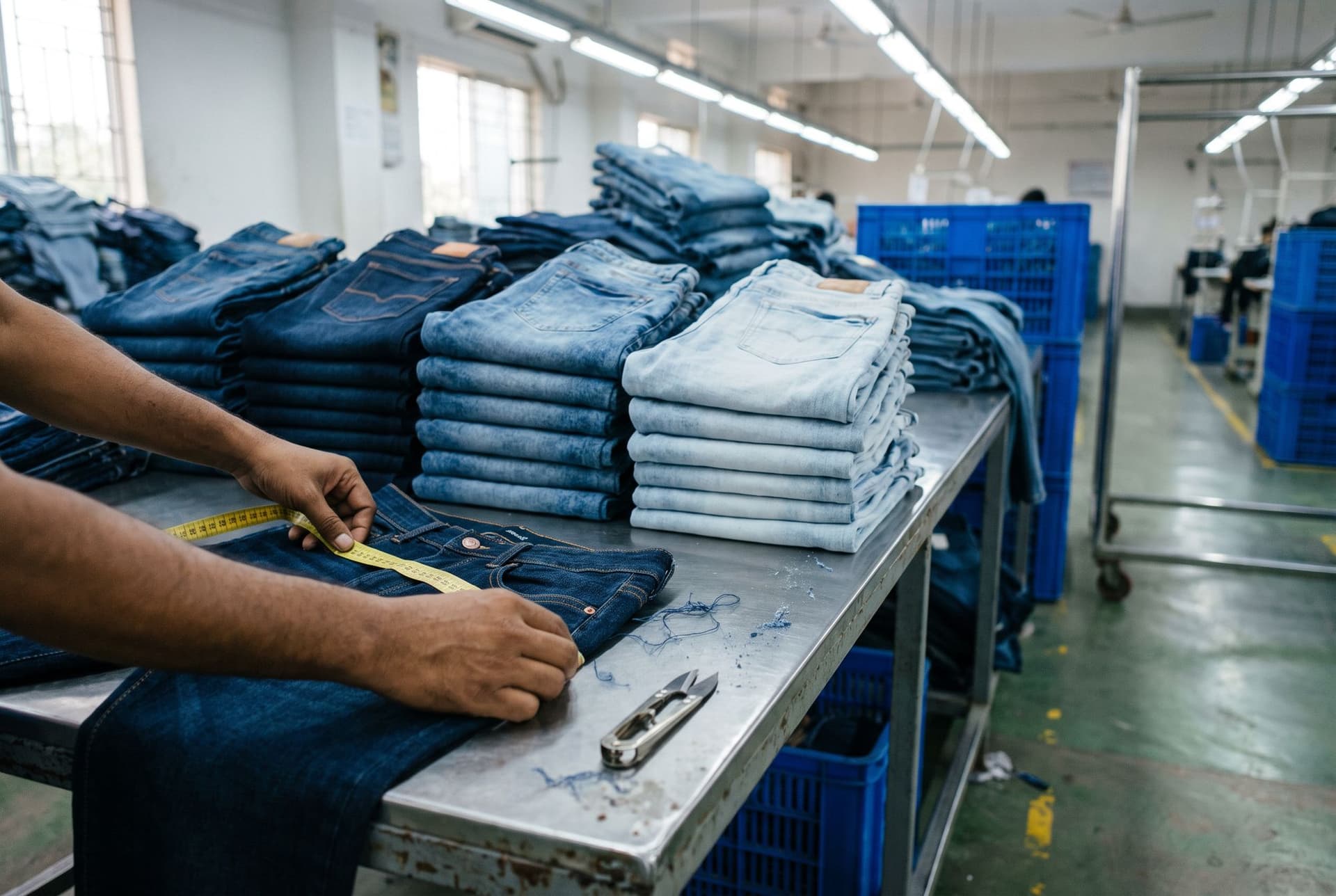
We quote denim jeans per style, from your tech pack or a reference garment, because fabric, weight, decoration, quantity and shipping terms set the price. Decoration, sampling and testing are costed as their own lines, and your quote states the shipping term (FOB, CIF or DDP).
The order cost estimator turns a price per piece into an order total and shows how it splits into fabric, trims and making. Once your quote states the shipping term, the landed cost calculator turns it into a delivered price for your market. Nothing you enter in either tool is sent anywhere.
The delivery date depends on the fabric, the decoration and the season, so it is confirmed in writing with your order, and payment terms are agreed with your quote. See how an order runs and our guide to payment terms in garment manufacturing.
Our sister factory does not take small runs of denim jeans, so there is no small-run route below our minimum of 2,000 pieces per style and colour. The minimum counts per style and colour: three colours of one style means 2,000 pieces of each.
Styles available
- Five-pocket jeans in all fits
- Wide leg, straight and slim
- Denim jackets and trucker jackets
- Overshirts and chore jackets
- Skirts, shorts and dresses
- Kids denim
Fabrics and weights
- Rigid denim 12–14.5 oz
- Comfort stretch 9–12 oz
- Lightweight chambray 5–8 oz
- Organic and recycled cotton denim
- Tencel™ and hemp blends
- Black, grey and coloured denim
Decoration and finishing
- Stone, enzyme and bleach washes
- Laser finishing and ozone fading
- Hand sanding, whiskers and destruction
- Tinting and overdyes
- Custom rivets, buttons, leather and jacron patches
- Low-water and low-chemical wash recipes
Specifying denim.
The detail below is what turns a sketch into a garment that arrives as you expected. Send what you have and we fill the gaps with you before sampling.
Put this in your tech pack
- Denim weight in ounces, composition, stretch percentage and whether the fabric is rigid, comfort or power stretch
- Fit block and full measurement sheet: waist, hip, thigh, knee, leg opening, front and back rise, inseam
- Wash recipe or a reference garment for the wash, including whiskers, hand sanding and destruction placement
- Hardware: button, rivets, zip brand and finish, plus jacron or leather patch artwork
- Pocket detail: bag fabric, arcuate stitching, pocket opening and depth
- Thread colours by seam, since denim usually uses two or three different threads
- Care and origin label content, plus any stretch-recovery claims you want tested
Free tech pack template: Excel, CSV or print, no email asked
What moves the price
- Denim fabric weight and stretch content, and whether the fabric is locally woven or imported
- Wash complexity: a rinse wash is far cheaper than a multi-step vintage wash with laser and ozone steps
- Hand work such as sanding, whiskering and destruction, which is priced per garment
- Hardware quality and branding, including custom rivets and buttons
- Quantity per wash, because each wash recipe is set up and processed as its own batch
What goes wrong with denim, and how to prevent it.
Every category fails in its own way. These are the problems to plan against on this product, and the checks that catch them before your goods ship.
| Risk | How to prevent it |
|---|---|
| Wash shade varying between batches | Every wash batch is compared against the approved sealed standard under controlled lighting, and garments are packed by batch. |
| Shrinkage and twisted legs after washing | Fabric skew and shrinkage are tested before cutting, patterns are compensated, and washed samples are measured. |
| Poor stretch recovery, so jeans bag out at the knee | Fabric recovery is laboratory tested, and the pre-production sample is wear-tested before bulk approval. |
| Back-staining and crocking on dark indigo | Rub-fastness tests are run on washed garments, and wash recipes are adjusted before bulk. |
| Hardware rust or nickel release | Hardware is tested for corrosion and nickel release, which also covers EU REACH limits for skin contact. |
Mill, sewing factory, laundry: who does what in Bangladesh denim
A pair of jeans passes through three stages of work, and each controls part of what you see in the finished pair. The mill makes the fabric: it dyes the warp yarn with indigo, weaves it and finishes it. The sewing factory cuts and sews to your pattern and attaches the hardware. The laundry, or wash plant, creates the look with washes, laser, ozone and hand work. Shade depends on the mill’s dye lots and the laundry’s recipe, and the fit after washing depends on the mill’s finishing, the factory’s pattern and the laundry’s process, so each stage needs its own questions.
On an order placed through CMB Sourcing, the factory making it is named in writing before production, with its address, certificates and audit reports. Where the sewing factory runs its own wash plant, as this page recommends, the sewing and laundry questions go to the same factory, and the mill questions go to whoever makes the fabric. Ask each the questions below before you approve a sample.
| Party | What it controls | Questions to ask |
|---|---|---|
| Denim mill | Yarn, indigo dyeing method and depth, weave, weight, fabric finishing, and shade from one dye lot to the next | Is the warp rope-dyed or slasher-dyed, and how many dips? Is the yarn ring-spun, open-end or core-spun stretch? How many ends and picks per inch? How are dye lots sequenced, and can my bulk come from one lot or consecutive lots? Which certificates cover this exact fabric article? |
| Sewing factory | The pattern and its shrinkage allowance, cutting, sewing, thread, hardware attachment, finishing and packing | Which washed-fabric test was the shrinkage allowance built from? Do you cut and bundle by fabric lot, so one garment never mixes lots? Who supplies the rivets and buttons, and how is their attachment checked? Is the pre-production sample made on the bulk line? |
| Laundry (wash plant) | The wash recipe, laser and ozone programmes, hand sanding and whiskering, tinting, chemicals and wastewater | Can I see your last two ZDHC ClearStream reports? Is your Higg FEM verified or self-assessed? Which steps in my recipe run on laser or ozone machines, and which are done by hand? Will bulk run on the same machines and recipe as the approved sample? |
Bangladesh’s denim mills and jeans makers
Denim in Bangladesh is made by two kinds of company: mills that spin, dye and weave the fabric, and sewing groups that cut, sew and wash the jeans; some groups do both. The table lists six whose figures are public, from the company’s own website, its stock-exchange disclosures or the press, in alphabetical order. It is not a ranking and not a complete list, and naming a company here is not a claim that CMB Sourcing Ltd. works with it, buys from it or is approved by it.
How to use it. If you want a named mill’s fabric, say so when you ask for a quote: whether the sewing factory can buy it depends on the mill selling to that factory and on your quantity meeting the mill’s minimum for the article and shade. Ask for the mill’s name and the fabric article number on the fabric line of the quote, ask which certificates cover that exact article (the question is in the mill row of the table above), and check each certificate in the issuing body’s own database. Open Supply Hub, a free, open database of production locations, shows a mill’s address and the organisations that have added it, and a dated news check tells you whether the mill is still running: Beximco’s row is the reason.
| Company | What it is and where | Public fact and source |
|---|---|---|
| Beximco | Vertical textile and apparel group whose profile lists woven, denim and knit fabrics; Beximco Industrial Park, Kashimpur, Gazipur | The closure of all 16 textile and garment units at the park was announced by the interim government in March 2025; on 7 October 2026 a plan to restart one of them, mainly for jackets, still needed government approval (The Daily Star, 7 October 2026) |
| Envoy Textiles | Denim fabric mill with its own spinning and weaving; Mymensingh | Told the stock exchanges that its annual denim capacity had risen to 60 million yards from 52 million (The Financial Express, 15 July 2026); describes itself as the first denim mill rated LEED Platinum by the US Green Building Council |
| Ha-Meem Group | Garment group with its own denim mill, Ha-Meem Denim Mills Ltd.; Sripur, Gazipur | Installed capacity of over 4 million metres of denim a month, with yarn from its own spinning mill at 44 tons a day (company website) |
| Pacific Jeans Group | Jeans maker; Chattogram Export Processing Zone | Seven factories in the zone with about 35,000 workers (The Business Standard, 23 October 2025) |
| Shasha Denims | Denim fabric mill; Dhaka Export Processing Zone (extension), Savar | Listed on the Chittagong Stock Exchange since 17 January 2015 and on the Dhaka Stock Exchange since 18 February 2015 (company website) |
| Square Denims | Denim fabric mill of the Square group; Habiganj | Began production in July 2015 on a 294-bigha site and was making 1.2 million yards a month in August 2016 (The Daily Star, 25 August 2016) |
What the mill’s choices mean for your jeans
Denim warp yarn is dyed before weaving. Indigo builds up in layers, with the yarn dipped and aired typically three to twelve times, and a sulphur dye applied underneath or on top gives darker or different shades. Rope dyeing typically runs 12 to 36 ropes of yarn side by side through the range; slasher dyeing dyes a flat sheet of yarn and, where the range does not allow many dips, reaches only light and medium shades. Warp yarns for bottom-weight jeans typically run from Ne 4.0 to Ne 12.5, and the classic 14.5 oz construction has 60 to 64 warp ends and 38 to 42 picks per inch.
Yarn names describe the warp and the filling in that order: ring/OE means a ring-spun warp with an open-end filling, a mix that can lower fabric cost while keeping some ring-spun character. For stretch denim, Cotton Incorporated describes core-spun yarn, with cotton fibres twisted round a spandex (elastane) core.
Shade continuity starts at the mill. Mills use sequential dyeing, because yarn dyed at one moment most closely matches the yarn dyed just before and just after it, and Cotton Incorporated reports that this limits colour differences between panels after garment washing more effectively than shade sorting alone. Ask for the dye-lot numbers of your bulk fabric, and whether they are consecutive.
Tests to agree with the mill, factory and laundry before bulk
When washed jeans come out short, twisted or baggy, the cause can sit with any of the three parties. Agreeing the test methods and the laboratory before bulk turns that argument into a number that all three have signed up to.
| Question | Test method | What to agree |
|---|---|---|
| Will the finished jeans shrink when washed at home? | AATCC TM150-2025, dimensional change of garments after home laundering | Wash and dry settings, number of cycles and the tolerance; AATCC notes the method may not suit garments in some stretch fabrics |
| Will the legs twist? | AATCC TM179-2025, skew change after home laundering, measured on fabric or garment specimens after two laundering cycles | The skew limit, measured on fabric that has been through the same laundry process as bulk |
| Will stretch jeans bag at the knee? | ASTM D3107-26, stretch, growth and recovery of fabrics woven from stretch yarns | The load (3 lb or 4 lb) and the limits for stretch and growth; ASTM advises against using it to accept commercial shipments because results vary between laboratories, so test the approval sample and bulk in the same laboratory |
| Will dark indigo rub off? | AATCC TM8, colour fastness to crocking, dry and wet | Minimum dry and wet grades, tested after washing, since washing can change how much colour transfers |
| Does the laundry’s wastewater meet ZDHC limits? | ZDHC Wastewater Guidelines, version 2.2 (September 2024) | A ClearStream report for each of the April and October testing cycles, meeting all reporting limits for ZDHC MRSL parameters and at least the foundational limits for heavy metals and, for direct dischargers, for conventional parameters and anions |
Laundry records to ask for: ZDHC wastewater reports and the Higg FEM
Two industry programmes give you records to ask a denim laundry for: wastewater test reports under the ZDHC Wastewater Guidelines, and the Higg Facility Environmental Module (Higg FEM). Here is what each asks of a facility, from the ZDHC guidelines and Cascale’s verification page.
- ZDHC Wastewater Guidelines version 2.2: suppliers test wastewater twice a year through a ZDHC-approved laboratory, in the April and October cycles, and generate a ClearStream report on the ZDHC Gateway for each cycle
- Suppliers should meet all reporting limits for ZDHC MRSL parameters, which check for intentional use of restricted substances, and at least the foundational limits for heavy metals and, for direct dischargers, for conventional parameters and anions
- The limits for heavy metals and conventional parameters come in three levels, foundational, progressive and aspirational, each stricter than the last
- Any non-conformity in a ClearStream report calls for a root cause analysis and a corrective action plan uploaded to the supplier’s Gateway account
- The Higg FEM starts as a self-assessment on the Worldly platform; a verified module has been checked by a Cascale-approved third party, by desk review or on site, and Cascale’s guidelines allow verified Level 1 results to be shared with supply chain partners and publicly
Cotton denim jeans: duty and tax by market
Duty depends on where the garment is sold, not on where it is made. Cotton denim jeans from Bangladesh enter the UK, the EU, Canada, Australia and New Zealand at 0% under each market’s scheme for least developed countries, with a tax at import that a registered business recovers. The United States gives Bangladesh no preference, so a US buyer pays the normal rate for the tariff line plus the 10% Section 301 tariff on Bangladeshi goods that applies from 24 July 2026. The table gives the position on 25 September 2026; each market page sets out the rules of origin, the paperwork and the labelling in full, with sources.
The EU keeps its 0% rate for three years after Bangladesh leaves the least developed country category, now scheduled for 24 November 2029, so to about November 2032; after that the third-country duty on this line is 12%. The tax at import (VAT or GST) is charged on the goods’ import value plus any duty, and each market sets whether freight and insurance count in that value, so cost the landed price with it. Our own orders for denim jeans start at 2,000 pieces per style and colour. Your quote states the shipping term (FOB, CIF or DDP), and our landed cost calculator turns it into a delivered price for your market.
| Market | Import duty | Tax at import |
|---|---|---|
| United Kingdom | 0% under the Developing Countries Trading Scheme with proof of origin | Import VAT 20%, zero-rated on most children’s clothing |
| European Union | 0% under Everything But Arms with a REX statement, until about November 2032 (three years after graduation); 12% third-country rate on 6203 42 31 after that | VAT at the member state’s rate |
| United States | 16.6% (HTSUS 6203.42.45 men’s and 6204.62.80 women’s, cotton trousers, other, including blue denim) plus 10% Section 301 from 24 July 2026; no preference | No federal sales tax at import; merchandise processing fee applies |
| Canada | 0% under the Least Developed Country Tariff | 5% GST |
| Australia | 0% under the Australian System of Tariff Preferences (50% local-content rule) | GST 10% of the value of the taxable importation |
| New Zealand | 0% under New Zealand’s preference scheme for least developed countries | GST at import |
Sources
Checked . Rules and figures change, so confirm anything that affects your pricing.
Show all 29 sourcesHide the sources
- Cotton Incorporated: Denim fabric manufacturing, technical bulletin ISP 1010 (2004) (PDF) (opens in a new tab)
- AATCC TM150-2025, dimensional changes of garments after home laundering (opens in a new tab)
- AATCC TM179-2025, skew change in fabrics after home laundering (opens in a new tab)
- ASTM D3107-26, stretch properties of fabrics woven from stretch yarns (opens in a new tab)
- AATCC TM8, colour fastness to crocking (crockmeter) (opens in a new tab)
- ZDHC Wastewater Guidelines, version 2.2, September 2024 (PDF) (opens in a new tab)
- Cascale: Higg FEM verification (opens in a new tab)
- European Commission, TARIC: measures for 6203 42 31 00 (men’s or boys’ cotton denim trousers) imported from Bangladesh: 0% tariff preference, 12% third-country duty, simulated 25 September 2026 (opens in a new tab)
- USITC: Harmonized Tariff Schedule of the United States, 6203.42.45 and 6204.62.80 (cotton trousers, other, including blue denim), general rate 16.6% (opens in a new tab)
- GOV.UK: Developing Countries Trading Scheme, product-specific rules of origin for least developed countries (opens in a new tab)
- GOV.UK: VAT on imports, acquisitions and purchases from abroad (opens in a new tab)
- Federal Register 2026-15181: USTR notice of actions in the Section 301 investigations (10% on goods of Bangladesh from 24 July 2026) (opens in a new tab)
- Canada Border Services Agency: Guide to the Least Developed Country Tariff (opens in a new tab)
- Canada Border Services Agency: determining duties and taxes (5% GST at import) (opens in a new tab)
- Bangladesh Customs: DFQF Australia (Australian System of Tariff Preferences, rules of origin) (opens in a new tab)
- Australian Taxation Office: GST and imported goods (value of the taxable importation) (opens in a new tab)
- New Zealand Customs Service: Generalised System of Preferences, LDC and LLDC countries (opens in a new tab)
- UN News: UN launches drive to highlight environmental cost of staying fashionable (25 March 2019; around 7,500 litres of water for one pair of jeans) (opens in a new tab)
- Levi Strauss & Co.: The Life Cycle of a Jean, full results (2015; 3,781 litres over the life of one pair of 501 jeans, by phase) (opens in a new tab)
- CCIFB (French Chamber of Commerce and Industry in Bangladesh): member profile of Beximco Ltd. (2021): a fully vertical textile and apparel group producing woven, denim and knit fabrics, based at Beximco Industrial Park (PDF) (opens in a new tab)
- The Daily Star (7 October 2026): Beximco seeks to reopen factories with $23m investment (closure of all 16 textile and garment units at Beximco Industrial Park, Kashimpur, announced by the interim government in March 2025; plan to restart Prefix Fashions, mainly for jackets, needs approval from Invest Bangladesh and Bangladesh Bank) (opens in a new tab)
- Envoy Textiles: company website (plant in Mymensingh with its own spinning and weaving; LEED Platinum from the US Green Building Council, described as the first among denim mills worldwide) (opens in a new tab)
- The Financial Express (15 July 2026): Envoy Textiles boosts denim fabric capacity to 60m yards (annual capacity up from 52 million yards; price-sensitive information filed with the stock exchanges) (opens in a new tab)
- Ha-Meem Group: Denim Mill (Ha-Meem Denim Mills Ltd., Sripur, Maona, Gazipur; installed capacity of over 4 million metres a month; own spinning mill, 44 tons a day) (opens in a new tab)
- The Business Standard (23 October 2025): 7 Pacific Jeans factories reopen after weeklong shutdown, 35,000 workers resume duty (Chattogram Export Processing Zone) (opens in a new tab)
- Shasha Denims: About (listed on the Chittagong Stock Exchange on 17 January 2015 and the Dhaka Stock Exchange on 18 February 2015) (opens in a new tab)
- Shasha Denims: Contact (factory at DEPZ (Ext.), Savar, Dhaka) (opens in a new tab)
- The Daily Star (25 August 2016): Denim by Square flourishes as purchase orders pour in (Habiganj; production from July 2015 on 294 bighas; 1.2 million yards a month) (opens in a new tab)
- Open Supply Hub: free, open map of production locations, searchable by facility name and country (opens in a new tab)
Standards for denim.
The standards buyers most often ask about in this category. A certificate belongs to the factory or fabric mill that holds it, so we send you the certificates and test reports for the factory and fabric used for your order. The last column says how to check each one yourself.
| Standard | What it proves | Type | How to verify |
|---|---|---|---|
| OEKO-TEX® STANDARD 100 | Every component of a product — fabric, thread, labels, buttons, prints — is tested for harmful substances. | Voluntary standard | Enter the certificate number from the label in Label Check on oeko-tex.com. |
| ZDHC MRSL and Wastewater Guidelines | The Manufacturing Restricted Substances List controls which chemicals may enter production. | Voluntary standard | Ask for the facility’s ZDHC Gateway ID and its latest wastewater (ClearStream) report. |
| Higg Facility Environmental Module (FEM) | Measures a facility’s environmental management, energy and greenhouse gas emissions, water use, wastewater, air emissions, waste and chemicals. | Voluntary standard | Request the verified module on Worldly. |
| GOTS — Global Organic Textile Standard | Organic fibre tracked from farm to finished garment, with environmental and social criteria at every processing stage. | Voluntary standard | Search the GOTS public database of certified suppliers, and ask for the TC for your shipment. |
| amfori BSCI | Audits working conditions against the amfori Code of Conduct: fair pay, working hours, freedom of association, no child or bonded labour, health and safety, and the management systems behind them. | Voluntary standard | Ask for the amfori audit ID. amfori members can open the full report on the amfori Sustainability Platform. |
Quality checks on every order.
Bulk fabric is tested against the approved swatch before cutting, quality is checked on the line, and a final AQL inspection is run on the finished goods. You get the report before you approve shipment. For this product we work as a buying house with clothing manufacturers in Bangladesh: the factory makes your order, and we stay responsible for it from the first sample to shipment.
Before bulk, and if an inspection fails
- Before bulk: you approve a pre-production sample made in bulk fabric with bulk trims on the production line. It is sealed, and every inspection afterwards is judged against it.
- In writing before cutting: nothing is cut on a verbal go-ahead. The order confirmation you sign off fixes the price, the delivery date the factory has confirmed, the factory’s name and address, the measurement tolerances, and what happens if a date moves on either side.
- If the final inspection fails: nothing ships until you have seen the report and decided. The factory reworks the defective pieces and the lot is re-inspected; or the lot is sorted, so acceptable pieces ship and the rest are reworked or replaced; or, where the fault is fundamental, the goods are remade. Who pays depends on your terms with us and is agreed before production.
- A second check: your own inspector, or an independent firm such as QIMA, SGS, Intertek or Bureau Veritas, is welcome at any stage, and you can come yourself.
Denim: common questions.
Which countries let me import jeans from Bangladesh duty-free?
The UK, the EU, Canada, Australia and New Zealand all admit cotton denim jeans made in Bangladesh at 0% duty under their schemes for least developed countries, each with its own proof of origin: a DCTS origin declaration or Form A for the UK, a REX statement for the EU, and the local-content rules that Canada, Australia and New Zealand apply. Under Everything But Arms a single transformation is enough, so jeans cut and sewn in Bangladesh from imported denim qualify as well as jeans made from local fabric; stricter schemes generally ask for the fabric to be made in Bangladesh too, which is why fabric origin is worth planning for orders after the transition. The EU rate continues for three years after Bangladesh graduates on 24 November 2029, so to about November 2032, then 12% on the cotton denim trouser line. The United States gives no preference: 16.6% under HTSUS 6203.42.45 or 6204.62.80 plus the 10% Section 301 tariff from 24 July 2026.
How do you keep wash shades consistent across bulk production?
Denim washing combines chemistry, mechanical action and time, so shade can drift between batches if it is not controlled. We start by approving a wash standard on your bulk fabric, usually with light, target and dark limits that show the acceptable range. Ask the laundry to record the full recipe: machine type, load size, water ratio, chemicals, stones or enzymes, laser and ozone settings, and cycle times. During production, garments are washed in controlled batches, and each batch is compared with the approved standard under consistent lighting before finishing continues. Pieces are grouped by shade so that a carton, and ideally a shipment, stays within one band. Fabric matters too, because different dye lots of the same denim can wash differently, so have each new fabric lot tested at an accredited laboratory before it goes into bulk washing.
What makes a denim wash more sustainable?
Traditional denim washing uses large amounts of water, pumice stones, bleach and energy to create worn effects. More sustainable methods replace many of those steps. Laser finishing burns whiskers, fades and distressing into the fabric digitally, cutting out much of the hand sanding and chemical spraying that used to create them. Ozone treatment fades indigo using gas instead of bleach and water-heavy rinses. Enzyme washes can replace some or all of the stones, reducing water use and sludge, and reusable abrasives last far longer than pumice. Fabric choice matters as well, with organic, recycled or lower-impact cotton and dye processes. Many Bangladeshi wash plants report chemical use and wastewater results through the ZDHC Gateway and assess their environmental performance with the Higg Facility Environmental Module, so ask for those reports from the laundry handling your order.
What is the minimum order for custom jeans, and what sets the price?
We publish no prices: a basic pair of jeans has a standard denim weight, a simple wash and standard hardware, and heavier or premium denim, laser and hand finishing, multiple washes, custom rivets, buttons and leather patches each add to it, each quoted as its own line. Our minimum for jeans is 2,000 pieces per style and colour, because denim minimums are set by the wash plant and the fabric mill rather than the sewing line: a wash recipe has to be developed and run per style and colour. Denim is not one of the categories our sister factory takes in small runs, so a first order is placed with a denim factory that has its own wash plant. Send us a reference pair or a tech pack and we will give you the price within one working day.
What denim weight should I choose for my jeans?
Denim weight is written in ounces per square yard and decides how the jeans feel, wear and drape. Rigid denim at 12–14.5 oz is the classic, hard-wearing choice that softens and fades with wear; it suits heritage and workwear styles and takes washes and hand finishing well. Comfort stretch at 9–12 oz, with a small percentage of elastane, is the mainstream choice for fitted and skinny styles and for womenswear, because it moves with the body and recovers. Lightweight chambray and denim at 5–8 oz suit shirts, summer trousers and childrenswear. Organic and recycled cotton denim and Tencel or hemp blends are available with the certificates to back the claim. Heavier denim costs more per pair and takes longer to wash, and stretch denim needs its recovery tested so the knees do not bag. We send denim swatches in two or three weights before sampling so you can choose by hand-feel.
Do jeans buttons and rivets need a nickel test for the EU?
Yes: the metal buttons, rivets and zips on jeans sold in the EU must not release more than 0.5 micrograms of nickel per square centimetre per week from the parts in direct and prolonged contact with skin. The limit is entry 27 of Annex XVII to REACH, which names rivet buttons, tighteners, rivets, zippers and metal marks used in garments. Hardware with a non-nickel coating has to stay within the limit for at least two years of normal use, so a plated rivet is judged on how its plating lasts, not only on how it tests when new. On jeans this matters at the waistband, where the back of the button and the rivets sit against skin. Ask the hardware supplier for a nickel release report for the exact button, rivet and finish in your bill of materials. Where hardware is attached before washing, have garments from the washed production tested too.
How much water does it take to make a pair of jeans?
Making a pair of jeans takes around 7,500 litres of water on the figure the United Nations published in March 2019; Levi Strauss & Co.’s 2015 life cycle study counted 3,781 litres over the whole life of one pair of 501 jeans, home washing included. The headline number matters less than where the water goes. In the Levi’s study, fibre production, mostly cotton, accounted for 68% of the water consumed and the wearer’s home washing for 23%, while fabric production took 6% and cutting, sewing and finishing 1%, about 34 litres. So the wash recipe, which laser, ozone and enzyme methods can make leaner, is a small share of the total but the share a brand specifies directly, and fibre choice moves the large number. If you publish a water claim, name the study and what it counted. For your own style, ask the laundry for the measured litres per garment of your approved recipe.
How are jeans made, step by step, from yarn to finished pair?
Jeans are made in three stages: a mill turns yarn into dyed denim, a sewing factory cuts and sews it, and a laundry washes the finished garment. At a mill that rope-dyes, the warp yarn is spun, gathered into ropes, dipped in indigo and aired, typically three to twelve times, then re-beamed into a sheet and sized, a coating that reduces abrasion and keeps the indigo from rubbing off during weaving. Most filling yarn goes straight to the loom without that preparation, and the standard weave is a 3/1 twill. The sewing factory cuts the fabric lot by lot, sews the panels and attaches the buttons, rivets and patch. The laundry creates the look with enzyme or stone washes, laser, ozone and hand work, and the jeans are measured, inspected and packed. Because washing changes the size, the pattern carries a shrinkage allowance built from a washed-fabric test.
What is the difference between right-hand, left-hand and broken twill denim?
Right-hand, left-hand and broken twill describe the diagonal line in a denim’s weave: rising to the right, rising to the left, or interrupted so that it never runs straight. The standard denim weave is a 3/1 twill, in which each warp yarn passes over three filling yarns and under one, and each neighbouring yarn steps up by one to draw the diagonal. Cotton Incorporated’s denim bulletin notes that the line shows most clearly when the warp yarn’s twist runs opposite to the twill direction, which also tends to make the fabric feel a little softer. Open-end yarn is made only with Z twist, so it suits a left-hand twill when a pronounced line is wanted, while ring-spun yarn can be twisted either way. Ask the mill which twill and twist a fabric uses, and compare washed swatches. Whichever you choose, leg twist is tested, not assumed, with AATCC TM179, the skew change test.
Related products
Costs and market rules
Ways to work with us
This product is made by one of the clothing manufacturers in Bangladesh we work with as a buying house, and the factory is named to you in writing before production starts.
Guides on this topic
Planning an order of denim?
Send a tech pack, a sketch or a photo of a garment you like. We reply within one working day with questions or a first costing.
- A reply within one working day
- An enquiry, not an order: you are committed to an order only when you sign the written order confirmation
- Certificates and audit reports shared before production
- AQL final inspection report before you approve shipment
- Your patterns and artwork never shown to or reused for other buyers