Workwear and uniform manufacturer in Bangladesh
Workwear has to survive industrial laundering, and where a garment counts as personal protective equipment, we arrange certified testing. The coveralls, work trousers, jackets and hi-vis come from audited partner factories in Bangladesh, in polyester–cotton twill from 200 to 300 GSM, canvas and ripstop. The confirmed minimum is 2,000 pieces per style and colour.
- Typical fabric
- Twill, canvas, hi-vis
- Price
- Quoted per style
- Minimum order
- 2,000 pieces per style and colour
In short
Workwear is specified for the laundry and the job, not the rail. Our partner factories make coveralls, work trousers, jackets, hi-vis and hospitality uniforms in polyester–cotton twill from 200 to 300 GSM, canvas, ripstop and fluorescent fabrics, with bar-tacked stress points and certified testing where a garment claims protection. Each garment is quoted from your specification. CMB Sourcing Ltd. is a manufacturer and buying house: knitwear (such as T-shirts, polos and hoodies) and caps are made in our own factory, everything else in an audited partner factory, and we manage every order. The minimum order for workwear is 2,000 pieces per style and colour.
Minimum order and your quote
- Minimum order
- 2,000 pieces per style and colour
- Price
- Quoted per style, from your tech pack
- Shipping term
- FOB, CIF or DDP, stated on your quote
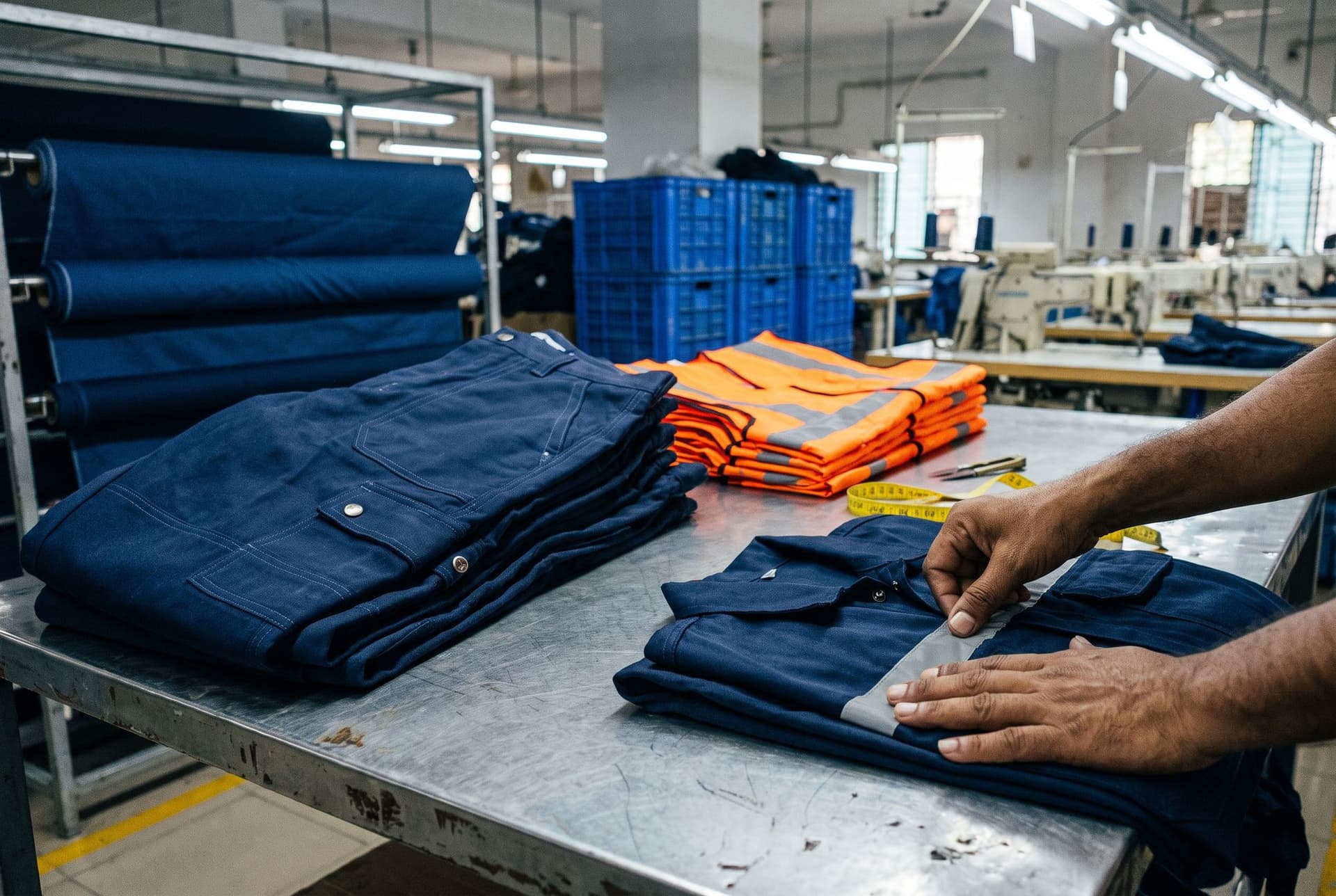
We quote workwear per style, from your tech pack or a reference garment, because fabric, weight, decoration, quantity and shipping terms set the price. Decoration, sampling and testing are costed as their own lines, and your quote states the shipping term (FOB, CIF or DDP).
The order cost estimator turns a price per piece into an order total and shows how it splits into fabric, trims and making. Once your quote states the shipping term, the landed cost calculator turns it into a delivered price for your market. Nothing you enter in either tool is sent anywhere.
The delivery date depends on the fabric, the decoration and the season, so it is confirmed in writing with your order, and payment terms are agreed with your quote. See how an order runs and our guide to payment terms in garment manufacturing.
Our sister factory does not take small runs of workwear, so there is no small-run route below our minimum of 2,000 pieces per style and colour. The minimum counts per style and colour: three colours of one style means 2,000 pieces of each.
Styles available
- Coveralls and boiler suits
- Work trousers and cargo pants
- Work jackets and gilets
- High-visibility clothing
- Chef and hospitality uniforms
- Medical scrubs
- Corporate shirts and polos
- School uniforms
Fabrics and weights
- Polyester–cotton twill 200–300 GSM
- Cotton canvas and duck
- Ripstop and stretch workwear fabrics
- Fluorescent hi-vis fabrics
- Flame-retardant fabrics (on request)
- Industrial-wash-resistant blends
Decoration and finishing
- Bar-tacked and triple-stitched stress points
- Reflective tape
- Kneepad pockets and tool loops
- Embroidered and heat-transfer logos
- Individual name personalisation
Specifying workwear and uniforms.
The detail below is what turns a sketch into a garment that arrives as you expected. Send what you have and we fill the gaps with you before sampling.
Put this in your tech pack
- Fabric composition, weight and any protective standard the garment must meet
- Hi-vis requirements: colour class, tape configuration and the standard you are certifying to
- Full measurement grid across a wide size range, including tall and short fittings if needed
- Pocket and tool loop plan with dimensions, plus reinforcement at stress points
- Stitch specification: seam type, stitches per inch and bar tack placement
- Closure detail: zips, studs or hook and loop, and metal-free requirements where relevant
- Branding plan: embroidery, transfer or printed logos, and whether garments are personalised by name
Free tech pack template: Excel, CSV or print, no email asked
What moves the price
- Fabric: cotton-rich twills, ripstop and inherently flame-resistant fabrics sit at very different price levels
- Certification testing, which is charged per standard and often per colour
- Reflective tape, which is priced per metre and adds sewing operations
- Number of pockets, panels and bar tacks, since workwear is construction-heavy
- Personalisation, because named or numbered garments break the run into small batches
What goes wrong with workwear and uniforms, and how to prevent it.
Every category fails in its own way. These are the problems to plan against on this product, and the checks that catch them before your goods ship.
| Risk | How to prevent it |
|---|---|
| Seams failing under load | Seam strength and stitch density are specified and tested, with bar tacks at stress points checked during inline inspection. |
| Reflective performance dropping after washing | Tape is wash-tested to the relevant standard before bulk, and the certification is kept with the order file. |
| Colour fading in industrial laundering | Fabric is tested to industrial wash cycles rather than domestic ones, when that is how the garment will be cleaned. |
| Sizing inconsistency across a large range | The full size set is approved before bulk, and measurements are checked in every size at final inspection. |
Making workwear and uniforms in Bangladesh
Bangladesh’s export statistics do not count workwear on its own. The UK tariff carries separate “industrial and occupational” codes for trousers and bib and brace overalls under headings 6203 and 6204, and for “other garments” under 6211, but the Export Promotion Bureau’s 6-digit and 8-digit lines do not split them out, so a work trouser sits in the same line as jeans and chinos. In FY2025-26 (July 2025 to June 2026) men’s cotton woven trousers (6203.42) were US$4.85 billion and the women’s line (6204.62) US$3.50 billion; the four “other garments” lines under 6211 in cotton and man-made fibres came to US$251.58 million. Knitted cotton trousers, 6103.42 and 6104.62, were US$735.44 million and US$1.12 billion.
The EU’s import statistics do separate work trousers, at eight digits. In 2025 the EU imported €265.1 million of men’s and boys’ cotton industrial and occupational trousers (CN 6203 42 11) from outside the Union: €60.5 million from China, €43.0 million from Bangladesh and €42.0 million from Pakistan (Eurostat Comext, 2025). By member state, Italy (€8.0 million) and Poland (€7.7 million) declared the most from Bangladesh, and in Poland that was 46% of the €16.9 million it imported from outside the EU (our arithmetic). The Czech Republic took €1.7 million from Bangladesh out of €14.1 million, most of the rest from China (€10.7 million), and Hungary recorded none from Bangladesh, out of €0.8 million in all. Goods are counted in the member state where they are declared, so trousers cleared in one country and sold in another appear under the first.
Most workwear is woven, not knitted, and that changes where the fabric comes from. Local mills cover about 40% of Bangladesh’s woven fabric demand (Bangladesh Textile Mills Association, via the USDA, December 2025), so more of the country’s woven fabric is imported than made locally. China reported 2025 exports to Bangladesh (UN Comtrade) of US$666.4 million of heavy cotton wovens over 200 g/m² (heading 5209), including US$139.5 million of dyed twill, and US$77.7 million of synthetic staple and cotton blends over 170 g/m² (5514), US$52.0 million of it dyed polyester-cotton twill. A polyester-cotton twill in a corporate shade is dyed to order, so the mill’s delivery time and dye-lot minimum come before cutting. Ask where the twill is woven and dyed before you fix a delivery date, because a bought-in fabric adds the mill’s delivery to the time before cutting; the bulk roll is then tested against the approved swatch before it is cut.
Workwear and uniform orders start at 2,000 pieces per style and colour, which fits how programmes are bought: a main order across the size grid, then top-ups as staff join. For a top-up to match, the same fabric from the same mill and the approved colour standard must be available, so keep the mill reference and the approved colour standard with your first order file and ask the mill’s minimum for a repeat colour. CMB Sourcing Ltd. names the audited partner factory to you in writing before the first run, with its address, certificates and audit reports, and sends the AQL final inspection report for that run and for every top-up.
Workwear by industry: which standard applies in each market
Workwear divides by the job it does. A garment that claims to protect its wearer is personal protective equipment, and the market’s standard decides the fabric, the design and the paperwork. A garment that makes no protective claim, which covers most healthcare, hospitality and corporate uniforms, is ordinary clothing, and the test that matters is the wash it will go through. The table names each standard as its standards body or regulator listed it on 17 October 2026, and what to ask for before bulk. Where a market is not named, ask the wearer’s employer which standard its safety specification requires.
| Industry | Standard by market | What to ask for before bulk |
|---|---|---|
| Flame-resistant (heat, flame, flash fire, welding) | EU and UK: EN ISO 11612:2015 for heat and flame; EN ISO 11611 for welding; EN ISO 14116 for limited flame spread only. United States: NFPA 2112, 2023 edition, for industrial personnel exposed to flash fire | A certificate for the exact fabric article to the named standard, and whether the fabric is inherently flame-resistant or treated; for the EU and UK, the type-examination certificate for the garment design from a notified body (CE marking) or a UK approved body (UKCA marking); for the United States, proof that the garment is certified to NFPA 2112 |
| High visibility (work near moving traffic or plant) | EU and UK: EN ISO 20471. United States: ANSI/ISEA 107-2020. Canada: CSA Z96:22. Australia: AS 4602.1:2024. New Zealand: AS/NZS 4602.1:2011, which remains current there | Certificates for the fluorescent background fabric and the retroreflective tape to that market’s standard, the test report or certificate for the garment design in the class you need, and the tape’s wash-test result; for the EU and UK, the type-examination certificate as above |
| Healthcare (scrubs and tunics) | Scrubs and tunics that make no protective claim are ordinary clothing. A surgical gown is a different, regulated product: in the United States the FDA treats it as a Class II medical device that needs a 510(k) premarket notification, and AAMI PB70 grades the barrier performance of protective apparel from level 1 to level 4 | Shrinkage and colour change tested to ISO 15797, the industrial washing procedure for testing workwear, if the uniforms go to an industrial laundry; a garment sold as a barrier against fluids or infection is outside what this page covers |
| Hospitality (chef jackets, aprons, front of house) | Ordinary clothing, not PPE, unless the garment claims protection; a chef’s jacket sold as a uniform makes no protective claim | Shrinkage and colour change tested to ISO 15797 if the laundry is industrial, or to ISO 6330 if staff wash at home, and a test report for any finish named on the label, such as stain release |
| Corporate (shirts, polos, blouses, trousers) | Ordinary clothing; the market’s labelling rules for fibre content, origin and care apply, as to any garment | Wash tests to ISO 6330 for home washing, or to ISO 15797 for an industrial laundry, and the approved colour standard kept on file so that top-ups match |
Workwear and uniforms: duty and tax by market
Duty depends on where the garment is sold, not on where it is made. Cotton work trousers and coveralls from Bangladesh enter the UK, the EU, Canada, Australia and New Zealand at 0% under each market’s scheme for least developed countries, with a tax at import that a registered business recovers. The United States gives Bangladesh no preference, so a US buyer pays the normal rate for the tariff line plus the 10% Section 301 tariff on Bangladeshi goods that applies from 24 July 2026. The table gives the position on 25 September 2026; each market page sets out the rules of origin, the paperwork and the labelling in full, with sources.
The EU keeps its 0% rate for three years after Bangladesh leaves the least developed country category, now scheduled for 24 November 2029, so to about November 2032. The tax at import (VAT or GST) is charged on the goods’ import value plus any duty, and each market sets whether freight and insurance count in that value, so cost the landed price with it. Our own orders for workwear and uniforms start at 2,000 pieces per style and colour. Your quote states the shipping term (FOB, CIF or DDP), and our landed cost calculator turns it into a delivered price for your market.
| Market | Import duty | Tax at import |
|---|---|---|
| United Kingdom | 0% under the Developing Countries Trading Scheme with proof of origin | Import VAT 20%, zero-rated on most children’s clothing |
| European Union | 0% under Everything But Arms with a REX statement, until about November 2032 (three years after graduation); 12% on 6203 42 11 and 6211 32 10 after that | VAT at the member state’s rate |
| United States | 16.6% on cotton work trousers (HTSUS 6203.42.45); coveralls and other lines differ, plus 10% Section 301 from 24 July 2026; no preference | No federal sales tax at import; merchandise processing fee applies |
| Canada | 0% under the Least Developed Country Tariff | 5% GST |
| Australia | 0% under the Australian System of Tariff Preferences (50% local-content rule) | GST 10% of the value of the taxable importation |
| New Zealand | 0% under New Zealand’s preference scheme for least developed countries | GST at import |
Sources
Checked . Rules and figures change, so confirm anything that affects your pricing.
Show all 32 sourcesHide the sources
- Export Promotion Bureau, Bangladesh: export data for July to June 2025-26, file “Product Wise Export (Goods) For The Month of July-June 2025-26” (4-, 6- and 8-digit HS sheets) (opens in a new tab)
- USDA Foreign Agricultural Service: Cotton and Products Update, Bangladesh, report BG2025-0013 (2 December 2025): BTMA says local mills meet about 85% of knit fabric demand and about 40% of woven (opens in a new tab)
- UN Comtrade: China’s reported exports to Bangladesh in 2025 of HS 5209 (US$666.4 million) and 5209.32 (US$139.5 million), 5211 (US$596.4 million), 5513 (US$141.0 million), 5514 (US$77.7 million) and 5514.22 (US$52.0 million) (opens in a new tab)
- Eurostat Comext (dataset DS-045409): EU and member-state imports in 2025 of CN 6203 42 11, men’s or boys’ cotton industrial and occupational trousers, from outside the EU, Bangladesh, China and Pakistan (API query) (opens in a new tab)
- UK Integrated Online Tariff: commodity 6203 42 11 00, men’s or boys’ cotton trousers and breeches, “industrial and occupational”, under heading 6203 (opens in a new tab)
- UK Integrated Online Tariff: commodity 6203 42 51 00, men’s or boys’ cotton bib and brace overalls, “industrial and occupational”, under heading 6203 (opens in a new tab)
- UK Integrated Online Tariff: commodity 6204 62 11 00, women’s or girls’ cotton trousers and breeches, “industrial and occupational”, under heading 6204 (opens in a new tab)
- UK Integrated Online Tariff: commodity 6204 62 51 00, women’s or girls’ cotton bib and brace overalls, “industrial and occupational”, under heading 6204 (opens in a new tab)
- UK Integrated Online Tariff: commodity 6211 32 10 00, “industrial and occupational clothing”, men’s or boys’ other garments of cotton, under heading 6211 (tracksuits, ski suits and swimwear; other garments) (opens in a new tab)
- UK Integrated Online Tariff: commodity 5209 32 00 00, dyed 3-thread or 4-thread twill, under heading 5209 (woven cotton fabrics, 85% or more cotton, over 200 g/m²) (opens in a new tab)
- UK Integrated Online Tariff: commodity 5514 22 00 00, dyed 3-thread or 4-thread twill of polyester staple fibres, under heading 5514 (woven fabrics of synthetic staple fibres mixed mainly or solely with cotton, over 170 g/m²) (opens in a new tab)
- DIN Media: DIN EN ISO 11612:2015-11, Protective clothing – Clothing to protect against heat and flame – Minimum performance requirements (ISO 11612:2015), marked current (opens in a new tab)
- NFPA: NFPA 2112, Standard on Flame-Resistant Clothing for Protection of Industrial Personnel Against Short-Duration Thermal Exposures from Fire (current edition 2023; next edition 2028) (opens in a new tab)
- ISO 20471:2013 — High visibility clothing: test methods and requirements (opens in a new tab)
- ISEA: ANSI/ISEA 107-2020, American National Standard for High-Visibility Safety Apparel (announcement, 28 September 2020) (opens in a new tab)
- CSA Group: CSA Z96:22, High-visibility safety apparel (opens in a new tab)
- Standards New Zealand: AS/NZS 4602.1:2011, High visibility safety garments – Part 1: Garments for high risk applications (current in New Zealand; replaced in Australia by AS 4602.1:2024) (opens in a new tab)
- US Food and Drug Administration: Medical gowns (a surgical gown is a Class II medical device that requires a 510(k) premarket notification; AAMI PB70 classifies protective apparel from level 1 to level 4; content current as of 17 January 2024) (opens in a new tab)
- ISO 15797:2017 — Textiles: industrial washing and finishing procedures for testing of workwear (opens in a new tab)
- ISO 6330:2021 — Textiles: domestic washing and drying procedures for textile testing (opens in a new tab)
- European Commission, TARIC: measures for 6203 42 11 00 (men’s or boys’ cotton industrial and occupational trousers) imported from Bangladesh: 0% tariff preference, 12% third-country duty, simulated 25 September 2026 (opens in a new tab)
- European Commission, TARIC: measures for 6211 32 10 00 (men’s or boys’ cotton industrial and occupational garments) imported from Bangladesh: 0% tariff preference, 12% third-country duty, simulated 25 September 2026 (opens in a new tab)
- GOV.UK: Regulation 2016/425 and the Personal Protective Equipment (Enforcement) Regulations 2018, Great Britain (CE marking recognised indefinitely; UK approved bodies) (opens in a new tab)
- GOV.UK: Developing Countries Trading Scheme, product-specific rules of origin for least developed countries (opens in a new tab)
- GOV.UK: VAT on imports, acquisitions and purchases from abroad (opens in a new tab)
- USITC: Harmonized Tariff Schedule of the United States (general rates checked 25 September 2026) (opens in a new tab)
- Federal Register 2026-15181: USTR notice of actions in the Section 301 investigations (10% on goods of Bangladesh from 24 July 2026) (opens in a new tab)
- Canada Border Services Agency: Guide to the Least Developed Country Tariff (opens in a new tab)
- Canada Border Services Agency: determining duties and taxes (5% GST at import) (opens in a new tab)
- Bangladesh Customs: DFQF Australia (Australian System of Tariff Preferences, rules of origin) (opens in a new tab)
- Australian Taxation Office: GST and imported goods (value of the taxable importation) (opens in a new tab)
- New Zealand Customs Service: Generalised System of Preferences, LDC and LLDC countries (opens in a new tab)
Standards for workwear and uniforms.
The standards buyers most often ask about in this category. A certificate belongs to the factory or fabric mill that holds it, so we send you the certificates and test reports for the factory and fabric used for your order. The last column says how to check each one yourself.
| Standard | What it proves | Type | How to verify |
|---|---|---|---|
| Workwear and PPE standards | EN ISO 20471 for high-visibility clothing, EN ISO 11612 for heat and flame protection, EN 343 for rain protection and EN ISO 13688 for general requirements. | Product test | Ask for the EU type-examination certificate and the notified body number. |
| ISO 9001 | Quality management system: documented processes for order review, purchasing, production control, inspection and corrective action — and evidence that they are followed. | Voluntary standard | Check the certificate number with the certification body or on IAF CertSearch. |
| ISO/IEC 17025 accredited lab testing | Physical and chemical tests from an accredited lab: colour fastness, shrinkage, pilling, seam strength, fibre composition and restricted substances. | Product test | Check the report number with the lab and confirm its accreditation scope covers the tests listed. |
| OEKO-TEX® STANDARD 100 | Every component of a product — fabric, thread, labels, buttons, prints — is tested for harmful substances. | Voluntary standard | Enter the certificate number from the label in Label Check on oeko-tex.com. |
| WRAP | Certifies a facility against 12 principles for lawful, humane and ethical production, including legal compliance, forced and child labour, harassment, pay and benefits, hours, health and safety, environment, customs compliance and security. | Voluntary standard | Search the facility name on the certified-facilities list at wrapcompliance.org. |
Quality checks on every order.
Bulk fabric is tested against the approved swatch before cutting, quality is checked on the line, and a final AQL inspection is run on the finished goods. You get the report before you approve shipment. CMB Sourcing manages the order as a clothing buying house in Bangladesh, so one team answers for sampling, production and inspection.
Before bulk, and if an inspection fails
- Before bulk: you approve a pre-production sample made in bulk fabric with bulk trims on the production line. It is sealed, and every inspection afterwards is judged against it.
- In writing before cutting: nothing is cut on a verbal go-ahead. The order confirmation you sign off fixes the price, the delivery date the factory has confirmed, the factory’s name and address, the measurement tolerances, and what happens if a date moves on either side.
- If the final inspection fails: nothing ships until you have seen the report and decided. The factory reworks the defective pieces and the lot is re-inspected; or the lot is sorted, so acceptable pieces ship and the rest are reworked or replaced; or, where the fault is fundamental, the goods are remade. Who pays depends on your terms with us and is agreed before production.
- A second check: your own inspector, or an independent firm such as QIMA, SGS, Intertek or Bureau Veritas, is welcome at any stage, and you can come yourself.
Workwear and uniforms: common questions.
Which countries let me import workwear from Bangladesh duty-free?
Workwear and uniforms made in Bangladesh enter the UK, the EU, Canada, Australia and New Zealand at 0% duty under their schemes for least developed countries, with a DCTS declaration or Form A for the UK, a REX statement for the EU, and the local-content rules of Canada, Australia and New Zealand. The EU tariff has specific lines for industrial and occupational clothing, 6203 42 11 for cotton work trousers and 6211 32 10 for cotton coveralls and similar garments, and both carry the same 12% third-country rate that the preference removes; use them, and note that they also matter where the garment is personal protective equipment. The United States gives no preference: cotton work trousers pay 16.6% under HTSUS 6203.42.45 plus the 10% Section 301 tariff on Bangladeshi goods from 24 July 2026, and coveralls fall under other lines. VAT or GST at import applies everywhere except the US and is recovered by a registered business.
Can you make certified high-visibility workwear?
Yes, although certification depends on more than bright fabric. High-visibility clothing sold as personal protective equipment in Europe must meet EN ISO 20471, which sets requirements for the fluorescent background material, the retroreflective tape, and the minimum visible areas for each class. Specify background fabrics and tapes that come with test certificates, and design the garment so that placement and quantities meet the class you need. Because this is protective equipment, the design must pass type examination before it is marked: by an EU notified body for CE marking, which Great Britain also accepts, or by a UK approved body for UKCA marking. Production must then match the approved design. Ask for the testing to be arranged and the technical file kept consistent with production; we check tape placement during inspection. Other protective standards, such as flame resistance, follow a similar approval route.
Will uniforms survive industrial laundering?
Workwear is often washed at high temperatures with strong detergents, sometimes after every shift, so garments are designed and tested for that from the start. Fabric choice comes first: polyester-cotton blends and specialist workwear fabrics keep their colour and shape better than pure cotton under industrial washing. Have colour fastness and dimensional stability tested at an accredited laboratory, using the wash method your laundry actually uses, such as ISO 15797 for industrial laundering, rather than a domestic wash test. Construction matters too, with bar-tacks at stress points, stronger threads, and reinforced pockets and seams. Reflective tapes and badges must also be rated for the wash cycle. For repeat uniform programmes, ask for approved fabrics, colours and sealed samples to be kept on file, so reorders match earlier deliveries even years later. Tell us how garments will be cleaned before we recommend fabrics.
What is the minimum order for workwear and uniforms, and what sets the price?
We publish no prices: a basic workwear piece is a standard polyester-cotton twill garment with reinforced seams in a stock colour, and reflective tape, flame-retardant fabric, kneepad pockets, embroidered logos and individual name personalisation each add to it and are quoted as separate lines. Our minimum for workwear and uniforms is 2,000 pieces per style and colour, counted across sizes, because a company orders a range of sizes of one design. Workwear is not one of the categories our sister factory makes in small runs, so orders are placed with a woven factory set up for heavy fabrics and bar-tacked construction. Tell us the garments, the fabric, whether you need hi-vis or flame-retardant certification, and the number of wearers, and we will confirm the minimum and the price within one working day.
Can you personalise uniforms with names, departments or sizes for each wearer?
Yes. Personalisation is set up as part of the order rather than added afterwards, so it is planned into the production and the packing. Names and departments are embroidered or heat-transferred to an approved placement from a list you supply, and the list is checked back to you before any garment is decorated, because a misspelt name is a garment nobody can wear. Sizes are cut from your wearer list, so the order is produced by person, not only by size total. Each garment is then packed with the wearer’s name on the bag and the cartons are marked by site or department, so a delivery of several hundred uniforms can be handed out without sorting. For repeat programmes, ask for the logo files, placements and size list to be kept on file, so a new starter’s uniform matches the original delivery. Send us the wearer list as a spreadsheet.
Can you make flame-retardant workwear, and which standard applies?
Flame-retardant workwear is made through our partner factories on request, and the standard depends on the hazard. ISO 11612 sets minimum performance requirements for clothing that protects against heat and flame, including radiant, convective and contact heat and molten metal splash. ISO 11611 covers protective clothing for welding and allied processes. ISO 14116 covers limited flame spread only, for occasional brief contact with small flames, and says it is not appropriate where heat protection is also needed. The fabric is either inherently flame-resistant or treated with a flame-retardant finish, at very different price levels. Either way the garment is personal protective equipment, so the design needs type examination before it can carry CE or UKCA marking, and testing is charged per standard and often per colour. Ask the test laboratory which threads, zips, tapes and badges the standard allows. Tell us the hazard and the standard your risk assessment names.
When does workwear count as PPE and need CE or UKCA marking?
Workwear counts as personal protective equipment when it is designed and made to protect the wearer against a risk to health or safety, and only then does it need CE marking in the EU, or UKCA or CE marking in Great Britain. That is the definition in Regulation (EU) 2016/425. A chef’s jacket, a corporate shirt or a plain work trouser sold as a uniform makes no protective claim, so it is ordinary clothing. The regulation sorts protective garments into three categories. Category I covers minimal risks, such as superficial mechanical injury or weather that is not extreme, and the manufacturer assesses conformity itself. Category II, everything in between, needs type examination by a notified body. Category III covers risks of death or irreversible harm, including heat comparable to air at 100 °C or more and electric shock, and adds checks on production. The claim you make decides the category, so settle it before sampling.
Which fabric is best for workwear: polyester-cotton twill, cotton or canvas?
Polyester-cotton twill is the usual choice for workwear and uniforms, because it keeps its colour and shape under industrial washing better than pure cotton. Our partner factories work in twills from 200 to 300 GSM, lighter for shirts and tunics and heavier for trousers, coveralls and jackets. Cotton canvas and duck are stiffer and harder-wearing, which suits heavy trades. Ripstop and stretch fabrics add tear resistance or freedom of movement. Fluorescent fabrics are for high-visibility garments, and flame-retardant fabrics are specified only where the job needs them. Most of this is woven fabric, and local mills meet only about 40% of Bangladesh’s woven demand, so a twill dyed to a corporate shade carries the mill’s dye-lot minimum and delivery time. Choose by the laundry and the task: tell us how the garments will be washed, what the wearer does and the climate, and ask for swatches with test reports before sampling.
What is the difference between a coverall, a boiler suit and a bib and brace?
A coverall and a boiler suit are the same garment, a one-piece that covers the body, arms and legs, while a bib and brace is a trouser with a chest bib held up by shoulder straps, which leaves the arms free. Boiler suit is the usual British name and coverall the American one. The choice is practical. A coverall protects the wearer’s own clothes and has no gap at the waist, which suits dirty or dusty work; a bib and brace is cooler, easier to move in, and worn over a shirt or under a jacket. Customs separates them too: the UK tariff has “industrial and occupational” codes for cotton bib and brace overalls (6203 42 51) and for other occupational garments in cotton (6211 32 10). For either, specify the fabric and weight, the closure, the pocket and tool-loop plan, kneepad pockets, bar tacks at stress points, and the size grid.
Related products
Buying for a workforce
Costs and market rules
Ways to work with us
This product is made by one of the clothing manufacturers in Bangladesh we work with as a buying house, and the factory is named to you in writing before production starts.
Guides on this topic
Planning an order of workwear and uniforms?
Send a tech pack, a sketch or a photo of a garment you like. We reply within one working day with questions or a first costing.
- A reply within one working day
- An enquiry, not an order: you are committed to an order only when you sign the written order confirmation
- Certificates and audit reports shared before production
- AQL final inspection report before you approve shipment
- Your patterns and artwork never shown to or reused for other buyers