Sweater manufacturer in Bangladesh
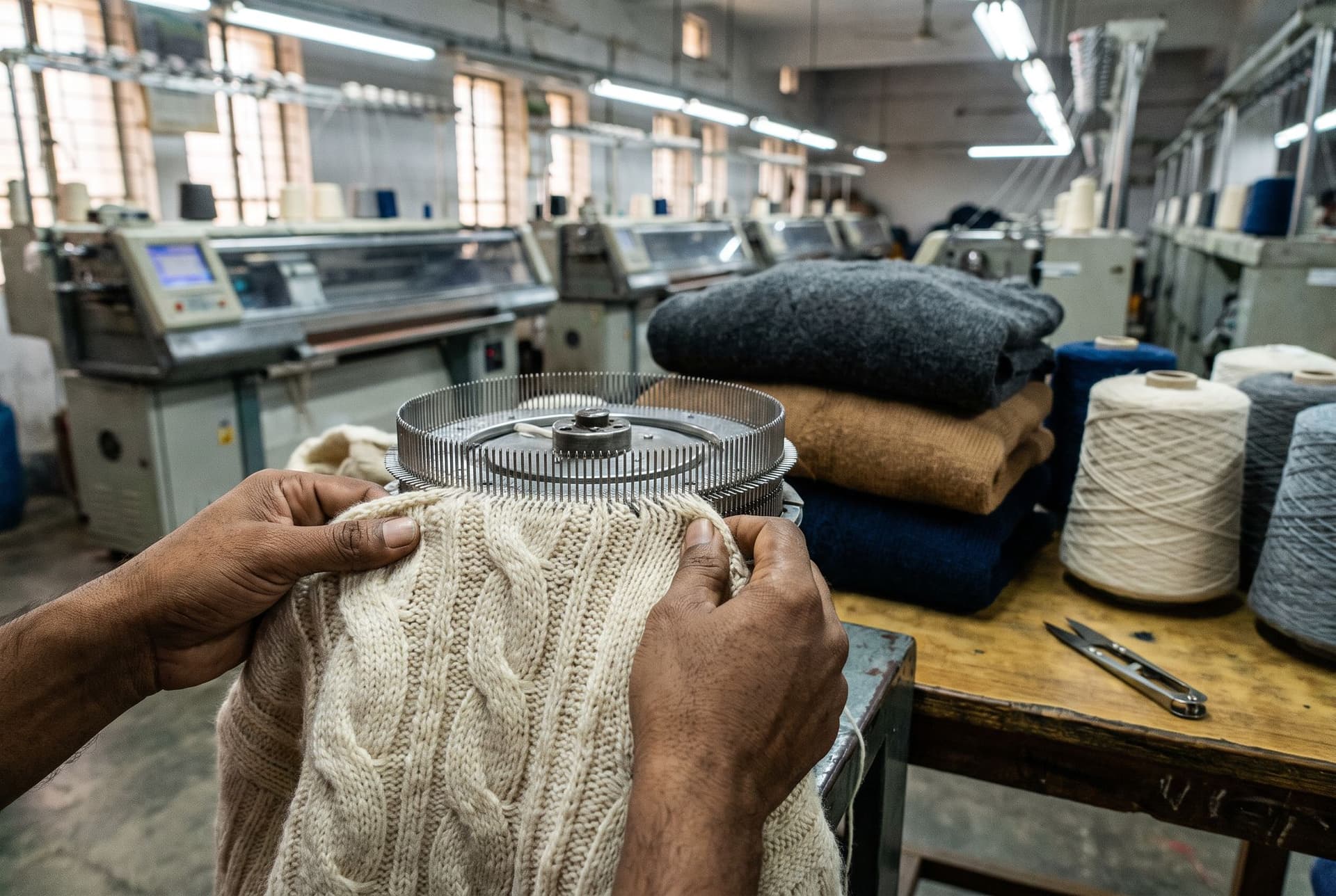
Flat-knitting is a trade of its own, so sweaters go to audited partner factories in Bangladesh built for it. They knit crews, cardigans and cable knits in cotton, acrylic blends, merino and lambswool blends, from 3 to 14 gauge. Each style is quoted from its yarn and gauge. Our orders start at 500 pieces per style and colour, with the exact minimum confirmed on your quote; a reference sweater can stand in for a tech pack.
- Typical fabric
- Flat knit 3–14 gauge
- Price
- Quoted per style
- Minimum order
- From 500 pieces per style and colour; the exact minimum is confirmed on your quote
In short
Sweaters are knitted on flat or circular knitting machines, either shaped on the machine or cut and sewn from knitted panels, so they need a specialist factory. We place crews, cardigans, knit polos, cable and jacquard designs in cotton, acrylic blends, merino and lambswool blends, across gauges from 3 to 14. Yarn, gauge and stitch pattern set the price, so each style is quoted on its own. CMB Sourcing Ltd. is a manufacturer and buying house: knitwear (such as T-shirts, polos and hoodies) and caps are made in our own factory, everything else in an audited partner factory, and we manage every order. Our orders start at 500 pieces per style and colour; the exact minimum for sweaters and knitwear is confirmed on your quote.
Minimum order and your quote
- Minimum order
- From 500 pieces per style and colour; the exact minimum is confirmed on your quote
- Price
- Quoted per style, from your tech pack
- Shipping term
- FOB, CIF or DDP, stated on your quote
We quote sweaters per style, from your tech pack or a reference garment, because fabric, weight, decoration, quantity and shipping terms set the price. Decoration, sampling and testing are costed as their own lines, and your quote states the shipping term (FOB, CIF or DDP).
The order cost estimator turns a price per piece into an order total and shows how it splits into fabric, trims and making. Once your quote states the shipping term, the landed cost calculator turns it into a delivered price for your market. Nothing you enter in either tool is sent anywhere.
The delivery date depends on the fabric, the decoration and the season, so it is confirmed in writing with your order, and payment terms are agreed with your quote. See how an order runs and our guide to payment terms in garment manufacturing.
Our orders start at 500 pieces per style and colour. The exact minimum for sweaters is confirmed in writing with your quote, because fabric and decoration change it: a custom dye lot needs more pieces than a stock colour.
Styles available
- Crew, V-neck and turtlenecks
- Cardigans
- Knit polos and vests
- Cable and fisherman knits
- Jacquard and Fair Isle
- Knit dresses and co-ords
- Beanies and scarves
- Kids and baby knitwear
Fabrics and weights
- Cotton and organic cotton yarn
- Acrylic and acrylic blends
- Merino and lambswool blends
- Viscose and nylon blends
- Recycled cotton and polyester yarns
- Fine gauge 12–14GG, mid 7–10GG, chunky 3–5GG
Decoration and finishing
- Fully fashioned shaping and linking
- Jacquard, intarsia and pointelle
- Embroidery and knitted-in logos
- Garment wash and softener finishes
- Anti-pilling treatment
Specifying sweaters and knitwear.
The detail below is what turns a sketch into a garment that arrives as you expected. Send what you have and we fill the gaps with you before sampling.
Put this in your tech pack
- Gauge (3 to 14) and the yarn count, composition and ply
- Knit structure: plain, rib, cable, jacquard or intarsia, with a stitch diagram or a physical swatch
- Panel measurements per size, including body length, chest, armhole depth, sleeve length and neck drop
- Trim details: neckband, cuff and welt depth, and whether the garment is linked or overlocked
- Colour references per yarn, since each colour in a jacquard or intarsia is dyed separately
- Buttons, zips and labels, with placement measured from the shoulder or centre front
- Blocking and finishing notes, including whether the garment is washed or steamed
Free tech pack template: Excel, CSV or print, no email asked
What moves the price
- Yarn: composition and count, with wool, merino and cashmere blends far above acrylic and cotton
- Gauge and stitch complexity, because fine gauges and cables take longer on the machine
- The number of colours, since jacquard and intarsia need separate yarn feeds and more handling
- Linking, which is hand-controlled work and is priced per panel rather than per garment
- Quantity per colour, as each yarn colour carries its own dyeing minimum
What goes wrong with sweaters and knitwear, and how to prevent it.
Every category fails in its own way. These are the problems to plan against on this product, and the checks that catch them before your goods ship.
| Risk | How to prevent it |
|---|---|
| Panels knitted to different tensions | Machine tension is set against an approved swatch, and panels are weighed and measured before linking. |
| Growth or shrinkage after washing | Yarn is wash-tested, the garment is blocked to the approved measurements, and the pre-production sample is measured after the full finishing process. |
| Uneven linking at neck and armhole | Linking is inspected panel by panel, and the sealed sample sets the standard for stitch alignment. |
| Pilling and colour crocking on blends | Pilling and rub-fastness tests are run at an accredited laboratory before bulk approval. |
Knitwear has two meanings in Bangladesh
The word knitwear covers two different industries in Bangladesh, and a quote request needs to say which one it means. In customs terms, knitwear is every garment in chapter 61 of the tariff, which covers clothing knitted or crocheted: t-shirts sit under heading 6109, and jerseys, pullovers and cardigans under heading 6110 of the same chapter. Bangladesh’s export figures count the same way. Export Promotion Bureau data reported by The Daily Star in October 2023 put sweater exports at US$5.94 billion in the 2022-23 fiscal year, within the knitwear category.
On the factory floor, the two meanings usually run on different machines. Cotton Incorporated says sweater machines tend to be flat-bed machines, and describes three ways of making the garment: panels shaped on the machine (full fashioning), whole garments knitted with no cut and sew, or lengths of fabric from which the panels are cut and sewn, which it calls the most common method. Circular machines are also used for cut-and-sew sweaters where a high production rate matters. Flat-bed machines also knit trims such as polo shirt collars. Jersey garments start on circular machines, where needles set around a cylinder knit a continuous tube of fabric that is then cut and sewn: single jersey for t-shirts, piqué for polo shirts, and fleece for hoodies and sweatshirts. Circular machines have a gauge too, and one German maker lists a circular machine that knits piqué, fleece and plain single jersey in gauges from E14 to E60, but that is the knitting mill’s choice. A jersey garment is specified by its fabric construction and weight in GSM, where a sweater is specified by gauge, yarn and stitch.
For a range, that means separate briefs. A jersey t-shirt and a lambswool jumper are specified in different terms and usually knitted on different machines, so a collection with both often needs two factories as well: when a supplier says it makes knitwear, ask which machines it runs. A polo shirt shows the overlap, with a circular-knit piqué body and a flat-knit collar. The jersey side has its own pages, T-shirt manufacturer in Bangladesh, Polo shirt manufacturer in Bangladesh and Hoodie and sweatshirt manufacturer in Bangladesh, and fabric weights and constructions are explained in the Fabric and GSM guide for knitwear: jersey, piqué, fleece and what to specify.
| What differs | Sweaters | Jersey |
|---|---|---|
| Machine | Mostly flat-bed machines; circular machines are also used for some cut-and-sew sweaters | Circular machines, with needles set around a cylinder |
| What comes off it | Panels shaped on the machine, whole garments, or lengths of fabric cut into panels; flat-bed machines also knit trims such as polo collars | A continuous tube of fabric, which is then cut and sewn |
| How you specify it | Gauge, yarn and stitch | Fabric construction and weight in GSM |
| Typical garments | Jumpers, cardigans, knit polos and vests | T-shirts, piqué polo shirts, hoodies and sweatshirts |
Sweaters and knitwear: duty and tax by market
Duty depends on where the garment is sold, not on where it is made. Cotton sweaters and knitwear from Bangladesh enter the UK, the EU, Canada, Australia and New Zealand at 0% under each market’s scheme for least developed countries, with a tax at import that a registered business recovers. The United States gives Bangladesh no preference, so a US buyer pays the normal rate for the tariff line plus the 10% Section 301 tariff on Bangladeshi goods that applies from 24 July 2026. The table gives the position on 25 September 2026; each market page sets out the rules of origin, the paperwork and the labelling in full, with sources.
The EU keeps its 0% rate for three years after Bangladesh leaves the least developed country category, now scheduled for 24 November 2029, so to about November 2032. The tax at import (VAT or GST) is charged on the goods’ import value plus any duty, and each market sets whether freight and insurance count in that value, so cost the landed price with it. Our own orders start at 500 pieces per style and colour, and the exact minimum for sweaters and knitwear is confirmed on your quote. Your quote states the shipping term (FOB, CIF or DDP), and our landed cost calculator turns it into a delivered price for your market.
| Market | Import duty | Tax at import |
|---|---|---|
| United Kingdom | 0% under the Developing Countries Trading Scheme with proof of origin | Import VAT 20%, zero-rated on most children’s clothing |
| European Union | 0% under Everything But Arms with a REX statement, until about November 2032 (three years after graduation); 12% on 6110 20 91 after that | VAT at the member state’s rate |
| United States | 16.5% (HTSUS 6110.20.20, cotton sweaters and pullovers, other), plus 10% Section 301 from 24 July 2026; no preference | No federal sales tax at import; merchandise processing fee applies |
| Canada | 0% under the Least Developed Country Tariff | 5% GST |
| Australia | 0% under the Australian System of Tariff Preferences (50% local-content rule) | GST 10% of the value of the taxable importation |
| New Zealand | 0% under New Zealand’s preference scheme for least developed countries | GST at import |
Sources
Checked . Rules and figures change, so confirm anything that affects your pricing.
Show all 16 sourcesHide the sources
- UK Trade Tariff: Chapter 61, articles of apparel and clothing accessories, knitted or crocheted (headings 6109 and 6110) (opens in a new tab)
- The Daily Star (3 October 2023): Knitwear’s export performance stronger than woven (EPB data: sweater exports US$5.94 billion in FY2022-23; sweaters counted as knitwear) (opens in a new tab)
- CottonWorks by Cotton Incorporated: Knit machinery, flat, circular and seamless (flat-bed machines for sweaters and polo collars; circular machines knit a fabric tube) (opens in a new tab)
- CottonWorks by Cotton Incorporated: Single and double knits (jersey for t-shirts, piqué for polo shirts, fleece for sweatshirts) (opens in a new tab)
- CottonWorks by Cotton Incorporated: Sweater manufacturing basics (flat-bed machines; full fashioning, whole garment and cut-and-sew, the most common method; circular machines also used for cut-and-sew) (opens in a new tab)
- Mayer & Cie: MV 4-3.2 QCe circular knitting machine (piqué, two-thread fleece and single jersey, gauges E14 to E60) (opens in a new tab)
- European Commission, TARIC: measures for 6110 20 91 00 (men’s or boys’ cotton pullovers and jumpers) imported from Bangladesh: 0% tariff preference, 12% third-country duty, simulated 25 September 2026 (opens in a new tab)
- GOV.UK: Developing Countries Trading Scheme, product-specific rules of origin for least developed countries (opens in a new tab)
- GOV.UK: VAT on imports, acquisitions and purchases from abroad (opens in a new tab)
- USITC: Harmonized Tariff Schedule of the United States (general rates checked 25 September 2026) (opens in a new tab)
- Federal Register 2026-15181: USTR notice of actions in the Section 301 investigations (10% on goods of Bangladesh from 24 July 2026) (opens in a new tab)
- Canada Border Services Agency: Guide to the Least Developed Country Tariff (opens in a new tab)
- Canada Border Services Agency: determining duties and taxes (5% GST at import) (opens in a new tab)
- Bangladesh Customs: DFQF Australia (Australian System of Tariff Preferences, rules of origin) (opens in a new tab)
- Australian Taxation Office: GST and imported goods (value of the taxable importation) (opens in a new tab)
- New Zealand Customs Service: Generalised System of Preferences, LDC and LLDC countries (opens in a new tab)
Standards for sweaters and knitwear.
The standards buyers most often ask about in this category. A certificate belongs to the factory or fabric mill that holds it, so we send you the certificates and test reports for the factory and fabric used for your order. The last column says how to check each one yourself.
| Standard | What it proves | Type | How to verify |
|---|---|---|---|
| OEKO-TEX® STANDARD 100 | Every component of a product — fabric, thread, labels, buttons, prints — is tested for harmful substances. | Voluntary standard | Enter the certificate number from the label in Label Check on oeko-tex.com. |
| RWS, RDS and RAF animal fibre standards | Responsible Wool, Responsible Down and Responsible Animal Fiber (mohair, alpaca) standards cover animal welfare and land management, with chain of custody to the finished product. | Voluntary standard | Search the Textile Exchange certified sites database. |
| GRS — Global Recycled Standard | Verifies recycled content (at least 20% to be certified, 50% for an on-product label) and adds social, environmental and chemical requirements for every processing site. | Voluntary standard | Search the Textile Exchange certified sites database. |
| amfori BSCI | Audits working conditions against the amfori Code of Conduct: fair pay, working hours, freedom of association, no child or bonded labour, health and safety, and the management systems behind them. | Voluntary standard | Ask for the amfori audit ID. amfori members can open the full report on the amfori Sustainability Platform. |
| WRAP | Certifies a facility against 12 principles for lawful, humane and ethical production, including legal compliance, forced and child labour, harassment, pay and benefits, hours, health and safety, environment, customs compliance and security. | Voluntary standard | Search the facility name on the certified-facilities list at wrapcompliance.org. |
Quality checks on every order.
Bulk fabric is tested against the approved swatch before cutting, quality is checked on the line, and a final AQL inspection is run on the finished goods. You get the report before you approve shipment. As a buying house, for each style we choose among clothing manufacturers in Bangladesh that specialise in the product, and name the factory to you before production.
Before bulk, and if an inspection fails
- Before bulk: you approve a pre-production sample made in bulk fabric with bulk trims on the production line. It is sealed, and every inspection afterwards is judged against it.
- In writing before cutting: nothing is cut on a verbal go-ahead. The order confirmation you sign off fixes the price, the delivery date the factory has confirmed, the factory’s name and address, the measurement tolerances, and what happens if a date moves on either side.
- If the final inspection fails: nothing ships until you have seen the report and decided. The factory reworks the defective pieces and the lot is re-inspected; or the lot is sorted, so acceptable pieces ship and the rest are reworked or replaced; or, where the fault is fundamental, the goods are remade. Who pays depends on your terms with us and is agreed before production.
- A second check: your own inspector, or an independent firm such as QIMA, SGS, Intertek or Bureau Veritas, is welcome at any stage, and you can come yourself.
Sweaters and knitwear: common questions.
Which countries let me import sweaters from Bangladesh duty-free?
Cotton sweaters and knitwear made in Bangladesh enter the UK, the EU, Canada, Australia and New Zealand at 0% duty under their least developed country schemes, with a DCTS declaration or Form A for the UK, a REX statement for the EU, and local-content rules in Canada, Australia and New Zealand. Flat-knit sweaters are knitted to shape from yarn in Bangladesh, so the origin position is usually clear even where the yarn is imported; ask us to confirm it for your market. The United States gives no preference and charges 16.5% on cotton sweaters under HTSUS 6110.20.20, plus the 10% Section 301 tariff on Bangladeshi goods from 24 July 2026; wool and acrylic blends fall under different lines with different rates, so send the fibre content with your enquiry. The tax at import (VAT or GST) applies everywhere except the US and is recovered by a registered importer. Our landed cost calculator turns your quote into a delivered price.
What does gauge mean in sweater knitting?
Gauge describes how many needles a knitting machine has per inch, and it decides how fine or chunky the knit looks. Low gauges, such as 3 to 5, produce thick, textured knits with visible stitches, ideal for cable and fisherman sweaters and cold-weather styles. Mid gauges around 7 to 10 give a versatile, medium-weight knit used for many everyday sweaters and cardigans. Fine gauges of 12 to 14 create smooth, lightweight knitwear that sits close to the body, often used for merino basics, knitted polos and layering pieces. Gauge works together with yarn thickness, because a fine gauge needs a finer yarn. It also affects cost and speed: chunky knits use more yarn, while fine knits take longer to knit. Share a reference sweater or photos, and we will recommend the gauge and yarn that match the look.
Can you produce jacquard, intarsia and cable knit designs?
Yes. Computerised flat-knitting machines create a wide range of patterns directly in the knit. Jacquard knits two or more colours into a repeating pattern across the garment, often used for Fair Isle and graphic designs, with the unused yarn on the reverse either secured or knitted in. Intarsia places blocks of colour, such as a logo or motif, in specific areas without loose yarn behind them, which gives a cleaner result but takes longer to knit. Cable knits twist groups of stitches to create raised rope patterns and suit lower gauges. Pointelle, rib variations and knitted-in logos are also possible. Each technique affects yarn use, knitting time and price, so we recommend discussing your artwork early. The factory programs the pattern and knits a swatch or sample for approval before bulk production starts.
Which yarn should I choose for a sweater, and how does it change the price?
Yarn is most of a sweater’s cost and almost all of its character. Cotton and organic cotton knit crisp, cool sweaters for spring and autumn ranges. Acrylic and acrylic blends are the lowest-cost route to a warm, soft, easy-care knit and are common in fashion and promotional programmes. Merino and lambswool blends bring warmth, drape and a premium hand-feel at a higher yarn price, and need care labels for hand or wool washing. Viscose and nylon blends add drape and strength to fine-gauge knits. Recycled cotton and polyester yarns, certified under the Global Recycled Standard, give a traceable sustainability claim. Because knitting time rises with finer gauges and heavier yarns cost more per kilogram, the same style in a 12-gauge cotton and a 5-gauge wool blend can differ widely in price. Send us a reference sweater and we will match the yarn and gauge before quoting.
How long does a sweater order take compared with a t-shirt order?
Longer, and the reasons are structural rather than a matter of effort. Yarn is often dyed to order, and yarn dyeing has its own minimums and lead time before knitting can start. Each size of each panel is knitted on a flat-knitting machine, then the pieces are linked and finished, which is slower per garment than cutting and sewing jersey. Sampling also takes longer, because a knitted proto has to be programmed and knitted rather than cut, and each change to gauge, stitch or shaping means a new programme. The practical consequences: settle yarn, gauge and colour before sampling rather than after, order your sweater range earlier in the season than your knit basics, and expect a wash and measurement test on the pre-production sample because knits move more than wovens. Ask for a dated critical path with the quote, so the knitwear delivery is planned, not hoped for.
What is the minimum order for sweaters, and what sets the price?
Our orders start at 500 pieces per style and colour; the exact minimum for your sweater and the shipping term are confirmed on your quote. We publish no prices, because five things set a sweater’s price. Yarn matters most: wool, merino and cashmere blends cost far more than acrylic and cotton. Gauge and stitch complexity come next, because fine gauges and cables take longer on the machine. Every extra colour in a jacquard or intarsia needs its own yarn feed and more handling. Linking is hand-controlled work, priced per panel rather than per garment. And quantity per colour counts, because each yarn colour is dyed separately and carries its own dyeing minimum, so every colour has to reach its quantity on its own. Send a reference sweater or photos with the yarn, gauge and colours, and we will reply with the minimum and price for your exact style within one working day.
What is the difference between fully fashioned and cut-and-sew sweaters?
A fully fashioned sweater has its panels knitted to shape on the machine, while a cut-and-sew sweater is cut from lengths of knitted fabric and then sewn together. Cotton Incorporated describes cut and sew as the most common method: it allows a high production rate and lets the cutter work around fabric defects. Full fashioning widens or narrows each panel by transferring loops to neighbouring needles, which leaves visible fashion marks and, in Cotton Incorporated’s words, provides a better fit and a smoother seam; the shaped panels are then joined by linking, which is hand-controlled work priced per panel. A third route knits the whole garment on the machine with no cutting or linking at all. For a buyer the choice shows in the seams and in the price, so state the method in the tech pack and say whether seams are linked or overlocked.
What US duty applies to wool, cashmere and acrylic sweaters?
US duty on a sweater from Bangladesh depends on the fibre that predominates by weight, and the general rates for the main fibres run from 4% to 32%. On 1 October 2026 the US tariff schedule lists wool sweaters at 16% under 6110.11.00, sweaters wholly of cashmere at 4% under 6110.12.10 and other cashmere sweaters at 16%, cotton at 16.5% under 6110.20.20, and man-made fibre sweaters, which covers acrylic and polyester, at 32% under 6110.30.30. Two lines inside the man-made group are lower: 17% where the garment contains 23% or more wool or fine animal hair by weight, and 6.3% where it contains 30% or more silk. An acrylic sweater with a quarter wool therefore carries a general rate of 17%, not 32%. The 10% Section 301 tariff on goods of Bangladesh, from 24 July 2026, is added to each rate. Send the exact fibre percentages, and have a customs broker confirm the line.
How must a wool or cashmere blend sweater be labelled?
A wool-blend sweater must be labelled with its fibres by name and percentage, and wool carries stricter rules than other fibres in the United States and in Europe. In the US, the FTC requires wool or recycled wool to be disclosed by name and percentage even when it is less than 5% of the garment, where other fibres below 5% are grouped as other fibre; reclaimed wool is called recycled wool; and a speciality fibre such as cashmere may be named only with its percentage, and only where its average fibre diameter does not exceed 19 microns. The FTC allows a 3% tolerance on stated percentages, and none on a single-fibre claim. In the UK and EU, virgin wool and fleece wool are reserved for wool never before incorporated in a finished product, and in a blend that wool must be at least 25% of the weight, with further conditions in Article 8 of Regulation (EU) No 1007/2011.
Related products
Costs and market rules
Ways to work with us
This product is made by one of the clothing manufacturers in Bangladesh we work with as a buying house, and the factory is named to you in writing before production starts.
Guides on this topic
Planning an order of sweaters and knitwear?
Send a tech pack, a sketch or a photo of a garment you like. We reply within one working day with questions or a first costing.
- A reply within one working day
- An enquiry, not an order: you are committed to an order only when you sign the written order confirmation
- Certificates and audit reports shared before production
- AQL final inspection report before you approve shipment
- Your patterns and artwork never shown to or reused for other buyers