Activewear and sportswear manufacturer in Bangladesh
Stretch recovery, flatlock seams and fabric that stays opaque decide activewear. We make it in our own factory in Bangladesh, in polyester–elastane and nylon–elastane for leggings, sports bras, training tees and shorts; have every fabric tested for opacity and colour fastness to sweat. Orders start from 500 pieces per style and colour, with the exact minimum confirmed on your quote.
- Typical fabric
- Interlock, mesh, quick-dry knits
- Price
- Quoted per style
- Minimum order
- From 500 pieces per style and colour; the exact minimum is confirmed on your quote
In short
Activewear stands or falls on stretch recovery and flat, comfortable seams. We make leggings, sports bras, training tees, running shorts and track pieces in our own factory, in polyester–elastane and nylon–elastane knits, recycled polyester and mesh, with flatlock seams and bonded details where they help. Each style is quoted from your tech pack; compression fabrics and bonding add to the price. CMB Sourcing Ltd. is a manufacturer and buying house: knitwear (such as T-shirts, polos and hoodies) and caps are made in our own factory, everything else in an audited partner factory, and we manage every order. Our orders start at 500 pieces per style and colour; the exact minimum for activewear and sportswear is confirmed on your quote.
Minimum order and your quote
- Minimum order
- From 500 pieces per style and colour; the exact minimum is confirmed on your quote
- Price
- Quoted per style, from your tech pack
- Shipping term
- FOB, CIF or DDP, stated on your quote
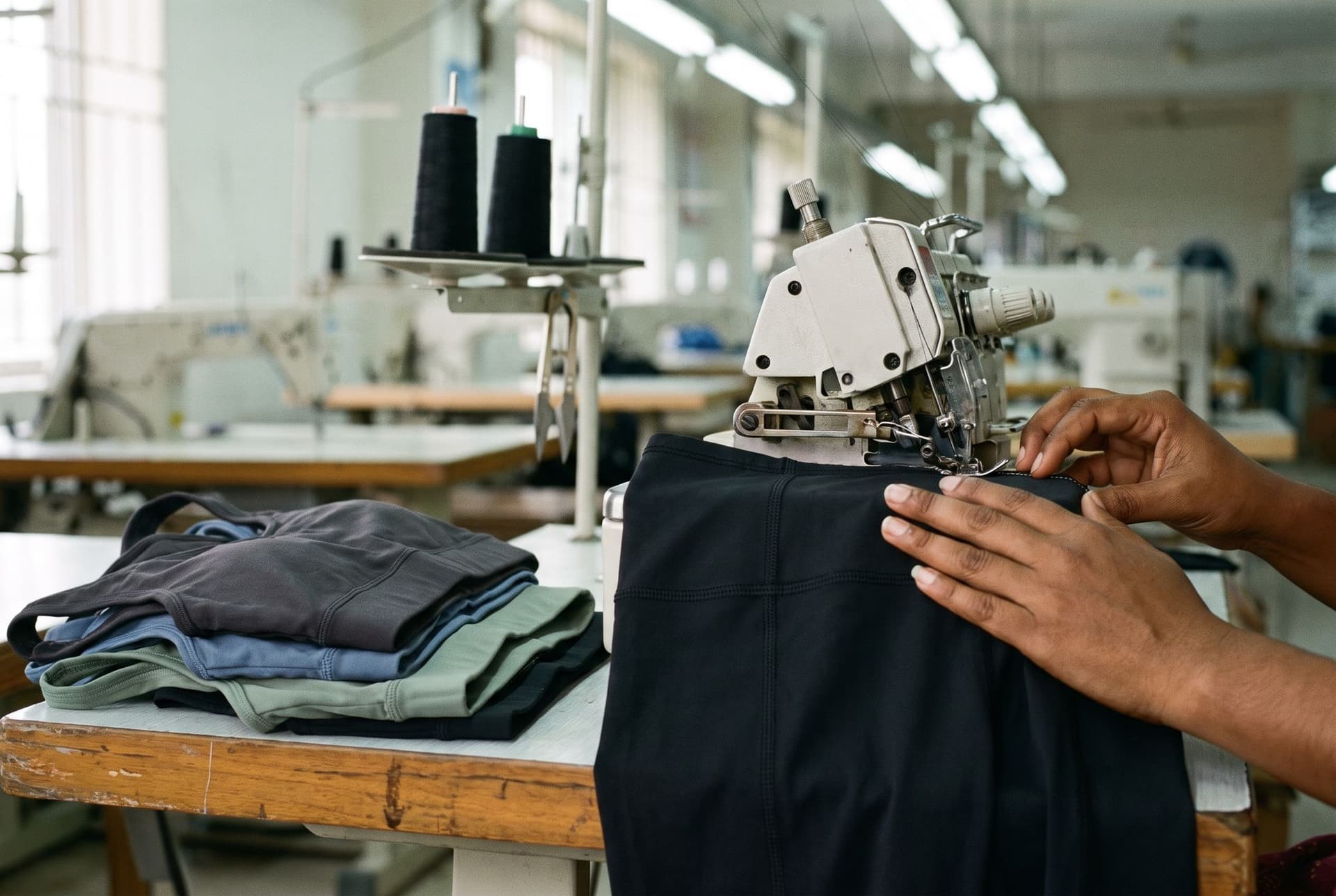
We quote activewear per style, from your tech pack or a reference garment, because fabric, weight, decoration, quantity and shipping terms set the price. Decoration, sampling and testing are costed as their own lines, and your quote states the shipping term (FOB, CIF or DDP).
The order cost estimator turns a price per piece into an order total and shows how it splits into fabric, trims and making. Once your quote states the shipping term, the landed cost calculator turns it into a delivered price for your market. Nothing you enter in either tool is sent anywhere.
The delivery date depends on the fabric, the decoration and the season, so it is confirmed in writing with your order, and payment terms are agreed with your quote. See how an order runs and our guide to payment terms in garment manufacturing.
Our orders start at 500 pieces per style and colour. The exact minimum for activewear is confirmed in writing with your quote, because fabric and decoration change it: a custom dye lot needs more pieces than a stock colour.
Starting a new label or a creator line with fewer pieces? Our sister factory takes runs below our minimum, to support new businesses and creators. Those orders are quoted separately by our sister factory. How small orders work.
Styles available
- Leggings and bike shorts
- Sports bras
- Training tees and tanks
- Running shorts
- Track jackets and pants
- Team kits and jerseys
- Base layers
- Yoga and studio sets
Fabrics and weights
- Polyester–elastane interlock 180–280 GSM
- Nylon–elastane for compression
- Recycled polyester (GRS)
- Mesh and bird’s-eye jersey
- Brushed back and peached finishes
- Moisture-wicking and quick-dry knits
Decoration and finishing
- Flatlock and coverstitch seams
- Sublimation printing
- Heat-transfer and reflective logos
- Bonded hems and laser-cut edges
- Anti-odour finishes
- Hidden pockets and waistband key pockets
Specifying activewear and sportswear.
The detail below is what turns a sketch into a garment that arrives as you expected. Send what you have and we fill the gaps with you before sampling.
Put this in your tech pack
- Fabric composition with elastane percentage, weight in GSM, and the stretch and recovery you need in both directions
- Performance finishes required: moisture wicking, anti-odour, UV protection or brushed inner face
- Seam plan: flatlock, coverstitch or bonded, and which seams must be chafe-free
- Full measurements per size, including relaxed and stretched dimensions for waistbands and cuffs
- Waistband construction: elastic width, whether it is enclosed or exposed, and drawcord detail
- Gusset, pocket and support details, including bra shelf, cups or pad pockets where relevant
- Sublimation or print artwork as vector files with placement across seams if the design is all-over
Free tech pack template: Excel, CSV or print, no email asked
What moves the price
- Fabric: recycled polyester and performance knits cost more than standard jersey, and higher elastane costs more again
- Finishes such as wicking, anti-odour or UV treatments, each applied as a separate process
- Seam type, since flatlock and bonded seams are slower and need specific machines
- Sublimation or all-over printing, which is priced by area and requires panel-by-panel alignment
- Support components: pads, shelf bras, elastics and silicone grippers
What goes wrong with activewear and sportswear, and how to prevent it.
Every category fails in its own way. These are the problems to plan against on this product, and the checks that catch them before your goods ship.
| Risk | How to prevent it |
|---|---|
| Fabric losing recovery, so leggings bag at the knee | Stretch and recovery are laboratory tested before bulk, and wear-tested on the pre-production sample. |
| Sheerness when stretched | Opacity is checked on-body under stretch at the sample stage, and fabric weight is adjusted if it fails. |
| Seams chafing or grinning open | Seam type and stitch density are specified, and seam strength is tested on finished garments. |
| Colour bleeding in sweat or chlorine | Perspiration and, where relevant, chlorine fastness tests are run at an accredited laboratory. |
Making activewear and sportswear in Bangladesh
Bangladesh’s export statistics have no activewear line. US Customs and Border Protection has classified women’s leggings knitted from nylon, polyester and spandex under 6104.63, women’s or girls’ knitted trousers and shorts of synthetic fibres, and a knitted sports bra under 6212.10, brassieres (ruling N321291). In FY2025-26 (July 2025 to June 2026) the Export Promotion Bureau recorded US$346.00 million of exports under 6104.63, about 31% of the US$1.12 billion recorded for the cotton equivalent, 6104.62. Knitted tracksuits, 6112.11 to 6112.19, came to US$26.65 million.
Import statistics show where Bangladesh stands in stretch garments. In 2025 it supplied US$91.2 million of the UK’s US$511.8 million of imports under 6104.63, the subheading that holds leggings, second to China; US$288.6 million of the EU’s US$2.24 billion from outside the Union, third behind China and Cambodia; and US$36.0 million of US$1.95 billion in the United States, under 2%, where Vietnam supplied 34%. In bras, 6212.10, which counts sports bras together with all others, it was second to China in the UK (28%) and the EU (15%) (UN Comtrade, 2025; the shares are our arithmetic). Subheading 6104.63 also holds women’s synthetic knitted trousers and shorts that are not sportswear, and 6212.10 holds every kind of bra, so neither figure measures activewear alone.
The statistics do not show where activewear is sewn. The Mapped in Bangladesh census found most export garment factories in four districts, Dhaka, Gazipur, Narayanganj and Chattogram, but it groups them as knit, woven or sweater rather than by product. For activewear the machine list tells you more than the district: ask for flatlock and coverstitch machines, bonding equipment if your design has bonded hems, and the factory’s recent opacity and stretch recovery test reports.
The fabric is where activewear differs from a cotton tee. Cotton makes up about 80% of the yarn Bangladesh’s mills spin (Bangladesh Textile Mills Association, via the USDA, December 2025), and a significant share of the country’s polyester fibre and yarn demand is still met by imports. Stretch fabric arrives in quantity: China alone reported exporting US$609 million of knitted fabric containing 5% or more elastane (heading 6004) and US$567 million of other synthetic knitted fabric (6006.31 to 6006.34) to Bangladesh in 2025 (UN Comtrade). With imported fabric, the time before cutting includes the overseas mill’s production and the sea or air journey, and the opacity, recovery and colour fastness tests can only start once the bulk rolls arrive.
Full package works when we source the fabric for you, locally or from abroad. CMT suits a brand that already buys a nominated or branded performance fabric and ships it to the factory. Activewear has no minimum of its own: our orders start at 500 pieces per style and colour, and the exact minimum for activewear and sportswear is confirmed on your quote.
Activewear and sportswear: duty and tax by market
Duty depends on where the garment is sold, not on where it is made. Synthetic activewear tops and leggings from Bangladesh enter the UK, the EU, Canada, Australia and New Zealand at 0% under each market’s scheme for least developed countries, with a tax at import that a registered business recovers. The United States gives Bangladesh no preference, so a US buyer pays the normal rate for the tariff line plus the 10% Section 301 tariff on Bangladeshi goods that applies from 24 July 2026. The table gives the position on 25 September 2026; each market page sets out the rules of origin, the paperwork and the labelling in full, with sources.
The EU keeps its 0% rate for three years after Bangladesh leaves the least developed country category, now scheduled for 24 November 2029, so to about November 2032. The tax at import (VAT or GST) is charged on the goods’ import value plus any duty, and each market sets whether freight and insurance count in that value, so cost the landed price with it. Our own orders start at 500 pieces per style and colour, and the exact minimum for activewear is confirmed on your quote. Your quote states the shipping term (FOB, CIF or DDP), and our landed cost calculator turns it into a delivered price for your market.
| Market | Import duty | Tax at import |
|---|---|---|
| United Kingdom | 0% under the Developing Countries Trading Scheme with proof of origin | Import VAT 20%, zero-rated on most children’s clothing |
| European Union | 0% under Everything But Arms with a REX statement, until about November 2032 (three years after graduation); 12% on 6109 90 20 and 6110 30 91 after that | VAT at the member state’s rate |
| United States | 32% (HTSUS 6109.90.10 man-made fibre knit tops; 6110.30.30 man-made fibre pullovers), plus 10% Section 301 from 24 July 2026; no preference | No federal sales tax at import; merchandise processing fee applies |
| Canada | 0% under the Least Developed Country Tariff | 5% GST |
| Australia | 0% under the Australian System of Tariff Preferences (50% local-content rule) | GST 10% of the value of the taxable importation |
| New Zealand | 0% under New Zealand’s preference scheme for least developed countries | GST at import |
Sources
Checked . Rules and figures change, so confirm anything that affects your pricing.
Show all 19 sourcesHide the sources
- Export Promotion Bureau, Bangladesh: export data for July to June 2025-26, file “Product Wise Export (Goods) For The Month of July-June 2025-26” (4-digit and 6-digit HS sheets) (opens in a new tab)
- US Customs and Border Protection ruling NY N321291 (16 September 2021): women’s knit leggings of nylon, polyester and spandex classified in 6104.63; knit sports bras in 6212.10 (opens in a new tab)
- UN Comtrade: imports in 2025 of HS 6104.63 (women’s or girls’ knitted trousers and shorts of synthetic fibres) and 6212.10 (brassieres) reported by the United States, the EU and the UK, from the world, Bangladesh and the other main suppliers (API preview) (opens in a new tab)
- The Business Standard (15 March 2022): Mapped in Bangladesh lists 3,723 export garment factories; most are in Dhaka, Gazipur, Narayanganj and Chattogram districts; factory types recorded as knit, woven, sweater and so on (opens in a new tab)
- USDA Foreign Agricultural Service: Cotton and Products Update, Bangladesh, report BG2025-0013 (2 December 2025): BTMA says local mills meet about 85% of knit fabric demand and about 40% of woven; about 80% of yarn spun is cotton (opens in a new tab)
- The Business Standard (17 September 2026): report on local polyester production; a significant portion of Bangladesh’s polyester fibre and yarn demand is still met through imports (opens in a new tab)
- UN Comtrade: China’s reported exports to Bangladesh in 2025 of HS 6004 (knitted fabric with 5% or more elastomeric yarn, US$609.1 million) and HS 6006.31 to 6006.34 (other synthetic knitted fabric, US$567.2 million) (opens in a new tab)
- European Commission, TARIC: measures for 6109 90 20 00 (synthetic fibre t-shirts and singlets) imported from Bangladesh: 0% tariff preference, 12% third-country duty, simulated 25 September 2026 (opens in a new tab)
- European Commission, TARIC: measures for 6110 30 91 00 (man-made fibre pullovers, men’s or boys’) imported from Bangladesh: 0% tariff preference, 12% third-country duty, simulated 25 September 2026 (opens in a new tab)
- GOV.UK: Developing Countries Trading Scheme, product-specific rules of origin for least developed countries (opens in a new tab)
- GOV.UK: VAT on imports, acquisitions and purchases from abroad (opens in a new tab)
- USITC: Harmonized Tariff Schedule of the United States (general rates checked 25 September 2026) (opens in a new tab)
- Federal Register 2026-15181: USTR notice of actions in the Section 301 investigations (10% on goods of Bangladesh from 24 July 2026) (opens in a new tab)
- Canada Border Services Agency: Guide to the Least Developed Country Tariff (opens in a new tab)
- Canada Border Services Agency: determining duties and taxes (5% GST at import) (opens in a new tab)
- Bangladesh Customs: DFQF Australia (Australian System of Tariff Preferences, rules of origin) (opens in a new tab)
- Australian Taxation Office: GST and imported goods (value of the taxable importation) (opens in a new tab)
- New Zealand Customs Service: Generalised System of Preferences, LDC and LLDC countries (opens in a new tab)
- Coats: About soft and secure seams for activewear and intimates (stitch types 602, 605 and 607; thread used by the flatseam) (opens in a new tab)
Standards for activewear and sportswear.
The standards buyers most often ask about in this category. A certificate belongs to the factory or fabric mill that holds it, so we send you the certificates and test reports for the factory and fabric used for your order. The last column says how to check each one yourself.
| Standard | What it proves | Type | How to verify |
|---|---|---|---|
| GRS — Global Recycled Standard | Verifies recycled content (at least 20% to be certified, 50% for an on-product label) and adds social, environmental and chemical requirements for every processing site. | Voluntary standard | Search the Textile Exchange certified sites database. |
| OEKO-TEX® STANDARD 100 | Every component of a product — fabric, thread, labels, buttons, prints — is tested for harmful substances. | Voluntary standard | Enter the certificate number from the label in Label Check on oeko-tex.com. |
| bluesign® | Controls chemical inputs before they reach production and assesses resource use, worker safety, and water and air emissions. | Voluntary standard | Check the system partner list on bluesign.com. |
| amfori BSCI | Audits working conditions against the amfori Code of Conduct: fair pay, working hours, freedom of association, no child or bonded labour, health and safety, and the management systems behind them. | Voluntary standard | Ask for the amfori audit ID. amfori members can open the full report on the amfori Sustainability Platform. |
| WRAP | Certifies a facility against 12 principles for lawful, humane and ethical production, including legal compliance, forced and child labour, harassment, pay and benefits, hours, health and safety, environment, customs compliance and security. | Voluntary standard | Search the facility name on the certified-facilities list at wrapcompliance.org. |
Quality checks on every order.
Bulk fabric is tested against the approved swatch before cutting, quality is checked on the line, and a final AQL inspection is run on the finished goods. You get the report before you approve shipment. We make it in our own factory, as a clothing manufacturer in Bangladesh for knitwear and caps, so one team answers for sampling, production and inspection.
Before bulk, and if an inspection fails
- Before bulk: you approve a pre-production sample made in bulk fabric with bulk trims on the production line. It is sealed, and every inspection afterwards is judged against it.
- In writing before cutting: nothing is cut on a verbal go-ahead. The order confirmation you sign off fixes the price, the delivery date the factory has confirmed, the factory’s name and address, the measurement tolerances, and what happens if a date moves on either side.
- If the final inspection fails: nothing ships until you have seen the report and decided. The factory reworks the defective pieces and the lot is re-inspected; or the lot is sorted, so acceptable pieces ship and the rest are reworked or replaced; or, where the fault is fundamental, the goods are remade. Who pays depends on your terms with us and is agreed before production.
- A second check: your own inspector, or an independent firm such as QIMA, SGS, Intertek or Bureau Veritas, is welcome at any stage, and you can come yourself.
Activewear and sportswear: common questions.
Which countries let me import activewear from Bangladesh duty-free?
The UK, the EU, Canada, Australia and New Zealand admit activewear made in Bangladesh at 0% duty under their schemes for least developed countries, with the usual proof of origin. Most performance fabric is imported into Bangladesh, so ask us to confirm the origin position for yours: the EU and UK rules for knitted garments are met when the fabric is cut and sewn in Bangladesh, but Australia’s 50% local-content test looks at cost. The United States gives no preference and taxes man-made fibre knits hard: 32% under HTSUS 6109.90.10 for tops and 6110.30.30 for pullovers, plus the 10% Section 301 tariff from 24 July 2026. Bangladesh is scheduled to graduate from least developed country status on 24 November 2029, after the UN General Assembly extended its preparatory period by three years on 29 October 2026, and the EU keeps Everything But Arms for three years after that, to about November 2032.
How do you make sure leggings are not see-through?
Opacity depends on fabric weight, knit structure, yarn and colour, so we check it at several stages. We start with fabrics known for good coverage, typically dense polyester-elastane or nylon-elastane interlock knits, and confirm weight and construction with the mill. Pale colours need extra attention because they show more. At the fit sample stage, leggings are stretched on a model or form in a squat position under bright light, which reveals thin areas that do not show when the fabric is relaxed. Stretch and recovery are tested too, because fabric that overstretches becomes sheer and baggy over time. Once a fabric passes, we lock the approved weight and composition for bulk production and check incoming rolls against it. If your brand wants documented results, opacity and stretch recovery can also be tested at an accredited laboratory.
Is recycled polyester as good as virgin polyester for sportswear?
For most activewear, recycled polyester performs very similarly to virgin polyester. It is usually made from post-consumer plastic bottles or textile waste, melted and spun into new yarn, and it can be knitted into the same moisture-wicking, quick-drying fabrics. The differences show up mainly in consistency: recycled yarn can vary slightly between lots, which affects dyeing, so shade approval and lot control matter. Have pilling, stretch recovery and colour fastness tested on the chosen fabric at an accredited laboratory before it is approved for bulk, exactly as for virgin polyester. If you want to use the word recycled on your label, the material needs certification to the Global Recycled Standard or the Recycled Claim Standard, with a transaction certificate for your shipment. We only support that claim on your product when the documents are in place.
Can you make sports bras and matching gym sets?
Yes: sports bras, leggings, bike shorts, training tops and yoga or studio sets are all made through us, in polyester-elastane or nylon-elastane knits. A sports bra is the most technical piece in the range. The tech pack should state the support construction, whether a bra shelf, cups or pad pockets, the elastics, the elastane percentage, and the stretch and recovery you need in both directions; nylon-elastane is the usual choice where compression matters. US Customs has classified a knitted sports bra under 6212.10, brassieres, not with knit tops, so give your broker the right line. For a matching set, have the bra and the leggings cut from the same fabric lot and approved against one shade standard, because two dye lots of the same colour can differ visibly side by side. Have the fabric tested for opacity when stretched, stretch recovery and colour fastness to perspiration before bulk, and wear-test the pre-production sample before you approve it.
What is the minimum order for leggings and training tops, and what sets the price?
Our own orders start at 500 pieces per style and colour, and the exact minimum for activewear and sportswear is confirmed on your quote. We publish no prices: a basic piece is a standard polyester-elastane knit in a stock colour without performance finishes or sublimation, and higher elastane content, recycled polyester, moisture-wicking or anti-odour finishes, flatlock and bonded seams, all-over printing and support components such as pads, shelf bras and silicone grippers each add to it and are quoted as separate lines. Full package works when we source the fabric, locally or from abroad; CMT suits a brand that already buys a nominated performance fabric and ships it to the factory. Imported fabric adds the overseas mill’s production and the journey before cutting. Send the fabric direction, the styles and the quantities, and we will confirm the route, the minimum and the price within one working day.
How much does it cost to make sportswear or a tracksuit in Bangladesh?
We publish no prices: your price depends on fabric, weight, decoration, quantity and shipping terms, and we send a first costing within one working day of receiving your styles. Our own orders start at 500 pieces per style and colour, and the exact minimum for activewear is confirmed on your quote. Prices are per piece and per style, so a tracksuit made of a track jacket and matching track pants is priced as two styles, each with its own fabric, trims and making. The things that raise a sportswear price above a basic polyester-elastane style are the same on every style: higher elastane content, recycled polyester, moisture-wicking or anti-odour finishes, flatlock and bonded seams, all-over printing and support components such as pads, shelf bras and silicone grippers, each quoted as a separate line. We have no published cost breakdown for activewear: the 2023 study of Bangladeshi cost sheets we cite for t-shirts, polos and woven shirts did not cover it. Send the styles, the fabric direction and the quantities, and ask for every quote on the same shipping term, FOB, CIF or DDP, so you compare like with like.
What is the difference between flatlock and coverstitch seams on activewear?
A flatlock seam on activewear joins two panels edge to edge so the join lies flat against the skin, while a coverstitch seam laps one layer over another or turns a hem, leaving a slight ridge inside. Thread maker Coats names the three stitch types most used for flat, stretchy seams: type 607, the four-needle flatseam, and types 602 and 605, two-needle and three-needle coverseams. The flatseam is the usual choice for leggings and base layers, where a ridge would chafe, but it is thread-hungry: Coats puts it at over 30 cm of thread for every 1 cm of seam. All three leave needle-thread loops on the underside, which can feel harsh, so name a soft thread in the tech pack. Flatlock needs its own machines and sews more slowly, so it is quoted as a separate line. Use it on seams that sit on skin, and coverstitch on hems.
Are anti-odour finishes on activewear regulated in the EU?
Yes: activewear given an anti-odour or antibacterial finish that works by controlling bacteria is a ‘treated article’ under the EU Biocidal Products Regulation, Regulation (EU) No 528/2012, and Article 58 sets conditions before it can be sold. Every active substance in the finish must be on the EU’s list of approved active substances for the relevant product type and use, or in Annex I; Article 94 also allows substances still under examination for that product type in the EU review programme. If you claim a biocidal property, such as ‘antibacterial’, the label must state that the article incorporates biocidal products, give the property where it is substantiated, name every active substance, mark nanomaterials with ‘nano’ in brackets, and carry any instructions for use. A consumer who asks is entitled to information on the treatment within 45 days, free of charge. Ask the mill for the finish’s active substance before sampling, and have your compliance adviser confirm the claim.
How do I prove a moisture-wicking or quick-dry claim on activewear?
A moisture-wicking or quick-dry claim on activewear is proved with a laboratory report on the bulk fabric to a named test method, not with a mill’s description. Three AATCC methods cover the property. TM195 measures and classifies the liquid moisture management properties of knitted, woven and nonwoven fabrics. TM197 measures vertical wicking rate: how fast a hanging strip of fabric carries liquid along it. TM201 measures drying rate, with a set volume of water applied to fabric in contact with a plate heated to 37 °C. Ask for results before and after a stated number of washes, because wicking is usually a finish applied as a separate process. Test the bulk lot, not the lab dip: with imported performance fabric the tests can only start once the bulk rolls arrive. Put the method, the wash count and the pass level in the tech pack, and keep the report beside the claim.
How are stretch and recovery tested on leggings fabric before bulk?
Stretch and recovery on leggings fabric are measured with ASTM D2594, the test method for stretch properties of knitted fabrics having low power. It gives two results: fabric stretch, measured when a known load is applied, and fabric growth, measured after a known extension is applied and removed. Growth is the figure behind leggings bagging at the knee, so agree a limit for it in both directions and write it into the tech pack beside the elastane percentage. Two cautions come from ASTM itself. The method suits fabrics with high stretch and good recovery from low tension; fabrics intended for support are better tested with D4964 or D6614. And ASTM does not recommend D2594 for accepting commercial shipments, because precision between laboratories is poor, so test the approved sample and the bulk lot in the same laboratory. A wear test on the pre-production sample then confirms what the numbers say.
Related products
Costs and market rules
Ways to work with us
We make this in our own factory. Products we do not make ourselves go to one of the clothing manufacturers in Bangladesh we work with as a buying house, named to you in writing before production starts.
Guides on this topic
Planning an order of activewear and sportswear?
Send a tech pack, a sketch or a photo of a garment you like. We reply within one working day with questions or a first costing.
- A reply within one working day
- An enquiry, not an order: you are committed to an order only when you sign the written order confirmation
- Certificates and audit reports shared before production
- AQL final inspection report before you approve shipment
- Your patterns and artwork never shown to or reused for other buyers