Also inDeutschEspañolČeštinaItalianoFrançaisDanskNederlandsPolskiSvenska한국어Português日本語Română
OEM and ODM apparel manufacturing in Bangladesh
OEM: we make exactly to your specification, knitwear and caps in our own factory and other products in partner factories. ODM: we propose styles, fabrics and trends, and develop them into your range.
- Shipping terms
- FOB, CIF, DDP
- Ships from
- Chattogram sea port, Dhaka airport
- Quality control
- Inline checks and AQL final inspection
- Minimum order
- From 500 pieces per style and colour
In short
OEM means the garment is made exactly to your specification, in our own factory for knitwear and caps or in a partner factory for other products; ODM means we propose styles, fabrics and trends and develop them into your range. Established brands with full tech packs usually want OEM. Buyers who want development support, or a ready concept to put their name on, want ODM. Both end in the same production, inspection and shipping process. For either, orders with CMB Sourcing Ltd. start at 500 pieces per style and colour, higher in some categories.
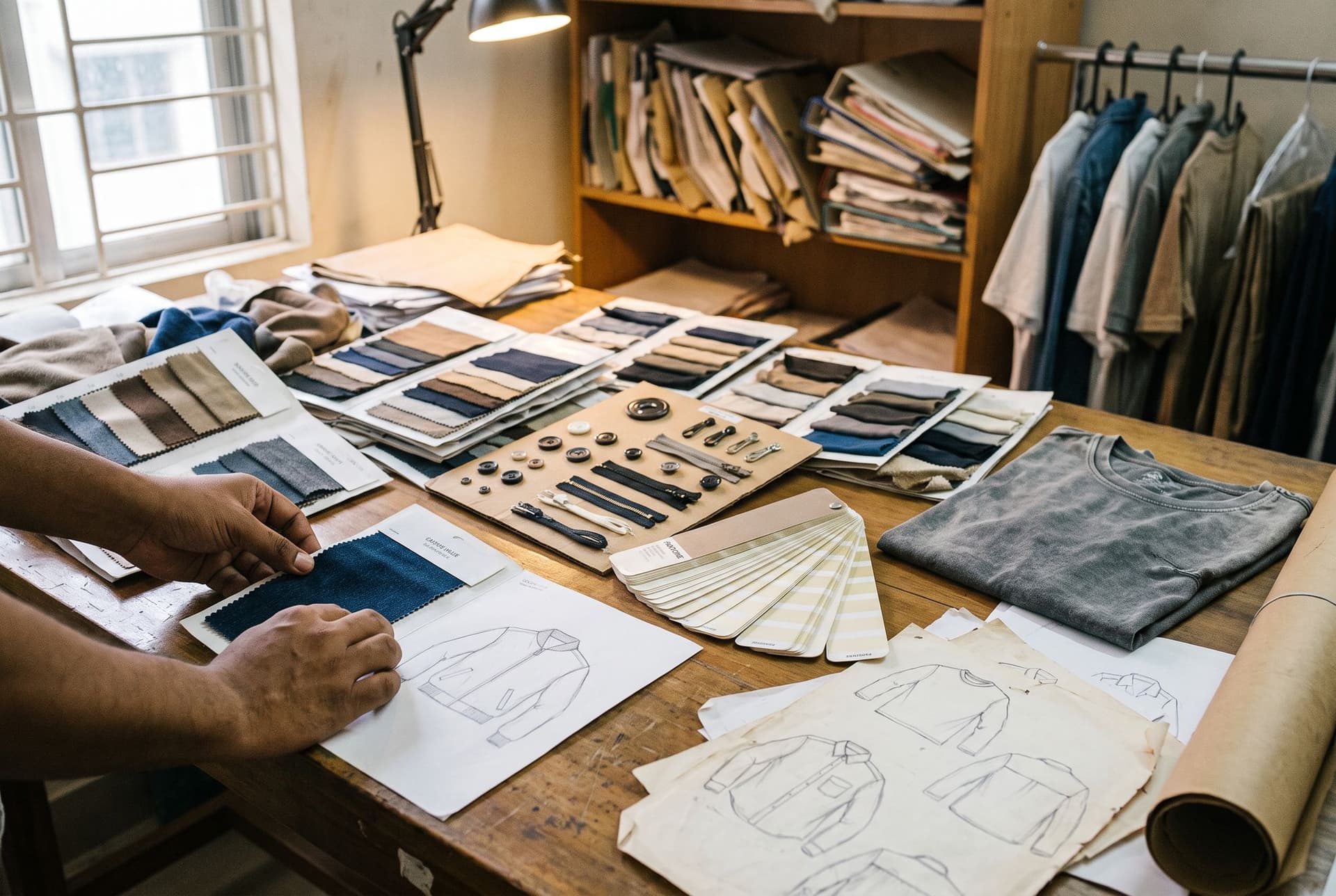
Worked example: one zip hoodie, as OEM and as ODM
As OEM, you send a tech pack for the hoodie: flat drawings, a measurement chart with tolerances for every size, the fabric composition and weight, the zip and other trims, artwork with its placement, and your label and packing instructions. The quote itemises pattern making, grading and each sample stage, then gives a price per piece once the specification is fixed, with any testing your buyer requires as its own line. The pattern is made from your specification and belongs to you.
As ODM, you send a brief instead: the market, the price position, the season, the target customer and the quantity you expect. You receive style and fabric proposals with costing options at different price points, and the development work is quoted before it starts. Once you choose a style and confirm the order, production, inspection and shipping run exactly as they do on an OEM order.
Either way, the minimum counts per style and per colour. Hoodies start at 500 pieces per style and colour.
- You send (OEM): a complete tech pack, and approval of the fit sample
- You send (ODM): a brief, then your choice of styles and comments on each development round
- The quote shows: development cost itemised, then the price per piece for production
- Both end with: inline checks, an AQL final inspection, export documents and proof of origin
Sources
Checked . Rules and figures change, so confirm anything that affects your pricing.
Who it is for
Established brands with detailed tech packs (OEM), or buyers who want product development support and ready concepts (ODM).
What is included
- Pattern making from your specs or reference garments
- Grading across your size range
- Seasonal fabric and trim libraries (ODM)
- Costing options at different price points
- Compliance documentation per order
How the price works.
What sits inside the number we quote, and what you need to supply for it to hold. Quotes state the shipping term, so you can compare like with like.
What the price covers, and what is quoted separately
- OEM: production to your specification, quoted per piece once the specification is fixed
- ODM: development work quoted separately, then production once you select styles
- Pattern making, grading and sampling, itemised so you can see development cost
- Testing and certification where your buyer requires it
- Inspection, export documents and delivery under the shipping term you choose
What you provide
- For OEM: a complete technical specification and approved fit
- For ODM: a brief covering market, price position, season and target customer
- Volume expectations, so development is aimed at a realistic production route
- Feedback at each development round, which is what keeps a range on schedule
- Clarity on who owns the pattern and design rights, agreed in writing
Where this goes wrong, and how to prevent it.
The common failure points on this model, and the control that catches each one before it costs you money.
| Risk | How it is prevented or handled |
|---|---|
| Development drifting through endless rounds | Agree the rounds and deadlines at the start, and close each round with written comments rather than open-ended discussion. |
| A developed style that cannot be made at your price | We cost the concept before sampling, so the design lands inside your target price rather than being re-engineered later. |
| Ownership disputes over patterns and designs | Ownership is stated in the order confirmation, and your patterns and artwork are never reused for another buyer. |
Choose this model when
- OEM: you have complete tech packs and want them made exactly, at scale
- ODM: you want product development support, from concept boards to a costed range
- You need a supplier who can hold a retailer’s specification and testing manual
- You plan repeat programmes where consistency between seasons matters
Not the right model when
- You want a proven basic quickly, which is private label
- You want to supply your own fabric, which is CMT
- Your quantities are below our minimums, which goes to our sister factory as a small run
How it works.
An approval point at every stage, so you know exactly what you are getting before bulk production starts.
Brief or tech pack review
Development samples and costing options
Range review and selection
Production and inspection
Shipment
What to ask for, in order
A model is only as good as the paper trail behind it. These are the documents to ask for on an order under this model, from the first costing to the shipment, so nothing depends on trust alone.
OEM: a costing against your tech pack, with any specification questions listed
ODM: concept and fabric proposals, then a costed range with a sample plan
Order confirmation with fabric, weight, mill and delivery date
The factory named with its address, audits and certificates, before production
Sample approvals at each stage, then the sealed sample record
The final inspection report, then invoice, packing list, transport document and proof of origin
Read next
- How to write a tech packWhat an OEM order needs from you, with a free template
- Quality control and inspectionAQL, defect classes and what the report contains
- Compliance and factory auditsWhat retail buyers’ compliance teams ask for
How this compares with the other models.
The price you are quoted depends on which model you choose. The same style costs a different amount under each, because each puts different work, and different risk, inside the price.
| Model | You supply | The price covers | Where the risk sits |
|---|---|---|---|
| OEM / ODM (this page) | A full specification (OEM), or a brief (ODM) | Production to spec, or development plus production | Shared: we develop, you approve, our sister factory or a partner factory makes |
| Full package (FOB) | Tech pack or sample | Fabric, trims, production, inspection and export documents; sampling is quoted separately | The supplier carries material risk; you carry freight from the port |
| CMT | Fabric, trims, often the pattern | Cutting, sewing, finishing, packing | You carry fabric quality, shortages and import delays |
| Private label | Your labels, artwork, colour choices | A proven block in your fabric choice; labels, hangtags and packaging are quoted as their own lines | The supplier carries material risk; fit is proven before you start |
| Custom | Your design: sketch, reference or tech pack | Pattern, grading, fabric and trim development, sampling to a sealed sample, production, inspection, export documents | The supplier carries material risk once the sample is sealed; development is quoted per style |
| Small runs | Tech pack or reference; stock fabric preferred | Cut and sew from 150 pieces at our sister factory, priced separately | Our sister factory carries production; we manage and inspect |
| Sampling | Sketch, tech pack or reference | Pattern, grading and each sample stage, quoted per style | Nothing goes to bulk until you have approved a sealed sample |
Products made this way.
Every product category, each with its own page.
Common questions.
Who owns the designs on an OEM or ODM order?
Your brand owns an OEM design from the start, and an ODM style you pay to develop is held for you alone once you confirm the order. On an OEM order, the patterns made from your specification belong to you, and we never show them to or reuse them for another buyer. On an ODM order, we propose the concepts; once you have paid for the development and confirmed the order, the resulting styles, patterns and artwork are kept for your brand and not offered to anyone else. Ownership is stated in the order confirmation. Your patterns and sealed samples stay on file under your name, and digital pattern files and grading can be handed over on request, useful if you later move production. No supplier can make a generic style exclusive; what we promise is that your specific development is never resold.
What should an OEM tech pack include?
A complete tech pack is the fastest route to an accurate price and a first sample that is close to right. Include flat sketches of the front, back and details; a measurement chart with points of measure and tolerances for every size; construction notes such as seam types, stitch density and finishing; and a bill of materials listing each fabric, lining, trim and label with composition, weight and colour references. Add artwork files and placement for prints or embroidery, packing and folding instructions, and any testing or certification your retailer requires. A reference garment helps a great deal, especially for fit. If parts are missing, send what you have. At the sampling stage we can complete the pattern and technical details, and we list any assumptions we make so you can confirm them before sampling starts.
How does ODM development work?
ODM, or original design manufacturing, means the supplier proposes the designs, fabrics and trims and develops them into your range, instead of making to a tech pack you supply. You start with a brief covering the category, target customer, price point, season, expected quantity and any reference images or brands you like. We respond with style proposals, fabric options and trim ideas drawn from current development work, with costing options at different price points, and the development work is quoted before it starts. You choose the directions you like and send comments, and we develop samples for review. At the range review you select the styles to adopt, request changes to fit, colour or detail, and approve final samples before production begins. Costing stays visible throughout, so design decisions are made with the price in view. ODM shortens the path from idea to product, especially for brands without an in-house technical design team.
What is the difference between OEM and ODM clothing manufacturing?
OEM (original equipment manufacturing) means the factory makes your own design exactly to your tech pack; ODM (original design manufacturing) means the supplier proposes the designs and develops them into your range from your brief. The difference is where the design comes from, and it changes what you send, what you pay for and how development runs. For OEM you supply a complete specification: flat drawings, a measurement chart with tolerances, the fabric and trim details, and approval of the fit sample. The quote itemises pattern making, grading and each sample stage, then gives a price per piece once the specification is fixed. For ODM you send a brief covering market, price position, season and target customer, and receive style and fabric proposals with costing options; that development work is quoted separately. OEM suits established brands with full tech packs; ODM suits buyers who want development support. From there, both run through the same production, inspection and export documents.
What is the minimum order for OEM clothing production?
Our OEM and ODM orders start at 500 pieces per style and colour, which is also the minimum for t-shirts and hoodies, and several categories start higher: denim, jackets, woven shirts, workwear and uniforms at 2,000; underwear at 5,000 pieces and socks at 5,000 pairs. For other categories, such as polo shirts, the exact minimum is confirmed on your quote. The minimum counts per colour as well as per style, because each colour is a separate fabric lot, so a style in three colours means three minimums. On an OEM order, pattern making, grading and sampling are itemised on the quote as development cost, separate from the production minimum. On an ODM order, the development work is quoted before it starts, and the styles you select then run at the same minimums. If your quantities fall below these minimums, our low MOQ page describes a separate small-run route.
Is OEM clothing manufacturing the same as full package (FOB) production?
Largely yes: on our orders, OEM and full package describe the same order from two sides. OEM says whose design it is, yours, while full package, often called FOB, says who buys the materials, the supplier. A 2010 World Bank working paper groups OEM, FOB and package contracting as one supplier type: a contractor that sources and finances the fabric and trim and makes to the customer’s specification and design. The same paper keeps the label full package for ODM, where the supplier also designs the product, so ask any supplier what it means by the term. If you supply the fabric yourself, the order becomes CMT, where the paper notes the factory is paid a processing fee, not a price for the garment. On our OEM orders the factory works from your tech pack, we source the fabric and trims, and the quote lists pattern making, grading and sampling separately from the price per piece.
Is ODM the same as private label or white label clothing?
No, ODM is not the same as private label or white label: the three differ in where the garment comes from. A white label garment is finished stock that a seller relabels. A private label garment is cut from a proven block a factory already runs, in your fabric and colour with your labels and packaging; the block is shared, so the same fit can appear under other brands. An ODM style is developed from a brief covering market, price position, season and customer: we propose styles, fabrics and trims with costing options, development is quoted before it starts, and once you have paid for it and confirmed the order, the style is kept for your brand alone. Ask three things of any ODM offer: does the pattern already exist, who else can buy it, and what is charged for development. Either way, our orders start at 500 pieces per style and colour, higher in some categories.
Is OEM a clothing brand, and what does OBM mean?
No, OEM is not a brand. In clothing, OEM stands for original equipment manufacturing: a supplier makes garments to the buyer’s specification and design, and the buyer’s brand goes on the label. A 2010 World Bank working paper on the apparel value chain sets it beside two other models. ODM, original design manufacturing, means the supplier also carries out the design. OBM, original brand manufacturing, means the manufacturer sells products under a brand of its own. So a garment described as OEM has no brand until yours is sewn in, and the maker’s name need not appear on it: in the United States the label carries the name or RN of a business handling the garment, with the country of origin shown as well. CMB Sourcing Ltd. works on an OEM and ODM basis, in its own factory for knitwear and caps and in audited partner factories for other products, and sells no retail stock or single pieces.
Who is responsible for fit on an OEM order: my brand or the factory?
On an OEM order your brand is responsible for the fit it specifies and approves, and the supplier is responsible for making bulk match it. The dividing line is the sealed sample. You supply the measurement chart with tolerances and approve the fit sample; the pre-production sample is then made in bulk fabric and sealed, and the final AQL inspection is judged against it. If bulk falls outside the agreed tolerances, that is a production fault: the report reaches you before shipment, and goods that cannot be made acceptable are not shipped. If bulk matches the sealed sample and customers still find it tight or short, the specification was wrong, which is a design decision. So test before you seal: try the fit sample on real wearers and check the size set at both ends of the range. On an ODM style we propose the pattern, but your approval carries the same weight.
Related services
Guides on this topic
Tell us what you want to make.
CMB Sourcing Ltd. is a knitwear manufacturer and buying house in Narayanganj, Dhaka. Send a tech pack, a sketch or a photo of a garment you like, and we reply within one working day with questions or a first costing.
- A reply within one working day
- An enquiry, not an order: you are committed to an order only when you sign the written order confirmation
- Certificates and audit reports shared before production
- AQL final inspection report before you approve shipment
- Your patterns and artwork never shown to or reused for other buyers