In short
Clothing from Bangladesh keeps entering the EU at 0% duty until about November 2032: the UN moved its LDC graduation to 24 November 2029, and Everything But Arms runs three years beyond that. Afterwards, on current trade shares, most garments would pay 12%. The years between are for planning, not panic.
Want a costing for your own style? Send us your enquiry
Clothing made in Bangladesh keeps entering the European Union at 0% duty until about November 2032. On 29 October 2026 the UN General Assembly moved Bangladesh’s graduation from the Least Developed Country (LDC) category from 24 November 2026 to 24 November 2029,1 and the EU’s Everything But Arms scheme continues for three years after graduation.6 China pays 12% on a cotton T-shirt, so for six more years Bangladesh keeps a 12-point head start on it. What a brand does with those years decides what its costs look like when they end.
This guide explains what was decided and why, what EU law says happens next, how Bangladesh compares with the other countries Europe buys clothing from, what nobody knows yet, and a plan for each year. It is written for sourcing teams. The sources are open so that students, journalists and researchers can check every line. For the same dates market by market, from Canada to Japan, see our LDC graduation guide.
The short answer
| Question | Answer |
|---|---|
| When does Bangladesh graduate? | 24 November 2029 (it was 24 November 2026) |
| EU duty on clothing from Bangladesh today | 0% under Everything But Arms (EBA), with a statement on origin from a registered (REX) exporter |
| Until when? | About November 2032: EBA ends only after a three-year transition counted from graduation |
| EU duty without a preference | 12% on most garment codes (6.5% on bras) |
| United Kingdom | 0% under the Developing Countries Trading Scheme, unchanged to November 2032; then Enhanced Preferences if Bangladesh qualifies as economically vulnerable |
| Switzerland | 0% from any country: Switzerland abolished its industrial tariffs on 1 January 2024 |
| Do orders placed now change? | No, as long as the goods meet the origin rules and the paperwork is right |
What did the UN decide on 29 October 2026, and why?
The UN graduates a country from the LDC category when it meets at least two of three tests (income, human assets and economic vulnerability) at two reviews in a row. Bangladesh met all three in 2018 and again in 2021, and the General Assembly gave it a five-year preparatory period ending on 24 November 2026.4
In February 2026 Bangladesh asked for three more years. In July the UN Economic and Social Council passed the request to the General Assembly without a recommendation of its own.5 On 29 October the Assembly adopted draft resolution A/81/L.8, introduced by Uruguay on behalf of the Group of 77 and China, which extends the preparatory period “on an exceptional basis” by three years, to 24 November 2029. Nepal received the same.2321
The resolution gives its reasons. It cites recent conflicts and the disruption they caused to energy and supply flows, the lingering effects of earlier shocks, uncertainty in global trade and long-standing domestic vulnerabilities. It also notes the UN Committee for Development Policy’s view that Bangladesh’s recent political transition merits consideration. In return it invites Bangladesh to advance domestic reforms, to carry out its national smooth transition strategy with the support of the UN and its trading partners, and to report on that work every year to the Committee.21
Two things matter for buyers. This is a delay, not a reversal: Bangladesh still graduates. And the resolution makes the extra years conditional on reform, so the years are there to prepare, for the country and for the brands that buy from it.
What does EU law say happens to the duty?
The EU’s trade preferences for developing countries are set by a new law, Regulation (EU) 2026/1395, which applies from 1 January 2027.67 It has three tiers, and Bangladesh will pass through them in this order.
Everything But Arms: 0%, to about November 2032
EBA gives Least Developed Countries duty-free, quota-free access for everything except arms.8 Under Article 17(2), a country that stops being an LDC is removed from EBA only after a transitional period of three years from the date it stopped qualifying. Counted from 24 November 2029, that is about November 2032. The European Commission had said EBA would continue “at least until the end of 2029”;7 that was written before the extension and is now a floor, not an end date.
The EU’s tariff database shows the difference: 0% for Bangladesh, against a third-country duty of 12% on cotton T-shirts (6109 10 00 10) and on men’s cotton denim trousers (6203 42 31 00).910
Standard GSP: 9.6% on a 12% line
After EBA, a country normally falls back to the standard Generalised Scheme of Preferences (GSP), which cuts the duty on garments by a fifth: 9.6% instead of 12%. Knitted clothing (HS chapter 61) and woven clothing (chapter 62) are treated alike, because both sit in product section S-11b. A claim still repeated online, that knitwear would pay 9.6% and wovens 12%, does not match the Regulation.
The origin rule also tightens. Outside EBA, the EU’s rules for garments generally require double transformation: the fabric must be knitted or woven in the country as well as sewn into the garment, so a garment sewn from imported fabric would not qualify for 9.6% at all.
GSP+: 0%, with conditions
GSP+ removes the duty altogether for countries that ratify and apply a list of international conventions on human rights, labour rights, the environment and good governance, and that submit a plan of action and binding undertakings with their application. The old import-share test, under which a country’s GSP exports to the EU had to be below 9% of those from all beneficiaries, is gone, and the Regulation says the criteria were eased so that more graduating LDCs can qualify. A diversification test remains: a country qualifies as vulnerable only if its seven largest product sections make up more than 75% of its GSP-covered exports to the EU. Countries that have GSP+ today must apply again under the new law.7
The catch: the 37% textile safeguard
Two rules take garment preferences away from a country that supplies too large a share. Under Article 8, standard GSP on a product section is suspended for a country whose imports of that section average more than 37% of EU imports of the same products from all beneficiary countries over three years, reviewed every three years. Under Article 33, each year the Commission must also remove standard GSP and GSP+ preferences on the section for a country above 37% in a calendar year (point 3 of Annex IV). Article 33 does not apply to a country supplying 6% or less of total EU imports of those products; Bangladesh supplies about a fifth.
Clothing sits in section S-11b, which covers clothing and made-up textiles (HS chapters 61 to 63). On Eurostat figures, Bangladesh supplied about 49% of EU imports of that section from the beneficiary countries listed in the Regulation in 2023 to 2025: €56.3 billion of €114.8 billion, by our calculation. The share that counts is the one measured after Bangladesh leaves EBA, but on today’s trade its garments would lose both GSP rates and pay the full 12%.
So the plain reading of EU law is this: 0% to about 2032 is settled; what follows is not, and on current numbers it is 12%, unless something new is agreed.
Where does Europe buy its clothing?
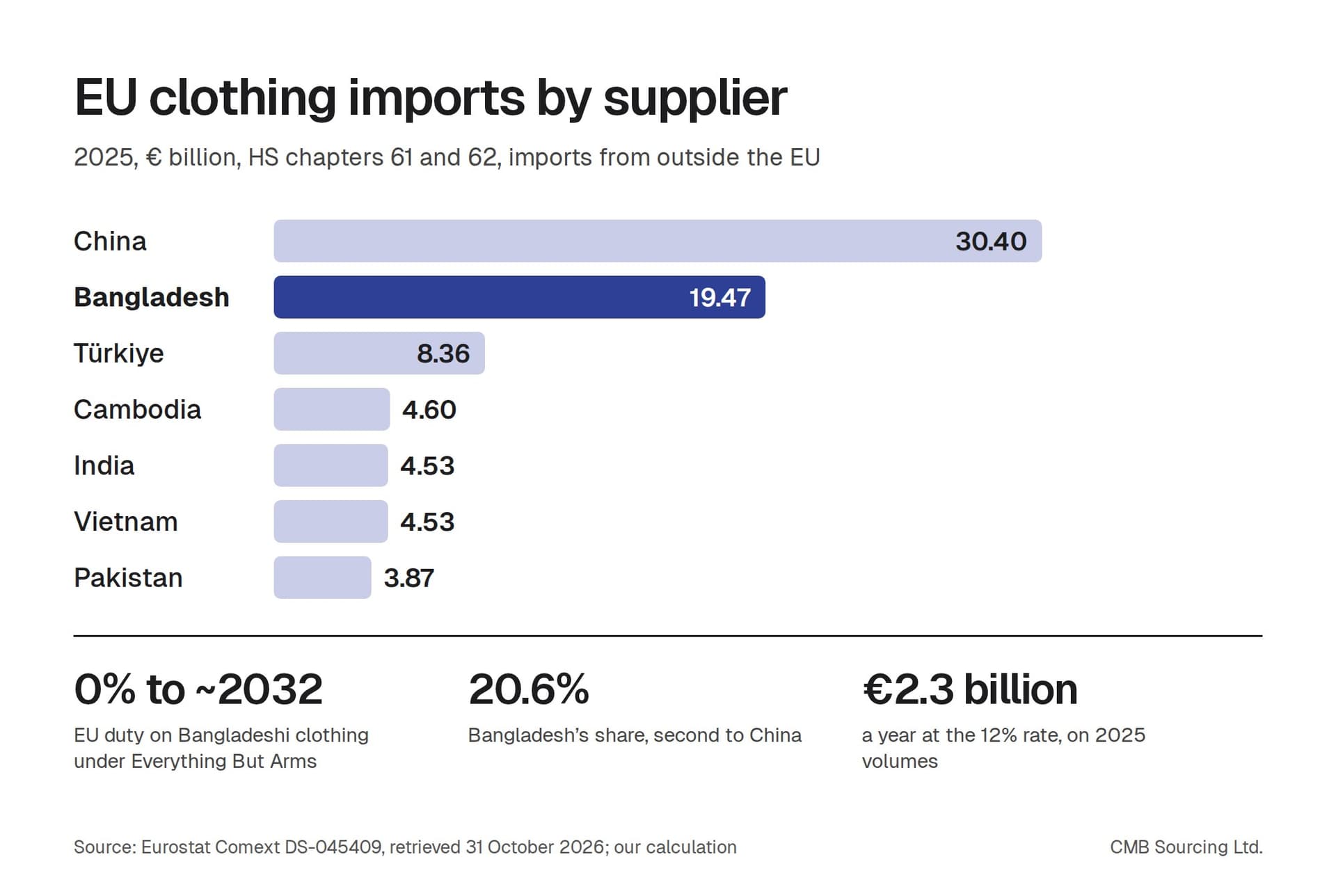
Our calculation from Eurostat’s Comext database, of EU imports of clothing (HS chapters 61 and 62) from outside the EU:11
| Supplier | 2023 | 2024 | 2025 | Share of 2025 | Change 2023 to 2025 |
|---|---|---|---|---|---|
| China | 24.27 | 27.73 | 30.40 | 32.1% | +25.2% |
| Bangladesh | 17.45 | 18.32 | 19.47 | 20.6% | +11.6% |
| Türkiye | 9.99 | 9.35 | 8.36 | 8.8% | −16.4% |
| Cambodia | 3.38 | 3.97 | 4.60 | 4.9% | +35.9% |
| India | 4.11 | 4.19 | 4.53 | 4.8% | +10.3% |
| Vietnam | 3.96 | 4.06 | 4.53 | 4.8% | +14.5% |
| Pakistan | 3.17 | 3.54 | 3.87 | 4.1% | +22.2% |
| All countries outside the EU | 85.78 | 90.05 | 94.60 | 100% | +10.3% |
Source: Eurostat Comext, dataset DS-045409, reporter EU27_2020, imports, value in euros, products 61 and 62, retrieved 31 October 2026. The totals, shares and changes are our sums and arithmetic on the published values, worked from the unrounded figures. You may reuse the table with a link to this page. UN Comtrade, which counts in US dollars, gives a slightly different split for 2025 (China 29.5%, Bangladesh 21.6%, as our EU guide shows); the ranking is the same.
One euro in five that the EU spends on clothing from outside the EU goes to Bangladesh. If all of it paid the full 12%, the duty would come to roughly €2.3 billion a year at 2025 volumes (our arithmetic; the rates differ slightly by code). That is the size of what the extension protects, and of what is at stake after 2032.
On what terms does each country ship to the EU?
| Country | Duty on most garments | What has to happen locally |
|---|---|---|
| Bangladesh | 0% under EBA, to about November 2032 | Single transformation: cutting and sewing from imported fabric can qualify |
| China | 12% | No preference |
| Türkiye | 0% in the EU–Türkiye customs union, on an A.TR movement certificate | Goods in free circulation in Türkiye |
| Vietnam | 0% on garments under the EU–Vietnam Free Trade Agreement, in force since 1 August 2020; TARIC shows 0% on the T-shirt and denim codes since 1 January 202515 | Fabric generally made in Vietnam, the EU or an eligible partner |
| India | 9.6% under standard GSP; an EU–India agreement was concluded on 27 January 2026 but is not yet in force13 | The agreement is reported to require double transformation for apparel14 |
| Cambodia | 0% on most garments; the EU withdrew EBA from some garment and footwear lines in 2020 over human rights16 | Single transformation where EBA applies |
| Pakistan | 0% under GSP+ today; under the new Regulation it keeps GSP+ only to 31 December 2028 unless it applies again | Double transformation, under the GSP origin rules |
Our guide to rules of origin explains single and double transformation, and Bangladesh, Portugal or Türkiye compares the European options.
Want the landed cost for your market?
We quote FOB, CIF or DDP and ship from Chattogram by sea or Dhaka by air. Tell us your market and quantity and we include shipping in the quote.
Why is this an opportunity for European brands?
Bangladesh’s advantage in Europe is not only the 0%. It is 0% with a single-transformation rule. A garment cut and sewn in Bangladesh from imported fabric can still qualify. Vietnam’s agreement, and India’s once it is in force, give 0% only when the fabric itself is made locally or in an approved partner. For a brand that wants a particular imported fabric, Bangladesh is, until about 2032, the largest source of clothing that reaches the EU duty-free without a fabric-origin condition.
- Scale. Bangladesh shipped €19.5 billion of clothing to the EU in 2025, second only to China, and the figure has grown every year since 2023.
- Time to test. Six years is long enough to run several seasons with a supplier, learn who delivers, and build the paperwork habits, such as a REX statement on origin for every EU shipment, that any future agreement will also need.
- The rules point the same way. The EU’s Forced Labour Regulation applies from 14 December 2027 to every product placed on the EU market, whatever its origin.17 Brands that use these years to build traceable supply chains, with named factories and audit reports they have read, will meet it with less work. Our guides on forced labour rules and cotton traceability and the EU due diligence directive cover both.
- A diplomatic track exists. In April 2026 the EU and Bangladesh initialled an 82-article Partnership and Cooperation Agreement, which opens the way to signature and ratification.12 It is not a trade agreement and changes no duty. In August 2026 the specialist news service MLex reported that the European Commission was ready to explore a trade deal with Bangladesh;22 no negotiation had been launched by 31 October 2026.
What should a European brand do, year by year?
| When | What to do |
|---|---|
| Now to the end of 2027 | Put Bangladesh in your range for the styles where duty matters most: cotton jersey, fleece and denim. Check that every EU shipment carries a valid statement on origin. Ask suppliers where each fabric is made. |
| 2027 | Prepare for the Forced Labour Regulation (14 December 2027): a factory list, audit reports you have read yourself, and fabric and yarn traceability for cotton. |
| 2028 and 2029 | Model your margins at 0%, 9.6% and 12% for the years after 2032. Watch whether Bangladesh applies for GSP+ and whether trade talks with the EU begin. Move styles that need local fabric to mills that make it in Bangladesh. |
| 24 November 2029 | Graduation. Nothing changes at the EU border that day: the three-year EBA transition begins. |
| 2030 to 2032 | Decide, on the facts by then, which styles stay. If a new preference or agreement is in place, nothing changes. If not, build the 12% into the price of every season that ships after about November 2032. |
What does the duty mean in money?
Duty is charged on the customs value: the price paid plus freight and insurance to the EU border. For every €100,000 of customs value:
| Scenario | Rate | Duty |
|---|---|---|
| EBA, now to about 2032 | 0% | €0 |
| Standard GSP, if Bangladesh fell below the 37% line and the garment met the stricter origin rule | 9.6% | €9,600 |
| No preference | 12% | €12,000 |
Import VAT is charged on top in every case, and on the duty as well, so a higher duty also raises the VAT. To run your own figures, use the landed cost calculator.
What does nobody know yet?
- The exact end of EBA. The Commission removes a country by a delegated act after the three years, so about November 2032 is the earliest date, not a fixed day.
- Whether Bangladesh applies for GSP+, and whether it qualifies. Even if it does, the 37% textile safeguard would remove the garment preference while its share stays that high.
- Whether an EU–Bangladesh free trade agreement is negotiated, and when. No negotiation had been launched by 31 October 2026.
- What the UK applies after November 2032. A country leaving the LDC tier moves to the scheme’s Enhanced Preferences only if it also counts as economically vulnerable, a test of how diversified its exports are; otherwise it moves to Standard Preferences.18
- When the EU–India agreement enters into force, and how its fabric rule works in practice.
We will update this page, with the date, when any of these changes.
What about Europe outside the EU?
- United Kingdom: 0% under the DCTS Comprehensive Preferences, unchanged for three years after graduation, to November 2032, then Enhanced Preferences if Bangladesh qualifies. Our UK import duty guide compares supplier countries.
- Switzerland: no industrial tariffs on clothing from any country since 1 January 2024.19
- Norway: duty-free entry for Least Developed Countries under its GSP.20
Each country has its own guide on our market pages, starting with the one for EU brands.
Who wrote this, and who we are
CMB Sourcing Ltd. is based in Narayanganj, Dhaka. We make knitwear and caps in our own factory, and for everything else, denim and woven garments included, we are a buying house that sources from audited partner factories and names the factory before production. Our own orders start at 500 pieces per style and colour. If you are planning EU or UK production for the years to 2032, send us a tech pack and we will quote it.
Questions buyers ask.
Is clothing from Bangladesh still duty-free in the EU?
Yes. Garments that meet the EU’s rules of origin enter at 0% under Everything But Arms, with a statement on origin made out by an exporter registered in the EU’s REX system. That stays the case until Bangladesh graduates from the Least Developed Country category on 24 November 2029, and for a three-year transition after it, to about November 2032. The UN General Assembly set the new graduation date on 29 October 2026, and Article 17(2) of Regulation (EU) 2026/1395 sets the three years. The duty Bangladesh avoids is 12% on most garment codes, the EU’s third-country rate, and 6.5% on bras. Orders placed now are not affected, provided the origin rules are met and the paperwork is right.
Why did the UN delay Bangladesh’s LDC graduation?
Bangladesh asked for three more years in February 2026. The UN Economic and Social Council passed the request to the General Assembly in July without its own recommendation, and on 29 October 2026 the Assembly adopted draft resolution A/81/L.8, introduced by Uruguay on behalf of the Group of 77 and China, which extends the preparatory period on an exceptional basis by three years, to 24 November 2029. Nepal received the same extension. The resolution cites recent conflicts and the disruption to energy and supply flows, the effects of earlier shocks, uncertainty in global trade, long-standing domestic vulnerabilities and, as the UN Committee for Development Policy noted, the country’s recent political transition. In return it invites Bangladesh to continue its reforms, to carry out its smooth transition strategy with international support, and to report its progress every year to the UN Committee for Development Policy. It is a delay, not a reversal: Bangladesh still graduates.
What EU duty will clothing from Bangladesh pay after 2032?
On current numbers, 12% on most garment codes. After Everything But Arms ends, a country normally moves to the standard GSP, which would charge 9.6% on a 12% line, or to GSP+, which charges 0% for countries that apply a list of international conventions. But Article 33 of Regulation (EU) 2026/1395 removes both preferences on a product section for any country above 37% of EU imports of that section from all beneficiary countries. On Eurostat figures, Bangladesh supplied about 49% of EU imports of that section, clothing and made-up textiles, from those countries in 2023 to 2025. The stricter origin rule outside EBA, which requires the fabric to be made locally too, would also apply. The share that counts is the one measured after Bangladesh leaves EBA, so a fall in that share, or a new trade agreement, would change the answer. Neither is in place today.
Can a factory in Bangladesh use fabric from China and still ship to the EU at 0%?
Under Everything But Arms, yes, for most garments. The EU’s origin rules for Least Developed Countries accept a single transformation: cutting and sewing a garment in Bangladesh from imported fabric is enough to make it Bangladeshi. The exporter must still be registered in the REX system and make out a statement on origin for each shipment, and the factory should keep the fabric and production records that support it. Stricter rules apply elsewhere, and to Bangladesh itself once EBA ends: the standard GSP and GSP+ and the EU’s agreements with Vietnam and, once in force, India generally require the fabric itself to be made locally or in an approved partner country, which is called double transformation. That difference is one of Bangladesh’s main advantages for European brands until about 2032.
Should a European brand move production out of Bangladesh because of LDC graduation?
Not because of graduation alone. The 0% duty under Everything But Arms continues to about November 2032, six more years from today, and orders shipped in that time are unaffected. The sensible use of the years is preparation: build traceable supply chains for the EU Forced Labour Regulation, which applies from 14 December 2027; keep origin paperwork clean; learn which suppliers deliver; and model your margins at 0%, 9.6% and 12% for the years after 2032. Move styles that depend on a stricter origin rule to fabric made in Bangladesh where you can. Then decide nearer the time, on the facts as they stand, whether Bangladesh applies for GSP+, whether trade talks with the EU begin, and what its share of EU imports is.
Sources
Checked . Rules and figures change, so confirm anything that affects your pricing.
Show all 22 sourcesHide the sources
- UN LDC Portal, “Bangladesh graduation status”, checked 31 October 2026 (opens in a new tab)
- The Business Standard, “Bangladesh gets 3 more years before LDC graduation”, 30 October 2026 (opens in a new tab)
- bdnews24, report on the General Assembly decision, 30 October 2026 (opens in a new tab)
- UN General Assembly, resolution 76/8 on the graduation of Bangladesh, Lao PDR and Nepal, 24 November 2021 (opens in a new tab)
- The Business Standard, “UN body leaves Bangladesh’s LDC graduation extension request to General Assembly”, July 2026 (opens in a new tab)
- Regulation (EU) 2026/1395 applying a scheme of generalised tariff preferences (EUR-Lex) (opens in a new tab)
- European Commission, “Questions and answers: the new EU Generalised Scheme of Preferences” (opens in a new tab)
- European Commission, Access2Markets, “Everything But Arms (EBA)” (opens in a new tab)
- EU TARIC, measures for cotton T-shirts (6109 10 00 10) from Bangladesh, 23 September 2026 (opens in a new tab)
- EU TARIC, measures for men’s cotton denim trousers (6203 42 31 00) from Bangladesh, 23 September 2026 (opens in a new tab)
- Eurostat Comext, dataset DS-045409, EU imports of HS 61 and 62 by partner, 2023 to 2025, retrieved 31 October 2026 (opens in a new tab)
- European External Action Service, “EU and Bangladesh pave the way for a closer partnership and more cooperation”, 20 April 2026 (opens in a new tab)
- European Commission, Intellectual Property Helpdesk, “EU–India Free Trade Agreement concluded”, 29 January 2026 (opens in a new tab)
- European Outdoor Group, “EU and India conclude landmark Free Trade Agreement” (opens in a new tab)
- European Commission, “EU–Viet Nam agreements” (opens in a new tab)
- Baker McKenzie, “EU Commission decides to partially withdraw Cambodia’s preferential access to the EU market”, 19 February 2020 (opens in a new tab)
- UNEP Law and Environment Assistance Platform, Regulation (EU) 2024/3015 prohibiting products made with forced labour (opens in a new tab)
- UK government, “Preference tiers under the Developing Countries Trading Scheme (DCTS)” (opens in a new tab)
- Swiss Federal Office for Customs and Border Security, “Abolition of industrial tariffs on 1 January 2024” (opens in a new tab)
- Norwegian Customs, “GSP: Generalized System of Preference” (opens in a new tab)
- UN General Assembly, draft resolution A/81/L.8, “Extension of the preparatory period preceding the graduation of Bangladesh and Nepal from the least developed country category”, 20 October 2026 (opens in a new tab)
- MLex, “EU Commission ready to explore trade deal with Bangladesh”, August 2026 (opens in a new tab)