Sock manufacturer in Bangladesh
A confirmed minimum of 5,000 pairs per style and colour is the starting point for socks made by audited partner sock units in Bangladesh, knitting on computerised machines. Crew, ankle, dress and compression socks come in combed and organic cotton, bamboo viscose and recycled polyester or nylon, with knitted-in logos and linked toes. Send a reference pair with your enquiry if you have one.
- Typical fabric
- Combed cotton, bamboo viscose
- Price
- Quoted per style
- Minimum order
- 5,000 pairs per style and colour
In short
Socks are knitted in one piece on circular sock machines, then linked at the toe, so the yarn blend and the needle count set the quality. Our partner factories make crew, ankle, sport, dress and compression socks in combed and organic cotton, bamboo viscose and recycled polyester or nylon, with knitted-in logos. Each design is quoted per pair from your artwork and yarn. CMB Sourcing Ltd. is a manufacturer and buying house: knitwear (such as T-shirts, polos and hoodies) and caps are made in our own factory, everything else in an audited partner factory, and we manage every order. The minimum order for socks is 5,000 pairs per style and colour.
Minimum order and your quote
- Minimum order
- 5,000 pairs per style and colour
- Price
- Quoted per style, from your tech pack
- Shipping term
- FOB, CIF or DDP, stated on your quote
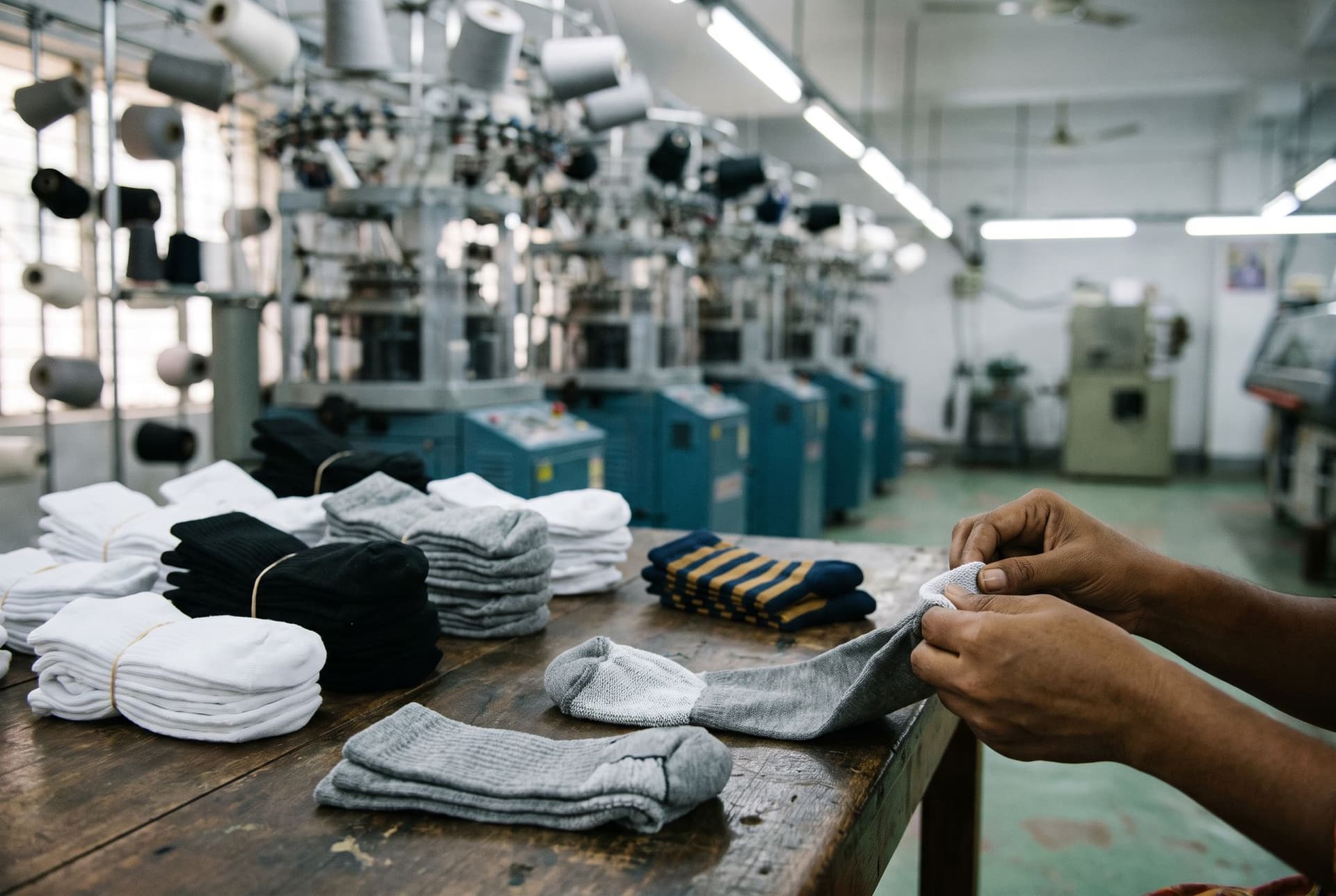
We quote socks per style, from your tech pack or a reference garment, because fabric, weight, decoration, quantity and shipping terms set the price. Decoration, sampling and testing are costed as their own lines, and your quote states the shipping term (FOB, CIF or DDP).
The order cost estimator turns a price per piece into an order total and shows how it splits into fabric, trims and making. Once your quote states the shipping term, the landed cost calculator turns it into a delivered price for your market. Nothing you enter in either tool is sent anywhere.
The delivery date depends on the fabric, the decoration and the season, so it is confirmed in writing with your order, and payment terms are agreed with your quote. See how an order runs and our guide to payment terms in garment manufacturing.
Our sister factory does not take small runs of socks, so there is no small-run route below our minimum of 5,000 pairs per style and colour. The minimum counts per style and colour: three colours of one style means 5,000 pairs of each.
Styles available
- Crew socks
- Ankle and no-show socks
- Sport and cushioned socks
- Dress socks
- Compression socks
- Kids and baby socks with grips
Fabrics and weights
- Combed cotton
- Organic cotton
- Bamboo viscose
- Recycled polyester and nylon
- Merino wool blends
- Elastane for stretch
Decoration and finishing
- Knitted-in jacquard logos
- Terry cushioning in sole and heel
- Hand-linked toes
- Anti-slip grips
- Header cards, bands and multipacks
Specifying socks.
The detail below is what turns a sketch into a garment that arrives as you expected. Send what you have and we fill the gaps with you before sampling.
Put this in your tech pack
- Sock length: no-show, ankle, crew or knee, with the height measured from the base of the heel
- Yarn composition and count, including any elastane, nylon reinforcement or bamboo blend
- Knit gauge and structure, plus terry cushioning zones if required
- Size range in shoe sizes, with the stretched foot length for each size
- Cuff specification: rib type, depth and elastic strength
- Knitted-in logo or jacquard artwork with colour count, or applied branding
- Packing: pairs banded, carded, polybagged or boxed, plus multipack assortment
Free tech pack template: Excel, CSV or print, no email asked
What moves the price
- Yarn: combed cotton, bamboo and recycled yarns sit above standard cotton
- Gauge and the number of colours in the knit, because each colour needs its own feed
- Cushioning and reinforcement zones, which use more yarn and slower machine settings
- Linking and finishing, since hand-linked toes cost more than machine-closed toes
- Packing format, as carded and boxed multipacks add materials and handling
What goes wrong with socks, and how to prevent it.
Every category fails in its own way. These are the problems to plan against on this product, and the checks that catch them before your goods ship.
| Risk | How to prevent it |
|---|---|
| Toe seam bulk causing discomfort | Toe closure method is approved on a worn sample, with hand linking specified where a flat seam matters. |
| Cuffs losing elasticity | Elastic yarn strength is specified and cuff recovery is tested after washing. |
| Pairs mismatched in size or shade | Pairing is checked after boarding, and socks are packed by knitting batch and shade. |
| Holes at heel or toe after limited wear | Nylon reinforcement is specified in high-wear zones and abrasion resistance is tested before bulk. |
Needle count: which machine suits which sock
Needle count is the number of needles round a sock machine’s knitting cylinder. Gauge is the number of needles per inch of the cylinder’s circumference, so the same count gives a finer knit on a smaller cylinder. On one sock-machine maker’s 4-inch men’s machines, 108 needles sits at about gauge 8½ and 200 needles at about gauge 16. The finest settings use needles 0.60 mm thick, against 0.85 mm at coarse settings and up to 1 mm on the same maker’s terry model. More needles round the same circle means smaller stitches, which is why a fine dress sock and a thick cushioned sport sock come off different machines.
The table gathers the ranges two machine makers publish. They are ranges, not rules: one maker says plainly that there are no strict requirements, and that a count chosen for baby socks can make socks for older children if the stitch is loosened and the leg lengthened. What matters for your order is that the approved sample and the bulk are knitted on the same cylinder size and needle count, so ask the factory to write both on the sample record.
| Sock | Needle count or gauge | Machine | Note |
|---|---|---|---|
| Baby socks | 96, 108 or 120 needles | Single cylinder | One maker advises separate machines for baby and adult sizes, for example 120 and 144 needles, because the size difference is too big for one needle count |
| Children aged about 2 to 8 | 84 to 204 needles on a 3-inch cylinder | Double cylinder | The sizes covered depend on the gauge chosen |
| Teenagers | 132 needles | Single cylinder | Listed by one maker as its count for teenagers’ socks |
| Everyday women’s and men’s socks | 144 to 168 needles | Single cylinder, 3½ to 4-inch | One maker lists 144 for women’s or men’s socks and 156 or 168 for men’s |
| Fine men’s socks | 200 needles; 4-inch men’s machines are built up to 240 | Single cylinder with fine needles | One maker lists 200 as its count for quality men’s socks |
| Cushioned terry socks | 84 to 144 needles on a 4-inch cylinder | Single cylinder with a terry device | The terry model takes needles 0.85 to 1 mm thick |
| Ribbed and links socks | Gauge 7 to 22 on 3½ to 4-inch cylinders | Double cylinder | Knits ribs, plain and links patterns for men’s, women’s and children’s socks |
| Medical compression socks, classes 1 to 3 | Gauge 14 to 34 on 4 to 6-inch cylinders | Dedicated single-cylinder medical machine | A separate product on separate machines; ask which compression class the factory knits |
Sock sizes start from foot length
The European size-designation standard for clothing, EN 13402, sizes socks by one body measurement: foot length. Part 2 names foot length as the primary dimension for socks and treats shoe size as a code based on foot length in centimetres, and Part 3, revised in 2017, gives example foot-length tables in an informative annex. In practice, every size on your pack should map to a foot-length range in centimetres as well as to the shoe sizes you print, and the factory should have both in writing before the size set is knitted.
Sizes are also limited by the machine, as the needle-count table above shows. One maker’s electronic machines control size by adjusting the stitch, and its medical models store each item in up to eight sizes, so several sizes can share one cylinder. If your range runs from children’s to adult sizes, ask which sizes share a cylinder and which need another machine.
- The size system printed for each market, such as EU shoe sizes, UK sizes, US sizes or letters, with the foot-length range in centimetres behind each size
- Which sizes are knitted on which cylinder and needle count, recorded on the approved size set
- For children’s socks, the age range and the foot length in centimetres printed next to each size
Labels and packs: what each market asks of socks
Socks are usually sold on a card, a band or in a multipack rather than with a sewn label, and each market’s rules allow for that in its own way. The checklist below goes on your artwork brief; the table after it gives the rule behind each line, from the official guidance in the sources as it stood on 23 September 2026. None of it is legal advice, so confirm the final pack with your compliance adviser or customs broker.
- For the US: “Made in Bangladesh” on the front of the card, band or package, next to the size
- Fibre content with percentages, in English for the US and Great Britain and in the local language for each EU country you sell in
- Care instructions on the card or band when the socks carry no sewn label
- For the US: your company name or registered identification number (RN)
- Barcode type and number for each pack, and who supplies the numbers
| Market | Rule | What it means for the pack |
|---|---|---|
| United States: fibre, origin and company | FTC rules under the Textile Fiber Products Identification Act | Packaged hosiery needs no label on each sock if the package label carries all the required information and it applies to every sock inside. Most socks must show the country of origin in English on the front of the package or label, next to the size, legibly and indelibly; a pack mixing different kinds of goods is exempt from that special rule. Where both socks of a pair have the same fibre content, only one needs a label. |
| United States: care | FTC Care Labeling Rule | Hosiery is exempt from permanent care labels, but care instructions must appear on a hang tag, the package or another conspicuous place. Hosiery retailing at US$3 or less that can be washed and dried at hot settings without damage needs no care label. |
| European Union | Regulation (EU) No 1007/2011 on textile fibre names and labelling | Fibre composition must be labelled or marked durably, legibly and visibly, be clear to the consumer before purchase, including online, and appear in the official language or languages of each Member State where the socks are sold. Socks are not on the list of products allowed a single inclusive label. |
| Great Britain | Textile Products (Labelling and Fibre Composition) Regulations 2012, with the assimilated EU regulation | The fibre label must be in English and be durable, easily legible, visible and accessible. The manufacturer or the importer into the UK is responsible for it. |
Socks: duty and tax by market
Duty depends on where the garment is sold, not on where it is made. Cotton socks from Bangladesh enter the UK, the EU, Canada, Australia and New Zealand at 0% under each market’s scheme for least developed countries, with a tax at import that a registered business recovers. The United States gives Bangladesh no preference, so a US buyer pays the normal rate for the tariff line plus the 10% Section 301 tariff on Bangladeshi goods that applies from 24 July 2026. The table gives the position on 25 September 2026; each market page sets out the rules of origin, the paperwork and the labelling in full, with sources.
The EU keeps its 0% rate for three years after Bangladesh leaves the least developed country category, now scheduled for 24 November 2029, so to about November 2032. The tax at import (VAT or GST) is charged on the goods’ import value plus any duty, and each market sets whether freight and insurance count in that value, so cost the landed price with it. Our own orders for socks start at 5,000 pairs per style and colour. Your quote states the shipping term (FOB, CIF or DDP), and our landed cost calculator turns it into a delivered price for your market.
| Market | Import duty | Tax at import |
|---|---|---|
| United Kingdom | 0% under the Developing Countries Trading Scheme with proof of origin | Import VAT 20%, zero-rated on most children’s clothing |
| European Union | 0% under Everything But Arms with a REX statement, until about November 2032 (three years after graduation); 12% on 6115 95 00 after that | VAT at the member state’s rate |
| United States | 13.5% (HTSUS 6115.95.90, cotton socks, other), plus 10% Section 301 from 24 July 2026; no preference | No federal sales tax at import; merchandise processing fee applies |
| Canada | 0% under the Least Developed Country Tariff | 5% GST |
| Australia | 0% under the Australian System of Tariff Preferences (50% local-content rule) | GST 10% of the value of the taxable importation |
| New Zealand | 0% under New Zealand’s preference scheme for least developed countries | GST at import |
Sources
Checked . Rules and figures change, so confirm anything that affects your pricing.
Show all 22 sourcesHide the sources
- Lonati: GE515H and GE516H men’s sock machines, technical data and needle counts (PDF) (opens in a new tab)
- Lonati: GE516C terry sock machine, technical data and needle counts (PDF) (opens in a new tab)
- Lonati: E1E13H children’s sock machine, 3-inch cylinder, sizes 2 to 8 years (PDF) (opens in a new tab)
- Lonati: DC88X double-cylinder machines for rib and links socks (PDF) (opens in a new tab)
- Lonati: LBE medical machines for class 1 to 3 compression socks (PDF) (opens in a new tab)
- Rainbowe sock machines: needle count by sock type (9 January 2024) (opens in a new tab)
- EN 13402-2:2002 Size designation of clothes, part 2: primary and secondary dimensions (preview) (opens in a new tab)
- EN 13402-3:2017 Size designation of clothes, part 3 (preview) (opens in a new tab)
- US FTC: business guide to the Textile and Wool Act labelling rules (hosiery and socks sections) (opens in a new tab)
- US FTC: complying with the Care Labeling Rule (hosiery exemption) (opens in a new tab)
- Regulation (EU) No 1007/2011 on textile fibre names and labelling, consolidated text (Articles 14, 16, 17 and Annex VI) (opens in a new tab)
- Business Companion (UK Trading Standards): labelling of textiles, reviewed July 2026 (opens in a new tab)
- European Commission, TARIC: measures for 6115 95 00 00 (cotton socks and hosiery) imported from Bangladesh: 0% tariff preference, 12% third-country duty, simulated 25 September 2026 (opens in a new tab)
- GOV.UK: Developing Countries Trading Scheme, product-specific rules of origin for least developed countries (opens in a new tab)
- GOV.UK: VAT on imports, acquisitions and purchases from abroad (opens in a new tab)
- USITC: Harmonized Tariff Schedule of the United States (general rates checked 25 September 2026) (opens in a new tab)
- Federal Register 2026-15181: USTR notice of actions in the Section 301 investigations (10% on goods of Bangladesh from 24 July 2026) (opens in a new tab)
- Canada Border Services Agency: Guide to the Least Developed Country Tariff (opens in a new tab)
- Canada Border Services Agency: determining duties and taxes (5% GST at import) (opens in a new tab)
- Bangladesh Customs: DFQF Australia (Australian System of Tariff Preferences, rules of origin) (opens in a new tab)
- Australian Taxation Office: GST and imported goods (value of the taxable importation) (opens in a new tab)
- New Zealand Customs Service: Generalised System of Preferences, LDC and LLDC countries (opens in a new tab)
Standards for socks.
The standards buyers most often ask about in this category. A certificate belongs to the factory or fabric mill that holds it, so we send you the certificates and test reports for the factory and fabric used for your order. The last column says how to check each one yourself.
| Standard | What it proves | Type | How to verify |
|---|---|---|---|
| OEKO-TEX® STANDARD 100 | Every component of a product — fabric, thread, labels, buttons, prints — is tested for harmful substances. | Voluntary standard | Enter the certificate number from the label in Label Check on oeko-tex.com. |
| GOTS — Global Organic Textile Standard | Organic fibre tracked from farm to finished garment, with environmental and social criteria at every processing stage. | Voluntary standard | Search the GOTS public database of certified suppliers, and ask for the TC for your shipment. |
| GRS — Global Recycled Standard | Verifies recycled content (at least 20% to be certified, 50% for an on-product label) and adds social, environmental and chemical requirements for every processing site. | Voluntary standard | Search the Textile Exchange certified sites database. |
| amfori BSCI | Audits working conditions against the amfori Code of Conduct: fair pay, working hours, freedom of association, no child or bonded labour, health and safety, and the management systems behind them. | Voluntary standard | Ask for the amfori audit ID. amfori members can open the full report on the amfori Sustainability Platform. |
Quality checks on every order.
Bulk fabric is tested against the approved swatch before cutting, quality is checked on the line, and a final AQL inspection is run on the finished goods. You get the report before you approve shipment. The order is placed and followed by our buying house in Narayanganj, Dhaka, from the first sample to shipment.
Before bulk, and if an inspection fails
- Before bulk: you approve a pre-production sample made in bulk fabric with bulk trims on the production line. It is sealed, and every inspection afterwards is judged against it.
- In writing before cutting: nothing is cut on a verbal go-ahead. The order confirmation you sign off fixes the price, the delivery date the factory has confirmed, the factory’s name and address, the measurement tolerances, and what happens if a date moves on either side.
- If the final inspection fails: nothing ships until you have seen the report and decided. The factory reworks the defective pieces and the lot is re-inspected; or the lot is sorted, so acceptable pieces ship and the rest are reworked or replaced; or, where the fault is fundamental, the goods are remade. Who pays depends on your terms with us and is agreed before production.
- A second check: your own inspector, or an independent firm such as QIMA, SGS, Intertek or Bureau Veritas, is welcome at any stage, and you can come yourself.
Socks: common questions.
Which countries let me import socks from Bangladesh duty-free?
Socks made in Bangladesh enter the UK, the EU, Canada, Australia and New Zealand at 0% duty under their schemes for least developed countries, provided the origin paperwork is right: a DCTS declaration or Form A for the UK, a REX statement for the EU, and the local-content rules of Canada, Australia and New Zealand. Socks are knitted to shape from yarn, so the origin position is usually straightforward even when the yarn is imported; ask us to confirm it for your market. The United States gives Bangladesh no preference, so cotton socks pay 13.5% under HTSUS 6115.95.90 plus the 10% Section 301 tariff from 24 July 2026. VAT or GST at import applies everywhere except the US and is recovered by a registered business. Our sock orders start at 5,000 pairs per style and colour, so the duty and tax on one order are worth calculating on the real quantity.
Can our logo be knitted into the socks?
Yes. Most branded socks use jacquard knitting, where your logo or pattern is knitted directly into the sock rather than printed on afterwards, so it lasts as long as the sock itself. The knitting machine reproduces the design as a grid of stitches, so artwork is adapted to the machine’s needle count. Bold shapes and simple text work best, while very fine lines or small lettering can look stepped. Inside the sock, the unused yarn is secured to prevent snagging on toes and heels. Where detail matters more, embroidery on the cuff or printing on the sole are alternatives. Colours are matched to your references with yarn lab dips, and the factory knits a sample for approval so you can see the logo at its real size. Placement options include the cuff, ankle, sole and toe.
Which yarns are best for socks?
Socks need a balance of comfort, durability and stretch, so most use blends rather than a single fibre. Combed cotton is soft, breathable and the most popular choice for everyday socks, usually blended with polyamide for strength and elastane for fit and recovery. Organic cotton works the same way and can carry a GOTS or OCS claim with the right certification. Bamboo viscose feels smooth and cool, while merino wool blends regulate temperature and resist odour, which makes them ideal for hiking and winter socks. Recycled polyester and polyamide suit sports socks and support recycled claims when certified. Construction adds performance too: terry cushioning in the sole, reinforced heels and toes, and hand-linked toe seams for comfort. Tell us how the socks will be worn, and we will recommend a suitable blend and construction.
What is the minimum order for custom socks, and what sets the price?
We publish no prices: a basic pair is a standard combed cotton crew or ankle sock in a stock colour with a simple knitted-in logo, and organic cotton, bamboo viscose, merino blends, terry cushioning, hand-linked toes, anti-slip grips, header cards and multipack packaging each add to it and are quoted as separate lines. Our minimum for socks is 5,000 pairs per style and colour; the knitting programme can set it higher, so a design with several colours or a complex jacquard carries a higher minimum than a plain sock, and sizes are usually limited to two or three. Socks are not one of the categories our sister factory makes in small runs, so orders are placed with a sock knitting unit. Send us the design, the yarn and the packaging and we will confirm the price per pair within one working day.
How are socks sized, and how do you make sure they fit?
Socks are knitted to a stretch fit rather than cut to a measurement, so sizing works differently from garments. Most programmes use two or three sizes covering a range of shoe sizes each, for example small, medium and large, and the knitting programme sets the length of the foot and the leg and the stretch of the welt for each. Fit depends on the yarn, the elastane content and the knitting tension, so each size is sampled on the actual machine and checked for foot length, heel placement and welt recovery on a leg form before bulk. Terry cushioning changes the fit inside a shoe, so a cushioned sock is sampled separately from a flat one. Sizing is printed on the header card or band and knitted into the toe or welt where you want it. Send us the shoe-size range you sell and we will propose the size split and sample each size for approval.
What should I check on a sock sample before approving bulk?
A sock sample should be approved on five checks, each written on the sample record so that bulk can be held to it. First, the machine: the cylinder size and needle count, because the same design knitted on a different count is a different sock. Second, size: the foot length in centimetres behind every size, checked on a leg form with the heel sitting in the right place. Third, the toe: wear the sample, since seam bulk is felt and not seen, and specify hand linking where a flat seam matters. Fourth, the cuff: its recovery after washing, so the sock still stays up. Fifth, durability: abrasion resistance, which has its own European test standard, EN 13770, written for knitted footwear garments such as socks and heavy tights. Have the tests run at an accredited laboratory before bulk, and keep an approved pair in each size as the sealed standard.
Do children’s socks need a tracking label and testing in the US?
Children’s socks sold in the United States are children’s products under the CPSIA when they are designed primarily for children aged 12 or younger, so they need tracking information and a Children’s Product Certificate from the importer, but not a label on each sock. The CPSC’s tracking-label guidance says labels need not be attached to children’s socks; the packaging must still carry the tracking information. Testing depends on what is added to the yarn. Dyed textiles are exempt from lead testing, but surface coatings that harden, such as screen printing, and heat transfer vinyl are not, so printed anti-slip grips need a lead test at a CPSC-accepted laboratory. Customs treats the smallest sizes separately too: babies’ cotton socks and booties, for a body height up to 86 cm, are listed at 8.1% on 1 October 2026, against 13.5% for other cotton socks, each before the 10% Section 301 tariff.
Can you make compression socks in Bangladesh?
Compression socks are among the styles made through our partner factories in Bangladesh, but a firm-fitting sports or travel sock and a medical compression stocking are different products made on different machines. Medical compression socks in classes 1 to 3 are knitted on dedicated medical machines, which one maker builds in gauges 14 to 34 on 4 to 6-inch cylinders, so the first question for any factory is which compression class it knits. The rules differ as well. In the United States, a stocking designed to apply controlled pressure to the leg for a medical purpose is a medical device under 21 CFR 880.5780, and the tariff has a separate subheading, 6115.10, for graduated compression hosiery. Tell us the compression you need, the claim on the pack and the market, and the quote confirms whether the order can be placed. Our minimum for socks is 5,000 pairs per style and colour.
How does the sock minimum work for multipacks and mixed colours?
The sock minimum is counted in pairs per style and colour, not per pack, so every colourway inside a multipack has to reach the minimum on its own. Our minimum for socks is 5,000 pairs per style and colour, which means a three-pack of three different colours starts at 15,000 pairs, or 5,000 packs, while a three-pack of one design in one colour starts at 5,000 pairs. The reason is the knitting programme: each design and colour is set up and run separately, and a complex jacquard can set the figure higher. Sizes are usually limited to two or three, with the split agreed on the quote. Header cards and multipack packaging are quoted as separate lines. For the US, one package label can carry the required information for every sock inside if it applies to all of them, with the country of origin on the front beside the size.
Related products
Costs and market rules
Ways to work with us
This product is made by one of the clothing manufacturers in Bangladesh we work with as a buying house, and the factory is named to you in writing before production starts.
Guides on this topic
Planning an order of socks?
Send a tech pack, a sketch or a photo of a garment you like. We reply within one working day with questions or a first costing.
- A reply within one working day
- An enquiry, not an order: you are committed to an order only when you sign the written order confirmation
- Certificates and audit reports shared before production
- AQL final inspection report before you approve shipment
- Your patterns and artwork never shown to or reused for other buyers