Underwear and loungewear manufacturer in Bangladesh
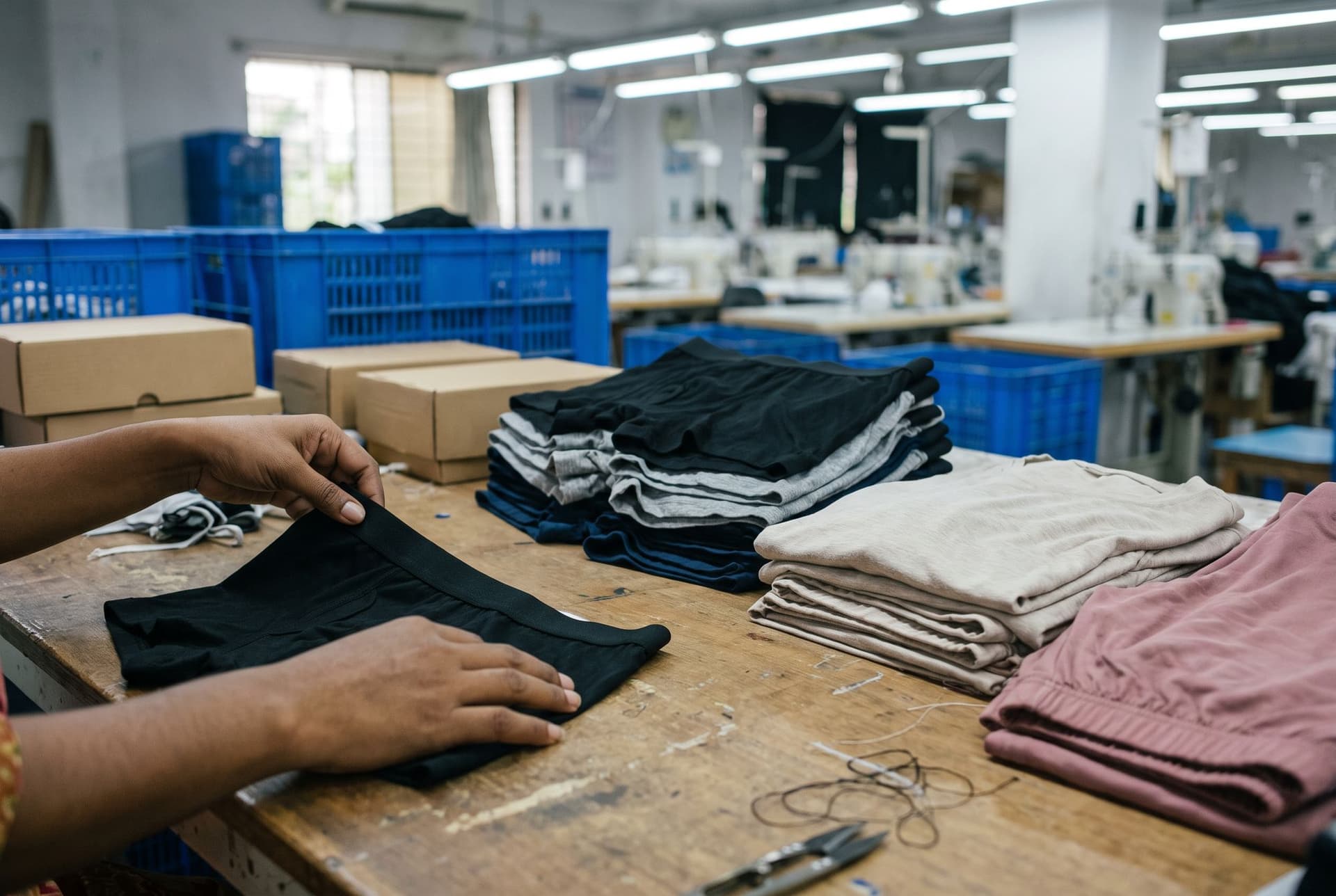
Underwear and loungewear are made in volume: the confirmed minimum for underwear is 5,000 pieces per style and colour. We make boxer briefs, briefs, bralettes and pyjama sets in our own factory in Narayanganj, in cotton–elastane jersey, modal and bamboo viscose. Softness and a waistband that lasts matter most, so have elastic recovery tested after repeated washing.
- Typical fabric
- Rib, modal, jersey
- Price
- Quoted per style
- Minimum order
- 5,000 pieces per style and colour
In short
Underwear is judged next to the skin, so the elastic, the seams and the fibre matter more than the look. We make boxer briefs, briefs, bralettes, pyjama sets and robes in our own factory, in cotton–elastane jersey and rib, modal and micromodal, bamboo viscose and brushed jersey. Waistbands and trims are costed per style, so each one is quoted from your tech pack. CMB Sourcing Ltd. is a manufacturer and buying house: knitwear (such as T-shirts, polos and hoodies) and caps are made in our own factory, everything else in an audited partner factory, and we manage every order. The minimum order for underwear is 5,000 pieces per style and colour.
Minimum order and your quote
- Minimum order
- 5,000 pieces per style and colour
- Price
- Quoted per style, from your tech pack
- Shipping term
- FOB, CIF or DDP, stated on your quote
We quote underwear per style, from your tech pack or a reference garment, because fabric, weight, decoration, quantity and shipping terms set the price. Decoration, sampling and testing are costed as their own lines, and your quote states the shipping term (FOB, CIF or DDP).
The order cost estimator turns a price per piece into an order total and shows how it splits into fabric, trims and making. Once your quote states the shipping term, the landed cost calculator turns it into a delivered price for your market. Nothing you enter in either tool is sent anywhere.
The delivery date depends on the fabric, the decoration and the season, so it is confirmed in writing with your order, and payment terms are agreed with your quote. See how an order runs and our guide to payment terms in garment manufacturing.
Starting a new label or a creator line with fewer pieces? Our sister factory takes runs below our minimum, to support new businesses and creators. Those orders are quoted separately by our sister factory. How small orders work.
Styles available
- Boxer briefs and trunks
- Briefs and bikinis
- Bralettes and camisoles
- Pyjama and lounge sets
- Night dresses and robes
- Thermal base layers
- Undershirts
Fabrics and weights
- Cotton–elastane jersey and rib
- Modal and micromodal
- Bamboo viscose
- Waffle and brushed jersey for lounge
- Organic cotton
- Cotton woven for pyjamas
Decoration and finishing
- Custom jacquard woven waistbands
- Printed and tagless labels
- Flatlock and bonded seams
- Lace trims
- Multipack and retail packaging
Specifying underwear and loungewear.
The detail below is what turns a sketch into a garment that arrives as you expected. Send what you have and we fill the gaps with you before sampling.
Put this in your tech pack
- Fabric composition and weight, including modal, micromodal or rib, with elastane percentage
- Waistband specification: jacquard or plain elastic, width, branding text and colours
- Full measurements per size, relaxed and stretched, including waist, rise, leg opening and inseam
- Gusset construction, lining fabric and whether the gusset is one or two piece
- Seam plan: flatlock, coverstitch or bonded, and how the waistband is attached
- For sleepwear, flammability requirements for your market, especially for children's ranges
- Packing: individual polybag, folded card, hanger or box, and any multipack assortment
Free tech pack template: Excel, CSV or print, no email asked
What moves the price
- Fabric: modal and micromodal cost more than cotton jersey, and higher elastane costs more again
- Custom jacquard waistbands, which need their own weaving set-up and minimums
- Multipack packing, which adds folding, carding and assortment work per unit
- Seam type and the number of operations, since bonded and flatlock construction are slower
- Testing for flammability or restricted substances where the market requires it
What goes wrong with underwear and loungewear, and how to prevent it.
Every category fails in its own way. These are the problems to plan against on this product, and the checks that catch them before your goods ship.
| Risk | How to prevent it |
|---|---|
| Waistband rolling or losing stretch | Elastic is specified by width and power, tension is set on the machine against the approved sample, and stretch recovery is tested after washing. |
| Shrinkage changing the fit | Fabric is wash-tested, the pattern is adjusted, and washed samples are measured against the size chart. |
| Colour transfer onto skin or other garments | Perspiration and rubbing fastness are tested at an accredited laboratory before bulk. |
| Uneven gusset alignment | Cutting is checked against markers and gusset placement is measured at inline inspection. |
Making underwear and loungewear in Bangladesh
Underwear and sleepwear are among Bangladesh’s larger knit lines. In FY2025-26 (July 2025 to June 2026) the Export Promotion Bureau recorded US$954.11 million under heading 6107, men’s and boys’ knitted underpants, briefs, nightshirts, pyjamas and dressing gowns, and US$1.37 billion under 6108, the women’s and girls’ equivalent including nightdresses. Cotton dominates: cotton underpants and briefs came to US$576.45 million for men and boys and US$556.60 million for women and girls, against US$199.15 million for the man-made fibre versions of both. Brassieres, knitted and woven together under 6212.10, were US$561.35 million.
Narayanganj, one of the four districts that hold most export garment factories in the Mapped in Bangladesh census, is where BKMEA, the knitwear exporters’ association, which represents about 2,540 knitwear member factories, has its head office.
Plain cotton jersey and rib are local fabrics: the Bangladesh Textile Mills Association puts local mills at about 85% of the country’s knit fabric demand (USDA report, December 2025). Stretch is where the time before cutting can grow. Knitted fabric with 5% or more elastane is a large import, with China alone reporting US$609 million of it shipped to Bangladesh in 2025 (UN Comtrade, heading 6004), so ask whether a high-stretch jersey is knitted locally or bought in. Ask the same for modal, micromodal and bamboo viscose. A custom jacquard waistband is woven to order, so it has its own development time alongside the fabric.
Full package is the simpler route for underwear, because fabric, elastic, labels and multipack packaging all have to arrive together: we source them, develop the sample and make the order in our own factory. The minimum for underwear is 5,000 pieces per style and colour, and each colour in a multipack counts separately.
Underwear and loungewear: duty and tax by market
Duty depends on where the garment is sold, not on where it is made. Cotton underwear from Bangladesh enter the UK, the EU, Canada, Australia and New Zealand at 0% under each market’s scheme for least developed countries, with a tax at import that a registered business recovers. The United States gives Bangladesh no preference, so a US buyer pays the normal rate for the tariff line plus the 10% Section 301 tariff on Bangladeshi goods that applies from 24 July 2026. The table gives the position on 25 September 2026; each market page sets out the rules of origin, the paperwork and the labelling in full, with sources.
The EU keeps its 0% rate for three years after Bangladesh leaves the least developed country category, now scheduled for 24 November 2029, so to about November 2032. The tax at import (VAT or GST) is charged on the goods’ import value plus any duty, and each market sets whether freight and insurance count in that value, so cost the landed price with it. Our own orders for underwear start at 5,000 pieces per style and colour. Your quote states the shipping term (FOB, CIF or DDP), and our landed cost calculator turns it into a delivered price for your market.
| Market | Import duty | Tax at import |
|---|---|---|
| United Kingdom | 0% under the Developing Countries Trading Scheme with proof of origin | Import VAT 20%, zero-rated on most children’s clothing |
| European Union | 0% under Everything But Arms with a REX statement, until about November 2032 (three years after graduation); 12% on 6108 21 00 after that | VAT at the member state’s rate |
| United States | 7.6% on women’s cotton briefs (HTSUS 6108.21.00) and 7.4% on men’s cotton underpants (6107.11.00), plus 10% Section 301 from 24 July 2026; no preference | No federal sales tax at import; merchandise processing fee applies |
| Canada | 0% under the Least Developed Country Tariff | 5% GST |
| Australia | 0% under the Australian System of Tariff Preferences (50% local-content rule) | GST 10% of the value of the taxable importation |
| New Zealand | 0% under New Zealand’s preference scheme for least developed countries | GST at import |
Sources
Checked . Rules and figures change, so confirm anything that affects your pricing.
Show all 15 sourcesHide the sources
- Export Promotion Bureau, Bangladesh: export data for July to June 2025-26, file “Product Wise Export (Goods) For The Month of July-June 2025-26” (4-digit and 6-digit HS sheets) (opens in a new tab)
- The Business Standard (15 March 2022): Mapped in Bangladesh lists 3,723 export garment factories; most are in Dhaka, Gazipur, Narayanganj and Chattogram districts; factory types recorded as knit, woven, sweater and so on (opens in a new tab)
- BKMEA: At a glance (knitwear exporters’ association, founded 1996, about 2,540 knitwear member factories, head office at 53-54 Chasara, Narayanganj) (opens in a new tab)
- USDA Foreign Agricultural Service: Cotton and Products Update, Bangladesh, report BG2025-0013 (2 December 2025): BTMA says local mills meet about 85% of knit fabric demand and about 40% of woven; about 80% of yarn spun is cotton (opens in a new tab)
- UN Comtrade: China’s reported exports to Bangladesh in 2025 of HS 6004 (knitted fabric with 5% or more elastomeric yarn, US$609.1 million) and HS 6006.31 to 6006.34 (other synthetic knitted fabric, US$567.2 million) (opens in a new tab)
- European Commission, TARIC: measures for 6108 21 00 00 (women’s or girls’ cotton briefs and panties) imported from Bangladesh: 0% tariff preference, 12% third-country duty, simulated 25 September 2026 (opens in a new tab)
- GOV.UK: Developing Countries Trading Scheme, product-specific rules of origin for least developed countries (opens in a new tab)
- GOV.UK: VAT on imports, acquisitions and purchases from abroad (opens in a new tab)
- USITC: Harmonized Tariff Schedule of the United States (general rates checked 25 September 2026) (opens in a new tab)
- Federal Register 2026-15181: USTR notice of actions in the Section 301 investigations (10% on goods of Bangladesh from 24 July 2026) (opens in a new tab)
- Canada Border Services Agency: Guide to the Least Developed Country Tariff (opens in a new tab)
- Canada Border Services Agency: determining duties and taxes (5% GST at import) (opens in a new tab)
- Bangladesh Customs: DFQF Australia (Australian System of Tariff Preferences, rules of origin) (opens in a new tab)
- Australian Taxation Office: GST and imported goods (value of the taxable importation) (opens in a new tab)
- New Zealand Customs Service: Generalised System of Preferences, LDC and LLDC countries (opens in a new tab)
Standards for underwear and loungewear.
The standards buyers most often ask about in this category. A certificate belongs to the factory or fabric mill that holds it, so we send you the certificates and test reports for the factory and fabric used for your order. The last column says how to check each one yourself.
| Standard | What it proves | Type | How to verify |
|---|---|---|---|
| OEKO-TEX® STANDARD 100 | Every component of a product — fabric, thread, labels, buttons, prints — is tested for harmful substances. | Voluntary standard | Enter the certificate number from the label in Label Check on oeko-tex.com. |
| GOTS — Global Organic Textile Standard | Organic fibre tracked from farm to finished garment, with environmental and social criteria at every processing stage. | Voluntary standard | Search the GOTS public database of certified suppliers, and ask for the TC for your shipment. |
| FSC® chain of custody | Applies to wood-based fibres such as viscose, modal and lyocell, and to paper hangtags, cartons and packaging. | Voluntary standard | Search the licence code on the FSC public certificate search. |
| amfori BSCI | Audits working conditions against the amfori Code of Conduct: fair pay, working hours, freedom of association, no child or bonded labour, health and safety, and the management systems behind them. | Voluntary standard | Ask for the amfori audit ID. amfori members can open the full report on the amfori Sustainability Platform. |
| WRAP | Certifies a facility against 12 principles for lawful, humane and ethical production, including legal compliance, forced and child labour, harassment, pay and benefits, hours, health and safety, environment, customs compliance and security. | Voluntary standard | Search the facility name on the certified-facilities list at wrapcompliance.org. |
Quality checks on every order.
Bulk fabric is tested against the approved swatch before cutting, quality is checked on the line, and a final AQL inspection is run on the finished goods. You get the report before you approve shipment. It is made in our own factory and followed by our team in Narayanganj, Dhaka, from the first sample to shipment.
Before bulk, and if an inspection fails
- Before bulk: you approve a pre-production sample made in bulk fabric with bulk trims on the production line. It is sealed, and every inspection afterwards is judged against it.
- In writing before cutting: nothing is cut on a verbal go-ahead. The order confirmation you sign off fixes the price, the delivery date the factory has confirmed, the factory’s name and address, the measurement tolerances, and what happens if a date moves on either side.
- If the final inspection fails: nothing ships until you have seen the report and decided. The factory reworks the defective pieces and the lot is re-inspected; or the lot is sorted, so acceptable pieces ship and the rest are reworked or replaced; or, where the fault is fundamental, the goods are remade. Who pays depends on your terms with us and is agreed before production.
- A second check: your own inspector, or an independent firm such as QIMA, SGS, Intertek or Bureau Veritas, is welcome at any stage, and you can come yourself.
Underwear and loungewear: common questions.
Which countries let me import underwear from Bangladesh duty-free?
Cotton underwear made in Bangladesh enters the UK, the EU, Canada, Australia and New Zealand at 0% duty under each market’s scheme for least developed countries, with a DCTS declaration or Form A for the UK, a REX statement for the EU, and the local-content rules that Canada, Australia and New Zealand apply. Underwear is one of the categories where the United States rate is comparatively low: 7.6% for women’s cotton briefs under HTSUS 6108.21.00 and 7.4% for men’s cotton underpants under 6107.11.00, plus the 10% Section 301 tariff on Bangladeshi goods from 24 July 2026, and there is no preference to claim. The tax at import (VAT or GST) applies everywhere except the US and is recovered by a registered importer. Because our underwear orders start at 5,000 pieces per style and colour, the duty and tax on one shipment are worth costing precisely with the landed cost calculator before you fix the retail price.
Can you make a custom jacquard waistband?
Yes. A woven jacquard waistband with your logo is one of the strongest branding details on underwear, and it is developed alongside the garment. We start from your artwork and brand colours, choose the elastic width, stretch and recovery that suit the style, and the elastic supplier weaves a strike-off for approval. Colour matching needs care, because elastic yarns take dye differently from the body fabric, so we approve the waistband and fabric together. Custom elastic has its own setup and minimum runs, which is why a custom waistband adds development time to a first order. After approval, have stretch and recovery after repeated washing tested at an accredited laboratory, because a waistband that loses tension quickly is the most common complaint about underwear. For smaller quantities, printed or heat-transfer logos on standard elastic are a practical alternative.
Which fabrics work best for underwear and loungewear?
It depends on the feel and performance you want. Cotton-elastane jersey and rib are breathable, familiar and easy to care for, which makes them the standard for everyday boxers, briefs and vests. Modal and micromodal, made from beech wood pulp, feel exceptionally soft and smooth and resist shrinking, which suits premium underwear. Bamboo viscose offers a similar silky feel. For loungewear, waffle knits, brushed jersey and French terry add texture and warmth, while woven cotton suits pyjamas. Organic cotton is available with GOTS certification if you want to make an organic claim, and wood-based fibres can come with FSC chain-of-custody documents. Whichever fabric you choose, have shrinkage, pilling and elastic recovery after washing tested at an accredited laboratory, because comfort after the tenth wash matters more to customers than the feel on day one.
What is the minimum order for underwear, and what sets the price?
We publish no prices: a basic underwear piece is a standard cotton-elastane jersey style with a plain elastic waistband in a stock colour, and modal, micromodal and bamboo viscose fabrics, custom jacquard waistbands, lace trims and retail multipack packaging each add to it and are quoted as separate lines. Our minimum for underwear is 5,000 pieces per style and colour, because underwear is small and sells in multipacks, so it is planned in long runs. Each colour in a multipack counts separately, so a three-colour pack needs 5,000 pieces of each colour. Smaller runs go to our sister factory, whose catalogue includes underwear and loungewear, and which prices them separately. Send us the styles, fabrics and packaging you have in mind and we will confirm the price within one working day.
Can you make loungewear and pyjama sets that match, in knit and woven fabrics?
Yes, and matching sets are where a factory’s planning shows. A knit set, such as a waffle top and joggers, should be made from the same dye lot so the two pieces match exactly, and the rib, drawcords and labels are specified once for both. A woven pyjama set in cotton poplin or flannel is cut so that checks and stripes match across the front and the pocket, with the same buttons and piping throughout. Where a set mixes knit and woven pieces, the two fabrics are dyed to the same lab dip standard and approved side by side, because the same colour reads differently on different constructions. Sets are packed as sets, with a hanger or a retail bag and the size on both pieces, so nothing is separated in the warehouse. Send us the pieces and the fabrics you want and we will sample the set together rather than as two orders.
Do pyjamas and nightwear need flammability testing or a fire warning label?
Pyjamas and nightwear sold in the UK need either flammability-tested fabric or a fire warning label, and children’s sleepwear sold in the United States needs flammability testing. The UK’s Nightwear (Safety) Regulations 1985 require children’s nightwear such as nightdresses and dressing gowns to meet the flammability performance of BS 5722; children means under 13. Children’s pyjamas, babies’ garments, cotton terry bath robes and adult nightwear are not held to that test but must carry a label: “KEEP AWAY FROM FIRE”, or “LOW FLAMMABILITY TO BS 5722” where the fabric meets the standard. US children’s sleepwear must pass 16 CFR 1615 in sizes 0 to 6X and 16 CFR 1616 in sizes 7 to 14; tight-fitting and infant garments are exempt from those two standards but still fall under the general rule, 16 CFR 1610. Decide early whether a set is sold as sleepwear or loungewear, and have the fabric tested at an accredited laboratory before bulk.
Does underwear need OEKO-TEX certification?
Underwear does not need OEKO-TEX certification by law: OEKO-TEX STANDARD 100 is a voluntary label, although buyers often ask for it on products worn next to the skin. The standard tests for harmful substances according to intended use, in four product classes. Underwear falls in class 2, products with direct skin contact, and items for babies and children up to 3 years fall in class 1, which has the strictest limits. Every component is tested, so the fabric, elastic, thread, labels and prints all count, and a certificate lasts 12 months. What the law requires is separate: chemical limits such as the EU’s REACH restrictions apply whether or not a garment carries the label. Ask for the certificate number, check it in Label Check on oeko-tex.com, and confirm the product class and the articles it lists. Which certificates the factory holds is confirmed in writing on your quote.
Related products
Costs and market rules
Ways to work with us
We make this in our own factory. Products we do not make ourselves go to one of the clothing manufacturers in Bangladesh we work with as a buying house, named to you in writing before production starts.
Guides on this topic
Planning an order of underwear and loungewear?
Send a tech pack, a sketch or a photo of a garment you like. We reply within one working day with questions or a first costing.
- A reply within one working day
- An enquiry, not an order: you are committed to an order only when you sign the written order confirmation
- Certificates and audit reports shared before production
- AQL final inspection report before you approve shipment
- Your patterns and artwork never shown to or reused for other buyers