In short
A garments buying house in Bangladesh is a local sourcing company that manages clothing production for overseas brands without owning sewing lines. It develops samples, sources fabric, names a suitable factory, inspects at every stage and ships. It is paid through a margin in the FOB price, a commission from the factory, or a fee from you; check it on the BGMEA associate member list or the BGBA directory before you commit.
Want a costing for your own style? Send us your enquiry
A garments buying house is a sourcing company based in Bangladesh that manages clothing production for overseas buyers. It does not usually own sewing lines. Instead it runs merchandising, sampling, fabric sourcing, quality control and shipping, and places each order with a factory suited to it, paid through a margin in the FOB price, a commission from the factory or a fee from you. To choose one, check it on the BGMEA associate member list or the BGBA directory, and expect it to name the factory before you pay a deposit. This guide explains what a buying house does, how it is paid, how to tell a real one from a middleman with a website, and the questions to ask before you commit an order. We are a buying house ourselves, so we answer the ten questions about our own company at the end of this guide.
What a buying house does
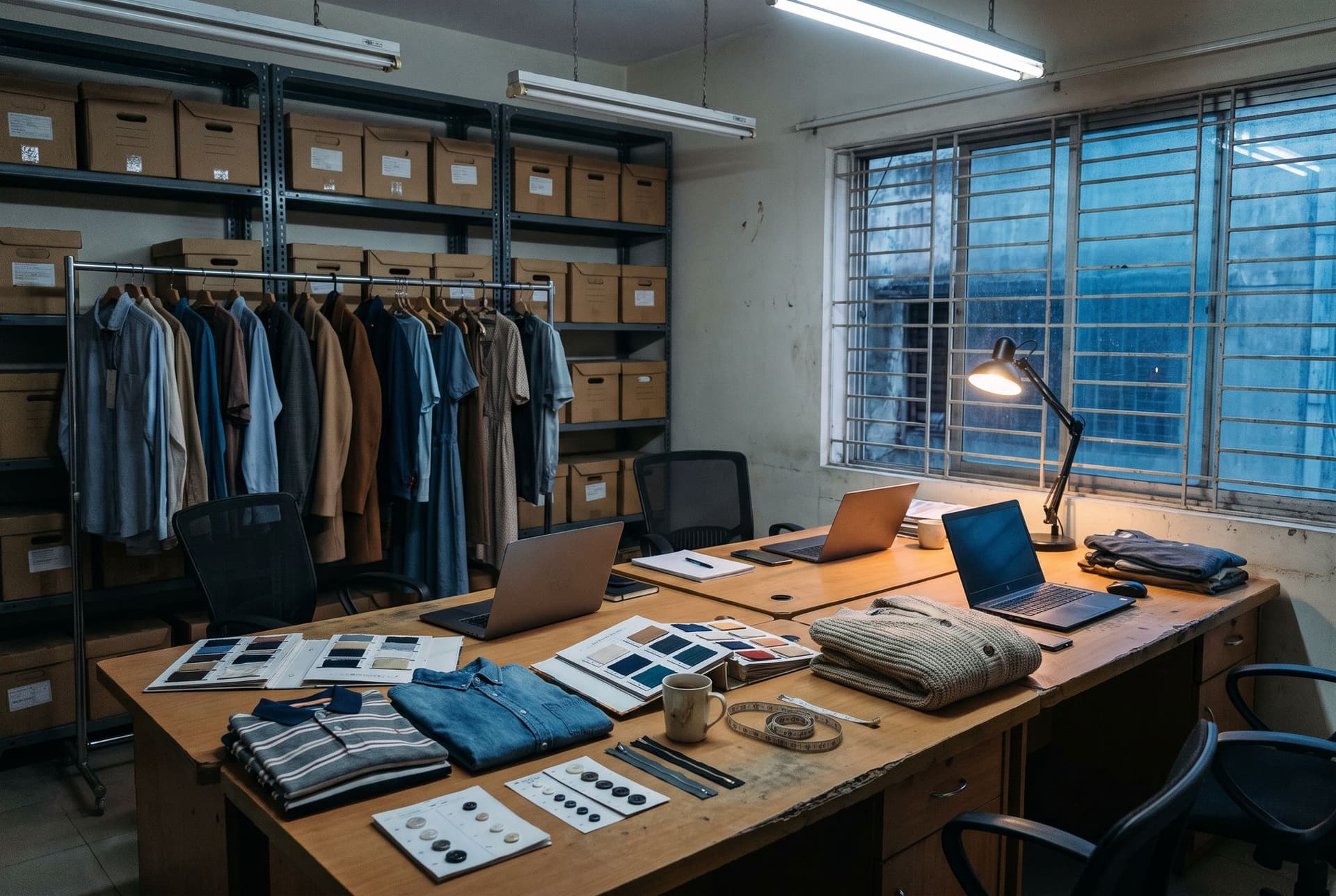
Think of a buying house as your production department in Bangladesh. On a typical order it:
- Turns your design, sketch or tech pack into a costed sample, and develops the pattern if you do not have one
- Sources fabric, trims, labels and packaging, and sends lab dips and swatches for approval
- Chooses a factory with the right product skills, capacity and compliance record, and names it to you
- Negotiates the price, the minimum and the delivery date with the factory
- Runs a pre-production meeting, then inspects fabric, first bundles, mid-production and the finished lot
- Books freight, prepares export documents and the proof of origin your market needs, and supervises loading
What it does not do matters just as much. A buying house does not sew, so it is only as good as the factories it works with and the checks it runs on them. That is why the questions later in this guide focus on factory transparency and inspection, not on the buying house’s own showroom.
How many buying houses there are, and how to check one is real
Bangladesh has a great many buying houses, and the number is hard to pin down because anyone with a trade licence can call themselves one. Public registers put a floor under the figure. The Bangladesh Garment Manufacturers and Exporters Association (BGMEA) publishes a list of its associate members, which is its category for buying houses: the edition dated 23 September 2026 runs to 1,794 entries, each with a registration number, a named principal and an office address. The Bangladesh Garment Buying House Association (BGBA), the trade body for buying houses specifically, publishes a member directory with a BGBA ID and a membership expiry date for each company. The Department of Textiles keeps a third, its register of buying houses; all three are described below.
Neither list is a quality mark. Registration proves a company exists, pays its fees and has an office; it says nothing about how it runs an order. But it is where a check should start, because a company that appears on neither register, cannot show an incorporation certificate from the Registrar of Joint Stock Companies (RJSC) and has no street address you can visit is not a buying house. It is a website.
- Ask for the RJSC incorporation certificate and the company’s trade licence, and check the legal name matches the one on the quote
- Look the company up on BGMEA’s associate member list, the BGBA directory or the Department of Textiles register, and note whether the membership is current
- Ask for the office address and, if you can, visit it or have someone visit it for you; a video call from the office is the next best thing
- Ask how many merchandisers and quality inspectors are on the payroll, as opposed to freelancers called in per order
Where the full lists are, and how to search them
Three public registers cover buying houses, and a fourth covers the factories they use. We opened each of them on 17 October 2026. Lists on directory and blog sites are copied from these, often years late, so search the source.
BGMEA associate members
On bgmea.com.bd, open Members, then Associate Member List; the page links to a PDF, List of Associate Member of BGMEA (Buying House). The edition dated 23 September 2026 has 87 pages and 1,794 entries in alphabetical order. Each gives the principal’s name and title, the company name with its BGMEA registration number, the office address, telephone numbers and, for most, an email address. To search it, open the PDF and use your browser’s find (Ctrl+F, or Cmd+F on a Mac). Search for one distinctive word of the company name, or for “Reg: ” followed by its number, because the entries are set in three columns and a long name can break across two lines. The list shows no renewal date, and associate membership is renewed every year: BGMEA’s circular of 18 December 2025 asked members to renew for 2026 with a fee of Tk 10,000, an updated trade licence and an income tax certificate. Ask the buying house for its certificate for the current year as well.
BGBA member directory
The Bangladesh Garment Buying House Association publishes its member directory as a table on its website, ten rows to a page, with a Search box above it. On 17 October 2026 it held 2,090 entries, each with a BGBA ID, the company name, a mailing address, a mobile number, an email address and a membership expiry date. Type one word of the company name into the Search box, then read the last column: 1,507 entries were marked “Expired”, and about 580 showed a date still ahead, most of them 30 June 2027.
Department of Textiles register
The Department of Textiles, the government department for the sector, has registered buying houses since 2019 under the Textile Act 2018. Its website is in Bengali: the page নিবন্ধিত বায়িং হাউজের তালিকা (list of registered buying houses) offers three PDF files, and the newest, file 3, is the Buying House Registration Register, in English, covering registrations up to September 2026. It runs to 699 pages, with entries numbered from the first, dated 16 May 2019, to number 2,691, dated 10 September 2026. Each gives the registration number and date, the company name, its registered and mailing addresses, the entrepreneur, capital in millions of taka, male and female staff, and a section marked Export, Import or Implement. Search it as you would the BGMEA list, with one word of the name, or with the number that follows “L-” in a registration number.
Factories: Open Supply Hub and BGMEA’s member search
None of the three registers covers factories. For those, Open Supply Hub is a free, open database of production locations, run by a non-profit, where brands, certification schemes, civil society groups and factory groups list the sites they work with; anyone can search it free of charge, and BGMEA agreed in May 2026 to add its member factories to it. BGMEA’s own member search finds a member factory by its number in the BGMEA Reg No box; in our test on 17 October 2026 the Unit Name box matched group names rather than single company names, and the keyword box returned no results. A listing shows that a site exists and who disclosed it, not that it passed an audit: our guide to verifying a factory and its certificates covers the checks that do.
Being on a register proves a company is registered. Whether it runs an order well is what the rest of this guide is for.
Buying house, factory direct, sourcing agent or trading company?
These four are often confused, and the difference decides who is responsible when something goes wrong.
| Option | Who you contract with | Best for | Watch out for |
|---|---|---|---|
| Buying house | The buying house, which places your order with a factory it names | Several product types, smaller or growing quantities, no staff of your own in Bangladesh | A margin in the price; whether the factory is named before you pay |
| Factory direct | The factory | Large, repeat volumes of one product type, with your own team or inspector on the ground | One factory’s minimums and specialism; you manage sampling and inspection yourself |
| Sourcing agent | The factory; the agent works for you under its own agreement and earns a commission | A first introduction when you already know how to run production | Duties vary from introductions only to inspecting, packing and arranging shipment, so write them into the agreement; the commission is not always disclosed |
| Trading company | The trader, who buys from factories and sells to you | Stock or near-stock goods at speed | You may never learn where the goods were made, which matters for audits and origin |
Going direct is the right choice more often than buying houses like to admit. If you order tens of thousands of pieces of one product, twice a year, from a factory you have visited, an intermediary adds cost without adding much. A buying house earns its place when your range spans knits, wovens and knitwear that no single factory makes well, when your quantities are below what export factories accept directly, or when nobody on your team can be in Narayanganj on a Tuesday to look at a first bundle.
How buying houses are paid
There are three models, and a buying house should tell you which one it uses before you ask.
- A margin inside the price per piece. The buying house quotes you a full-package price per piece and pays the factory less. You see one number. This is a common model for smaller brands.
- A commission from the factory. The buying house is paid a percentage of the order value by the factory, not by you. You will often read that this commission is 5% by law. The only 5% figure we found in Bangladeshi rules is something else: Bangladesh Bank caps commission or brokerage that an exporter owes to foreign importers or to agents on a shipment at 5% of the value of the goods when it is deducted from the export proceeds or remitted abroad, and can allow more where a trade customarily pays more (FEPD-1 Circular No. 26 of 30 July 2026, which repeats a rule from its 2018 foreign exchange guidelines). We found no rule that sets what a buying house earns: the rate is whatever it agrees with the factory. The buyer sees the factory’s price and the commission is inside it.
- A service fee from the buyer. Less common: you pay the buying house directly, per order or per month, and the factory invoices you at its own price. This is the most transparent model and suits larger, regular programmes.
Whichever model applies, know which one it is before you order, because it also changes the value you pay import duty on. What you should insist on is that sampling, laboratory testing, third-party inspection and courier charges are listed separately in the quote, so that a low price per piece does not turn into a high one once the extras arrive.
How the payment model changes your import duty
Who pays the buying house also decides whether its pay is charged duty when the goods land. In the United States, the European Union and the United Kingdom, duty is charged on a customs value that starts from the price paid for the goods, and all three draw the same line between a commission paid to your own agent and one that belongs to the seller. This is how the rules read on 23 September 2026.
- Buying commission, a fee you pay your own agent for representing you in the purchase. US Customs and Border Protection (CBP) does not add a bona fide one to the transaction value, the EU’s Union Customs Code leaves it out of the customs value, and HMRC lets UK importers leave it out when it is shown separately from the price of the goods.
- Selling commission, earned by an agent working for the seller. It is part of the value in all three: CBP adds it unless it is already in the price, and the EU and HMRC add commission and brokerage other than buying commission.
- Margin. A buying house that buys the goods and resells them to you at its own price is a seller, not an agent, and its mark-up is part of the price. The signs CBP looks for include taking title to the goods, unlimited discretion over the purchase and no direct contact between you and the factory.
Applied to the three payment models above, that gives the table below. Treat it as a starting point for a conversation with your customs broker, not a ruling on your shipments.
| How the buying house is paid | Who invoices you for the goods | Value duty is likely to be charged on |
|---|---|---|
| Margin inside the price per piece | The buying house | The full price you pay, margin included |
| Commission from the factory | The factory, at a price that already contains the commission | The full factory price: the price is the total paid to the seller, so nothing is deducted even if the agent really works for you |
| Service fee from you | The factory, at its own price, with the buying house invoicing its fee separately | The factory price, with the fee left out if you can show a genuine buying agency |
A worked illustration with round, invented numbers, not a quote: 5,000 cotton t-shirts at US$10.00 a piece, and a buying house paid 5% of that, or US$2,500. If the factory pays the commission and builds it into its price, you are invoiced US$10.50 a piece and the value for US duty is US$52,500. If you pay the factory US$50,000 and your agent US$2,500 on a separate invoice, and CBP accepts the agency, the value is US$50,000. At the 16.5% general rate for cotton t-shirts (HTS 6109.10.00), that is US$412.50 of duty on the commission alone, before any additional tariff charged as a percentage of value. Our guide to importing clothes from Bangladesh covers the other duties and fees.
What you have to prove
Calling a company a buying agent does not make it one. CBP puts the burden of proof on the importer and looks at what the parties actually do, above all whether you control the agent’s conduct on the work you give it. A written buying agency agreement is evidence but not conclusive, and without one an agency is very difficult to establish. The clearest pattern is the factory invoicing you for the goods and the agent invoicing you separately, each paid by you. An agent related to the factory, or also doing work for it, gets closer scrutiny; work for the factory does not rule out a buying agency if the agent works mainly for you, that work is limited, and the agent tells you what it is and what it is paid for it. HMRC may ask UK importers for the agency contract, the original seller’s invoice or contract of sale, and purchase orders or correspondence showing a genuine agency. CBP treats declaring a payment as a non-dutiable buying commission without that evidence as a failure of reasonable care that can lead to penalties.
For UK importers the duty at stake is often nil: cotton t-shirts, for example, carry 12% under the UK Global Tariff but 0% from Bangladesh under the Developing Countries Trading Scheme, for goods that meet its origin rules. The commission still matters, because HMRC bases import VAT on the customs value even when no duty is payable. Commission other than buying commission is added to the value for VAT; a buying commission is treated as a service, on which a VAT-registered importer accounts for VAT under the reverse charge. Bangladesh’s graduation from least developed country status is scheduled for 24 November 2029, after the UN General Assembly extended its preparatory period by three years on 29 October 2026; our LDC graduation guide covers what it means for these preferences.
Agree the payment model in writing before the first order, make sure the invoices match it, and ask your customs broker to confirm the treatment before you declare any payment as a buying commission. Our landed cost calculator shows what duty adds to your cost per piece.
Want a factory you can check?
We name the factory that will make your order in writing before production, with its address, certificates and audit reports. Tell us what you want to make.
What a good buying house does on your order
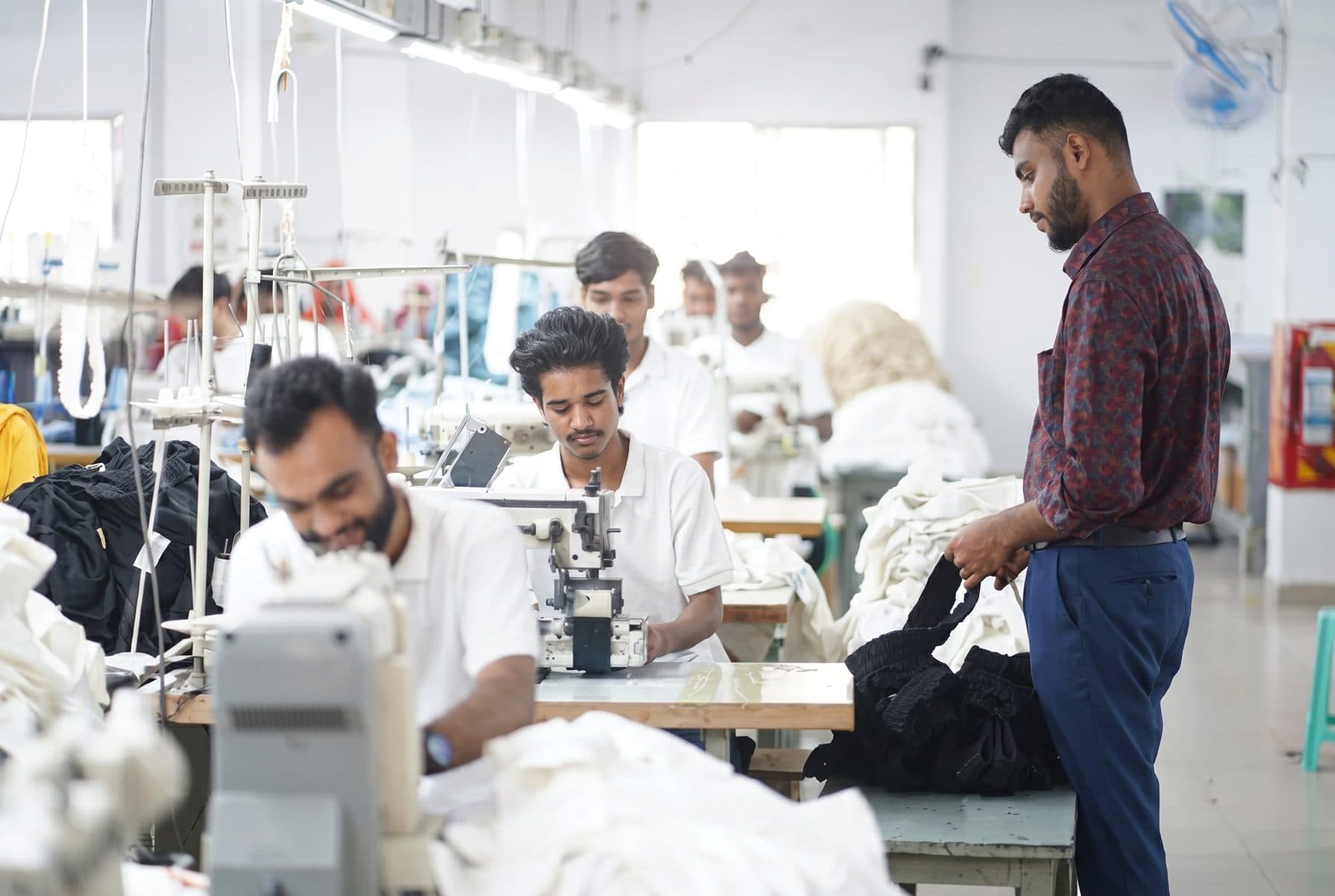
The difference between a buying house and a broker shows in the work between the quote and the shipment. On every order you should expect:
- The factory named in writing, with its address and its audit reports, before production starts, and a commitment that no part of the order moves elsewhere without your approval
- A sealed sample, approved by you, that every later check is judged against
- Fabric inspected before cutting, because a fault found after cutting has been multiplied by the number of pieces cut
- Inline inspection while your goods are being sewn, not only a final check when everything has already been made
- A final inspection to a stated AQL, with the report, photographs and measurements sent to you before the goods are released
- Export documents drafted for you to check before departure, and loading supervised with the seal number recorded
We describe each of these on our pages on quality control, compliance and factory audits and shipping, because they are the service you are actually paying for.
How to choose one
- Product fit. A buying house that lives on jersey basics is not the right home for a seam-sealed jacket. Ask which categories it ships most, and ask for a sample it has made in yours.
- Own teams. Merchandisers and inspectors on the payroll, working for you rather than for the factory.
- Factory transparency. The factory named before you pay a deposit, with certificates you can verify yourself in the issuing body’s database.
- Written terms. Minimums, sampling charges, payment terms and what happens when an inspection fails, all in writing before the first order.
- Communication. One named merchandiser, a reply within a working day, and a weekly production update once an order is running.
- Size match. A large buying house serving big retailers may not prioritise a first order of 1,000 pieces; a two-person office may not cope with six categories at once.
Questions to ask before you sign
- Which factory will make this order, and can I see its latest social audit and its building-safety status?
- Do you own any part of the factory, or have any financial link to it?
- Which pricing model do you use, and what is not included in the price per piece?
- What is the minimum per style and per colour for this product, and what happens below it?
- Who inspects, at what stages, to what AQL, and do I receive the reports?
- What is your policy if the final inspection fails: rework, sort, remake, and who pays?
- How long do sampling and bulk take for this product, counted from approved sample to goods ready?
- What are the payment terms, and can we use a letter of credit or an escrow arrangement for the first order?
- Will you sign my non-disclosure agreement before I send designs?
- May I send my own inspector or a third-party firm, unannounced?
Any hesitation on the first question tells you most of what you need to know.
Red flags
- A quote without a named factory, or a factory that changes after the deposit is paid
- Certificates shown as images with the certificate number cropped or blurred
- A price well below everyone else’s for the same specification, which usually means a different fabric or an unaudited site
- Pressure to pay the full amount before production, or to pay a personal account rather than the company’s
- No physical office, no RJSC registration, and no presence on the BGMEA or BGBA lists
- Claims of “our own factory” with no factory name, address or licence to back them
Costs beyond the price per piece
Whichever model applies, budget for the items that sit outside the price per piece: development samples and pattern making, fabric and lab-dip couriers, laboratory testing your market requires, a third-party inspection if your retailer insists on one, and freight and duty on the shipping term you choose. A good buying house lists these before you ask. Our guide to what makes up a garment price shows how each one lands in the final number.
What a good working relationship looks like
After the first order, the relationship should get easier, not harder. The buying house should keep your sealed samples, measurement charts and approved lab dips on file so that a reorder starts from an approved standard rather than from scratch. It should tell you when a factory is full and offer an alternative, rather than quietly moving the order. And it should tell you when Bangladesh is the wrong place for a style, because a buying house that says yes to everything is planning to subcontract.
How we work, for the record
CMB Sourcing Ltd. is a garments buying house in Narayanganj, Dhaka. We are also a manufacturer: we make knitwear and caps in our own factory, the factory of our sister company, Collective Studio Ltd., and place everything else, denim and leather included, with an audited partner factory that suits it, and our About page sets out who we are and what else we do not do. What you can check about us today: our Google Business Profile, verified in September 2026; our office at BSCIC Industrial Area, Narayanganj 1420, Bangladesh, on the map; and both founders, AB Rahman and Homaira Jashim, each with a public LinkedIn profile. You can call, visit by appointment or ask for a video call. Our RJSC registration number is not yet published on this site. Before paying any supplier, ask for its trade licence and registration documents, and check that the company name on them matches the invoice; ours is CMB Sourcing Ltd.
Our answers to the ten questions
- The factory, our sister factory or an audited partner factory chosen for the product, is named in writing before production starts, with its address and the certificates and audit reports it holds. Your order stays in the factory you approved; any change is agreed with you in writing first.
- CMB Sourcing Ltd. makes knitwear and caps only; denim, leather, woven and other products are made in audited partner factories. Our own factory is that of our sister company, Collective Studio Ltd., which has its own website, prices and minimum; Homaira Jashim is a co-founder of it and AB Rahman is its Head of Growth.
- We quote a full-package price per piece on a line-by-line costing sheet: fabric, trims, cost of making, packaging and any testing your market requires, each shown separately. If you supply the fabric and trims yourself, we quote a CMT (cut, make, trim) price instead. Sampling and freight are always listed on their own.
- 500 pieces per style and colour, t-shirts and hoodies included; 2,000 for denim, jackets, woven shirts, workwear and uniforms; 5,000 pieces for underwear and 5,000 pairs for socks; for other categories the exact minimum is confirmed on your quote. Below our minimum, knit and cut-and-sew runs from 150 pieces per style and colour are made by our sister factory, Collective Studio Ltd., managed by us with the same sampling and inspection and priced by Collective Studio itself.
- We do, working for you and not for the factory: bulk fabric is tested before cutting, we check on the line from the first bundles, and finished, packed goods are inspected by random sampling to ISO 2859-1 at the AQL agreed in the order (most apparel orders use 2.5 for major defects and 4.0 for minor ones). The report comes to you before shipment and you release the goods.
- Nothing ships. The factory reworks the defective pieces and the lot is re-inspected, or the lot is sorted, or the goods are remade. Who pays is set out in the order terms before production, not negotiated afterwards.
- We do not publish a standard number of days. The delivery date depends on the fabric, the decoration and the season, and it is confirmed in writing with your order.
- Payment terms are not published: they are agreed per order and confirmed in writing before production. Payment is by bank transfer (T/T), and letters of credit are considered for larger orders.
- No. Your patterns, artwork and tech packs are used only for your order and are never shown to or reused for other buyers.
- Your own quality team or independent inspectors such as QIMA, SGS, Intertek or Bureau Veritas are welcome at any stage; we arrange factory access and timing for them.
If that is the kind of buying house you are looking for, tell us what you want to make.
Questions buyers ask.
Where can I find a list of garments buying houses in Bangladesh?
Three public registers are the honest starting point. BGMEA, the manufacturers’ association, publishes its associate member list, which is its category for buying houses: the edition dated 23 September 2026 runs to 1,794 entries with a registration number, a named principal and an office address for each, in a PDF you can search with your browser’s find. BGBA, the Bangladesh Garment Buying House Association, is the trade body for buying houses specifically and publishes a searchable member directory with a BGBA ID and a membership expiry date per company. The Department of Textiles publishes its own register of buying houses, numbered up to 2,691 by September 2026. Commercial directories and blog lists copy from these registers, often years out of date, so go to the source. A register entry proves that a company exists, pays its fees and has an office; it does not tell you how it runs an order. Use the list to check that a company is real, then use the questions in this guide to decide whether it is any good.
How much does a buying house charge?
Often nothing visible to you, because many buying houses in Bangladesh are paid by the factory through a commission built into the FOB price, or they quote you one price per piece that already includes their margin. What matters is not the percentage but the price you are quoted against what the factory would charge you direct, and what you get for the difference: sampling management, fabric sourcing, inline and final inspection, export documents and a single accountable contact in your time zone. A buying house that will not say how it is paid, or that adds fees after the order is confirmed, is the one to avoid. Ask for the price per piece on your shipping term, ask what sampling, testing and freight cost on top, and ask whether the price changes if you take the order to the same factory directly. A clear answer to all three is a good sign.
Is a buying house better than going direct to a factory?
The answer turns on three things: how much you order, how many product types you need, and whether you have staff in Bangladesh. Direct makes sense when you order large, repeat quantities of one product type, can visit the factory, and have the merchandising and quality staff to manage sampling, inspection and shipping yourself. A buying house makes sense when your range spans several product types, so no single factory suits all of it, when your quantities are too small for a large factory to take seriously, or when you need someone on the ground who answers to you rather than to the factory. The trade-off is a margin in the price against the cost of doing the work yourself. For a first order the buying house route removes most of the risk, and many brands move their largest style direct later, keeping the buying house for the rest of the range.
What is a buying house in Bangladesh?
A buying house in Bangladesh is a sourcing company that manages clothing production for overseas buyers and places each order with a factory suited to it, usually without owning any sewing lines itself. Think of it as your production department in the country. On a typical order it turns your design or tech pack into a costed sample, sources fabric, trims and labels, chooses and names the factory, negotiates the price, minimum and delivery date, inspects fabric, first bundles, mid-production and the finished lot, and books freight and export documents. Because it does not sew, it is only as good as the factories it uses and the checks it runs on them. Unlike a trading company, it should tell you where your goods are made. BGMEA lists buying houses as associate members, with 1,794 entries in its edition of 23 September 2026, and BGBA keeps a member directory. CMB Sourcing Ltd. is a knitwear manufacturer and buying house in Narayanganj, Dhaka.
Sources
Checked . Rules and figures change, so confirm anything that affects your pricing.
Show all 22 sourcesHide the sources
- BGMEA — List of Associate Member of BGMEA (Buying House), edition dated 23 September 2026: 87 pages, 1,794 entries, each with registration number, principal, address and telephone (linked from the Associate Member List page; checked 17 October 2026) (opens in a new tab)
- Bangladesh Garment Buying House Association — Member directory (17 October 2026: 2,090 entries with BGBA ID, contact details and membership expiry date; 1,507 marked Expired; searchable table) (opens in a new tab)
- BGMEA — Associate Member List page (links the current PDF) (opens in a new tab)
- BGMEA — Circular of 18 December 2025: associate members (buying houses) to renew their certificate for 2026; fee Tk 10,000; updated trade licence or BIDA permission and income tax certificate required (opens in a new tab)
- Department of Textiles — list of registered buying houses (নিবন্ধিত বায়িং হাউজের তালিকা), up to September 2026, page updated 1 October 2026 (opens in a new tab)
- Department of Textiles — Buying House Registration Register (file 3): 699 pages, entries numbered to 2,691, first registration 16 May 2019, latest 10 September 2026; number, name, addresses, entrepreneur, capital, staff and section for each (opens in a new tab)
- The Financial Express — Buying houses asked to get registered with textile dept (12 June 2019): registration with the Department of Textiles under the Textile Law 2018 (opens in a new tab)
- BGMEA — Search a Member (BGMEA Reg No field; in our test on 17 October 2026 the Unit Name field matched group names and the keyword box returned no results) (opens in a new tab)
- Open Supply Hub — FAQs (anyone can search, contribute or download for free) (opens in a new tab)
- Open Supply Hub — Our mission (a non-profit; production-location data contributed by brands, civil society, certification schemes and factory groups, free to use) (opens in a new tab)
- BGMEA — BGMEA partners with Open Supply Hub (MoU signed 10 May 2026): member factories’ information and locations to be integrated into the platform (opens in a new tab)
- Bangladesh Bank: FEPD-1 Circular No. 26 (30 July 2026), consolidated foreign exchange regulations for export trade, Part-A paragraph 20(1): commission or brokerage to foreign importers or agents capped at 5% of the value of the goods unless Bangladesh Bank allows more (opens in a new tab)
- Registrar of Joint Stock Companies and Firms, Bangladesh (opens in a new tab)
- US Customs and Border Protection: Buying and selling commissions, informed compliance publication (revised October 2006): bona fide buying commissions are not added to transaction value, selling commissions are, and the importer carries the burden of proof (opens in a new tab)
- Bangladesh Bank: Guidelines for Foreign Exchange Transactions 2018, volume 1, chapter 8, paragraph 11(a), page 56: the same 5% ceiling on commission to foreign importers or agents in the earlier guidelines (opens in a new tab)
- EUR-Lex: Regulation (EU) No 952/2013, Union Customs Code, Articles 5(41), 70(2), 71(1)(a)(i) and 72(e): buying commissions are left out of customs value, other commissions and brokerage are added (opens in a new tab)
- HMRC (GOV.UK): Accounting for buying commission in the customs value (updated 28 October 2024): excluded when shown separately, the evidence HMRC may ask for, VAT by reverse charge (opens in a new tab)
- HMRC (GOV.UK): Valuing imported goods using Method 1 (transaction value): selling commission and brokerage must be included (opens in a new tab)
- HMRC (GOV.UK): Working out the VAT value using the customs value of the imported goods: based on the customs value even when no duty is payable; commission other than buying commission is added (opens in a new tab)
- UK Trade Tariff: commodity 6109 10 00 10, cotton T-shirts, 12% third-country duty, 0% under DCTS Comprehensive Preferences (Bangladesh a member), checked 23 September 2026 (opens in a new tab)
- UN LDC Portal: Bangladesh graduation status, scheduled for 24 November 2029 after the General Assembly extended the preparatory period on 29 October 2026; the Committee for Development Policy had found an extension appropriate (checked 31 October 2026) (opens in a new tab)
- US International Trade Commission, HTSUS: subheading 6109.10.00, T-shirts and singlets of cotton, knitted, general rate 16.5% (opens in a new tab)