In short
A cotton t-shirt is made in twelve stages: ginning, spinning, knitting, dyeing and finishing, fabric inspection, marker making, cutting, printing or embroidery, sewing, finishing, final inspection and packing. Published studies count 12 to 19 sewing operations and 5.94 to 6.84 standard minutes a shirt. One published cost sheet allows about 262 grams of body fabric, and a survey of 18 Bangladeshi dyeing factories found 164 litres of groundwater drawn per kilogram processed.
Want a costing for your own style? Send us your enquiry
A cotton t-shirt is made in twelve stages. Cotton is ginned and spun into yarn. The yarn is knitted into single jersey on a circular machine, then scoured, bleached, dyed and compacted. The finished fabric is inspected, laid out and cut to a marker, printed or embroidered if the design calls for it, sewn in 12 to 19 short operations, pressed, inspected, folded and packed.
CMB Sourcing Ltd. read every source named here on 23 November 2026. The figures are other people’s published figures, each given with its author or publisher and its year where the source gives one. They describe the factories and fabrics that were studied, not every factory, and none of them is a CMB Sourcing price, lead time or output.
| Stage | What happens | Machine or process | What is checked |
|---|---|---|---|
| 1. Ginning | Lint is separated from the seed, cleaned and pressed into bales | Gin stand, bale press | Moisture before ginning; a sample from every bale is classed |
| 2. Spinning | Fibre is opened, carded, drawn, sometimes combed, and twisted into yarn | Card, draw frame, comber, roving frame, ring or rotor spinning machine | Yarn is cleared of defects before it is wound |
| 3. Knitting | Yarn is looped into a tube of single jersey; rib is knitted for the neck | Circular knitting machine | Weight, width and stitch counts, as delivered and fully relaxed |
| 4. Dyeing and fabric finishing | Fabric is scoured, bleached, dyed, dried and compacted | Jet dyeing machine, relaxation dryer, compactor | Shrinkage left in the fabric, finished width and weight |
| 5. Fabric inspection | Rolls are examined before any fabric is cut | Visual grading in penalty points (ASTM D5430) | Defects per roll against the limit buyer and seller agreed |
| 6. Pattern and marker | The pieces for every size are arranged on one cutting plan | Pattern and marker software (CAD) | Marker efficiency: the share of the marker covered by garment pieces |
| 7. Spreading and cutting | Fabric is laid in many layers and cut along the marker | Cutting table, straight-knife cutting machine | Cut pieces are numbered, so each front is matched to its back |
| 8. Printing or embroidery | A placement print is added to the cut panel or the finished garment; embroidery normally to the panel | Screen printing, embroidery machine | A print strike-off or an embroidery sew-out approved before bulk |
| 9. Sewing | Shoulders, neck, sleeves, side seams and hems are joined in 12 to 19 operations | Overlock, flat lock and single-needle lockstitch machines | Seams, checked on the line and again at the end of it |
| 10. Garment finishing | Loose threads are trimmed and the garment is pressed | Hand trimming, pressing table | Loose threads and marks |
| 11. Final inspection | A random sample of the finished lot is inspected | Sampling to ISO 2859-1 at an agreed AQL | The number of defects found against the accept and reject numbers |
| 12. Folding, packing and shipping | Garments are folded, tagged, bagged and boxed for export | Hangtags, polybags, cartons | The packing specification: bag, barcode, carton size and marks |
From cotton to yarn: ginning and spinning
Cotton leaves the farm as seed cotton: fibre still attached to seed. Cotton Australia’s education kit (2021) describes what an Australian gin does next. The cotton is brought to a moisture level of 5%, leaf and sticks are cleaned out, and the fibre, now called lint, is pulled away from the seed. The kit puts lint at about 37% of the weight that arrives from the farm, seed at about 53% and trash at 10%. The lint is pressed into bales, 227 kg each in Australia, and a sample from each bale is graded.
At the spinning mill the bales are opened, blended and cleaned. A carding machine separates and aligns the fibres and draws them into a loose rope called sliver. Drawing evens the sliver out, a roving frame thins it and adds a little twist, and a spinning machine turns it into yarn. Three words on a t-shirt label come from this stage:
- Carded yarn is spun without the combing step.
- Combed yarn has that extra step, which removes the remaining waste and makes the yarn finer, stronger, smoother and more even, at a higher cost.
- Ring-spun yarn is twisted by a rotating spindle. Cotton Australia says ring spinning makes about 60% of the world’s short-staple yarn and the faster rotor (open-end) method about 30%.
Our guide to combed, carded and ring-spun cotton explains what each label can and cannot prove.
Knitting: yarn becomes single jersey
T-shirt fabric is knitted, not woven. A circular knitting machine has needles fixed around a rotating cylinder, and as the cylinder turns they form loop after loop into a tube of fabric. Cotton Australia says a modern machine may use more than 2,500 needles. A Cotton Incorporated technical bulletin (ISP 1009, 2004) describes one: 26 inches across, 2,256 needles, knitting single jersey from combed ring-spun yarn.
The body of a t-shirt is single jersey and the neckband is rib. Fabric weight is given in grams per square metre (GSM), and it changes after knitting. The single jersey in that bulletin weighed 135 GSM as it left the machine and 176 GSM once fully relaxed. Dyed and finished, it was delivered at 149 GSM. So ask for the weight of the finished fabric. Our fabric and GSM guide gives the usual weights for t-shirts.
Dyeing and finishing: colour, hand-feel and shrinkage
Undyed fabric off the machine is called greige. It is scoured to clean it, bleached to an off-white, and dyed. In the Cotton Incorporated bulletin’s example of a typical dyehouse sequence, for a cotton interlock, all three were done in one overflow jet machine. The wet fabric was then squeezed through a pad extractor, relaxation dried and compacted.
Knitting and wet processing stretch a knit, and the stretch comes back out in the wash as shrinkage. The bulletin tested its single jersey over five home launderings with tumble drying (“5 HLTD” in its tables). As knitted, the fabric shrank 12.1% in length and 15.9% in width. Dyed and relaxation dried, with softener only, it shrank 7.3% and 3.5%. Compacted, it shrank 4.5% and 6.0%. Relaxation drying lets the loops settle without tension. A compactor uses compressive force to shorten the fabric, which lowers length shrinkage. These are results for one fabric, not targets. Our guide to fabric shrinkage covers the tests and the limits buyers set.
Wet processing uses a lot of water. Uddin and colleagues (PLOS Sustainability and Transformation, 2023) surveyed 18 wet-processing factories in Bangladesh, 14 of them knit composite or knit dyeing mills. On average they drew 164 litres of groundwater to process one kilogram of textile, used 136 litres in the dyehouse and discharged 119 litres of wastewater. The range ran from 28 litres per kilogram at a denim dyeing unit to 285 at a knit composite factory where about 72% of the dyeing was in deep shades; the authors note that deep colours need more water and more washing and rinsing. The paper, submitted in December 2022, does not give the year of its survey, and its figures are per kilogram of textile, not per shirt.
Fabric inspection before cutting
Finished rolls are examined before a single piece is cut. The inspection company V-Trust, in an article dated 30 March 2025, calls the four-point system the most commonly used fabric inspection system in the garment industry and describes it as a standard under ASTM D5430. ASTM’s own summary of D5430 says it covers procedures to examine and grade fabrics by visual inspection, and that it may be used to accept rolls and shipments when buyer and seller agree. V-Trust explains that one flaw scores at most four points, and that some factories accept up to 40 points per 100 square yards while brands and buyers set their own limits. Our quality control page shows the scoring table.
Pattern, marker, spreading and cutting
A basic t-shirt has few pieces: front, back, two sleeves and the neck rib. The pattern is graded into each size, and the pieces for all sizes are arranged on a marker, the plan that is laid over the fabric and cut around. Marker efficiency is the area covered by pattern pieces divided by the area of the marker. In a 2024 paper in Tekstilna industrija by researchers at Bangladesh University of Business and Technology, a factory’s marker for one single jersey style in five sizes reached 86.72%, and the paper counts the other 13.28% as waste. By splitting the order into smaller markers and changing the marker width, the authors’ best marker, for two of the sizes, reached 92.73%.
How much fabric one shirt takes depends on its size, weight and marker. Rajib and colleagues at BGMEA University of Fashion and Technology (Journal of Textile Science and Technology, 2023) published one Bangladeshi factory’s cost sheet for a dozen basic t-shirts. It allows 3.14 kg of 160 GSM single jersey and 0.15 kg of rib, wastage included. Divided by twelve, that is about 262 grams of body fabric a shirt; the sheet does not state the sizes. Fabric was 42.6% of that t-shirt’s export price, the largest single cost.
In bulk, the fabric is laid on a long table in many layers and cut by machine along the marker. The cut pieces are numbered and bundled, and the first job on the sewing line is to match each front to its back by number.
Not sure which fabric to choose?
Send a garment you like or describe the feel you want. We propose fabrics that suit the product, its price and your market.
Printing or embroidery
A chest logo or a back graphic is a placement print. It is applied to the cut panel or to the finished garment. Embroidery is normally stitched into the panel before sewing. Our pages on screen printing and embroidery explain how each is set up, sampled and approved.
Sewing: 12 to 19 short operations
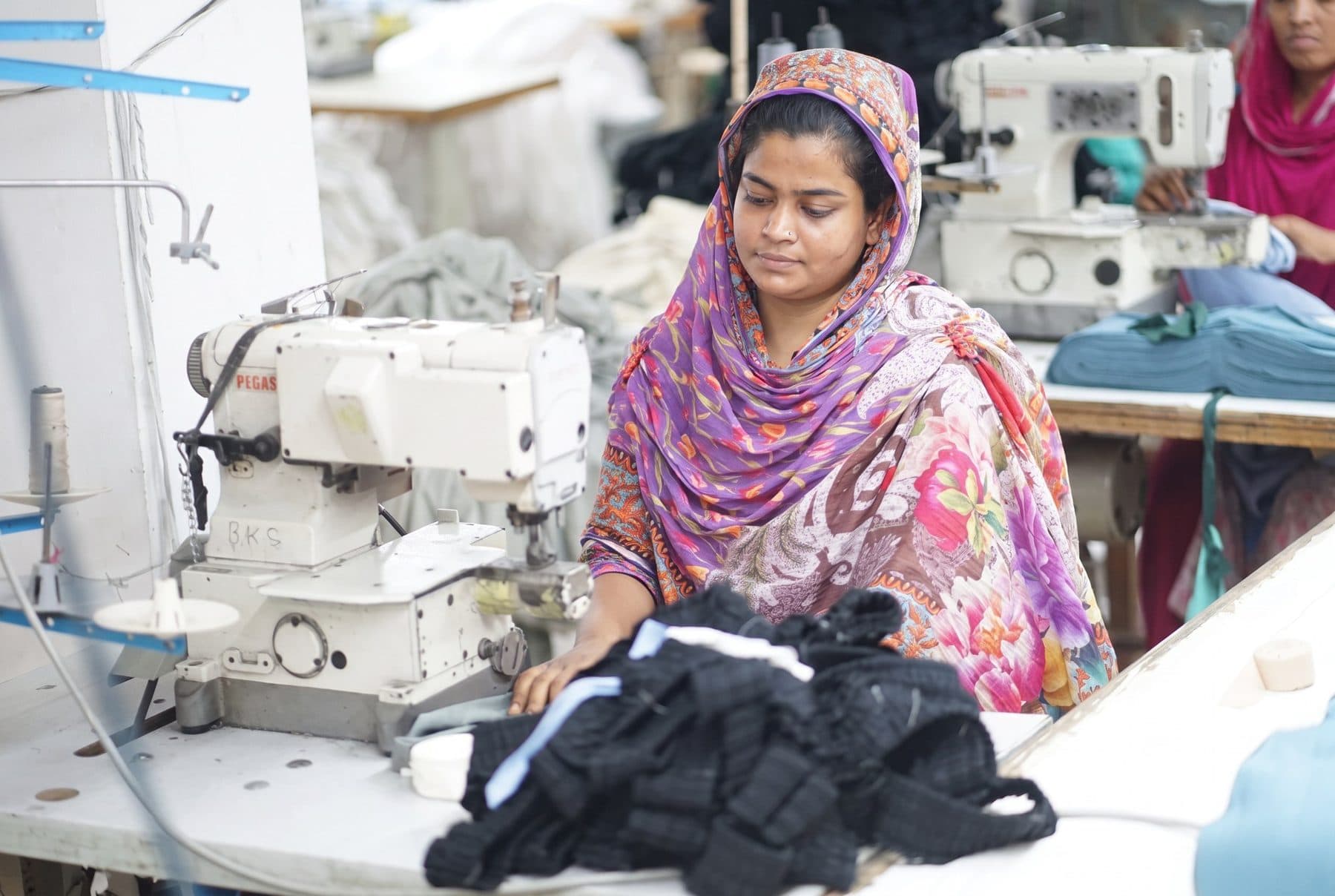
A t-shirt is not sewn by one person from start to finish. The work is split into short operations, each done on one kind of machine, and bundles move down the line. The count depends on the style and on what is counted. Rajib and colleagues give 12 operations for a basic t-shirt, 16 for a polo and more than forty for a woven shirt. A 2014 study in the European Scientific Journal lists 17 for a round-neck t-shirt, three of them helper jobs, with the machine for each:
- Match the numbered front and back (helper)
- Join the shoulders (overlock)
- Make the neck rib (single-needle lockstitch)
- Join the neck to the body (overlock)
- Pipe round the neck (flat lock)
- Tack the neck edge (lockstitch)
- Top-stitch the back neck tape (lockstitch)
- Attach the main label (lockstitch)
- Hem the sleeves (flat lock)
- Match the sleeves (helper)
- Join the sleeves (overlock)
- Close the side seams (overlock)
- Attach the care label (lockstitch)
- Turn the body (helper)
- Top-stitch the sides (flat lock)
- Top-stitch the neck (flat lock)
- Hem the bottom (flat lock)
That study puts 22 people on the line: 19 machine operators and three helpers. Three kinds of machine do all the machine work. The overlock joins two pieces with an over-edge stitch. The flat lock sews the neck piping, the hems and the top-stitching. The single-needle lockstitch handles the neck rib, the back tape, labels and tacks.
Machine names vary more than stitch numbers do. In the thread maker AMANN’s summary of the stitch standard ISO 4915, lock stitches are class 300, chain stitches class 400, overlock stitches class 500 and cover stitches class 600. The 2014 study gives the flat lock’s stitch as “chain / flat bed stitch”. The thread maker Coats, in its thread guide for children’s t-shirts, lists lockstitch 301, chainstitch 401, overlock 504 and 514, and stitch 406, which it calls a coverseam.
Factories measure sewing in standard minutes: the time allowed for the work in one garment, with allowances added. Two of these studies publish a total. The 2014 study prints 6.48 minutes, estimated from average cycle times with 20% allowances (its own cycle times work out at 6.45). A 2023 study in the International Journal of Industrial Management timed a full-sleeve t-shirt with 19 operations at 6.84 minutes, and at 5.94 after the line was reorganised. Each figure is one line in one factory.
Output depends on the people as well as the minutes. In a 2019 case study in the European Scientific Journal, a line sewing 160 GSM cotton t-shirts made 138 an hour with 23 people. After the work was shared out differently it made 160 an hour with 19 people. The Rajib cost sheet prices sewing thread by the 3,000-metre cone and allows one cone for a dozen t-shirts.
Finishing, final inspection and packing
Off the line, loose threads are trimmed, by hand in the 2014 study, and the shirt is pressed. Then the lot is inspected. A final inspection does not look at every piece. It draws a random sample under the sampling standard ISO 2859-1 and passes or fails the lot on the number of defects found. Our AQL chart gives the sample sizes and the accept and reject numbers.
Passed garments are folded, tagged, bagged and packed in cartons. The Rajib cost sheet lists hangtags, hangers, polybags, cartons, carton stickers and tape among the accessories, which came to 8.5% of the t-shirt’s export price. Our guide to garment packaging requirements covers what to specify.
BGMEA’s export tables, compiled from Export Promotion Bureau data, put “T-shirts and knitted shirts”, by its name a wider category than t-shirts alone, at US$8,143 million in the fiscal year 2025-26. That is about 21% of Bangladesh’s US$38,701 million of garment exports. The Observatory of Economic Complexity values world trade in knitted t-shirts, singlets and vests (HS 6109) at US$49.9 billion in 2024, with China exporting US$8.63 billion, Bangladesh US$8.55 billion and Vietnam US$3.06 billion. The two sources count differently, one by fiscal year and one by calendar year, so their figures should not be mixed.
How other clothes differ
Other cut-and-sewn clothes follow the same broad order: fibre, yarn, fabric, colour, cutting, sewing, finishing, inspection, packing. What changes is the fabric and the amount of sewing. A woven shirt is cut from fabric made on a loom. In the Rajib study it needs more than forty sewing operations against 12 for a basic t-shirt, and the making charge (CM) was 23.5% of the shirt’s export price against 15.2% of the t-shirt’s.
Where CMB Sourcing fits
CMB Sourcing Ltd. cuts, sews, finishes and packs t-shirts in our own factory in Narayanganj, Dhaka, the factory of our sister company Collective Studio Ltd., from 150 pieces per style and colour. Our t-shirt manufacturing page shows the fabrics, weights and options, and the free tech pack template is the quickest way to tell us what you want made.
Questions buyers ask.
How does a t-shirt factory work?
A t-shirt factory works as a line, not as a room of tailors each making whole shirts. Fabric is inspected, laid in many layers and cut along a marker. The cut pieces are numbered, bundled and passed down a sewing line, where each operation is done on one kind of machine. In a 2014 study in the European Scientific Journal that meant an overlock for shoulders, sleeves and side seams, a flat lock for hems and top-stitching, and a lockstitch for labels and tacks. Three published studies of t-shirt lines by researchers in Bangladesh describe 19 to 23 people on a line. One, in the European Scientific Journal in 2019, made 138 t-shirts an hour with 23 people before the work was rebalanced and 160 an hour with 19 people after. Finished shirts are trimmed, pressed, inspected on a random sample, folded and packed in cartons.
How many sewing operations does a t-shirt need, and how long does it take to sew?
Between 12 and 19 in the three published counts read for this guide, depending on the style and on whether helper jobs such as matching pieces, turning the body and cutting threads are counted. Rajib and colleagues (Journal of Textile Science and Technology, 2023) give 12 for a basic t-shirt. A 2014 study in the European Scientific Journal lists 17 for a round-neck t-shirt, and a 2023 study in the International Journal of Industrial Management lists 19 for a full-sleeve one. The 2014 study puts the sewing work at 6.48 standard minutes a shirt, and the 2023 study at 6.84, falling to 5.94 after the line was reorganised. A standard-minute total is the sum of every operator’s work on one shirt, with allowances; it is not the time a shirt takes to travel down the line.
How much fabric does one t-shirt use?
One Bangladeshi factory’s cost sheet, published by Rajib and colleagues in 2023, allows 3.14 kg of 160 GSM single jersey and 0.15 kg of rib for a dozen basic t-shirts, wastage included. Divided by twelve, that is about 262 grams of body fabric a shirt. The paper does not state the sizes. A heavier fabric, larger sizes or a looser fit raise the figure. So does a poor cutting plan: in a 2024 paper in Tekstilna industrija, one factory’s marker for a single jersey style covered 86.72% of the marker area with garment pieces, and the authors’ best marker, for two of the sizes, covered 92.73%.
How much water does it take to dye t-shirt fabric?
A survey of 18 wet-processing factories in Bangladesh, published in PLOS Sustainability and Transformation in 2023, found an average of 164 litres of groundwater drawn for each kilogram of textile processed, 136 litres used in the dyehouse and 119 litres discharged as wastewater. Individual factories ranged from 28 to 285 litres per kilogram, and the authors note that deep shades need more water and more washing and rinsing. The figures are per kilogram of textile, not per shirt, and the survey included yarn and denim dyeing as well as knit fabric. The same study cites the Best Available Techniques reference for the textiles industry as giving 70 to 250 litres per kilogram of fabric.
Where are most t-shirts made?
By export value, China and Bangladesh. The Observatory of Economic Complexity puts world trade in knitted t-shirts, singlets and vests (HS 6109) at US$49.9 billion in 2024: China exported US$8.63 billion, Bangladesh US$8.55 billion and Vietnam US$3.06 billion, and the largest importers were the United States (US$6.98 billion), Germany (US$4.81 billion) and France (US$2.66 billion). These goods were 14.5% of everything Bangladesh exported that year. BGMEA’s own tables put “T-shirts and knitted shirts”, a wider category, at US$8,143 million in the fiscal year 2025-26, about 21% of Bangladesh’s garment exports. These are export figures; they do not count t-shirts made and sold inside one country.
Sources
Checked . Rules and figures change, so confirm anything that affects your pricing.
Show all 15 sourcesHide the sources
- Cotton Australia: Cotton Education Kit, Chapter 7, "Processing: from gin to fabric" (2021 edition, PDF dated 2 June 2021), read 23 November 2026 (opens in a new tab)
- Cotton Incorporated: Technical Bulletin ISP 1009, "A Guide to Improved Shrinkage Performance of Cotton Fabrics" (© 2004), read 23 November 2026 (opens in a new tab)
- Uddin, Begum, Ashraf, Azad, Adhikary and Hossain (2023): "Water and chemical consumption in the textile processing industry of Bangladesh", PLOS Sustainability and Transformation 2(7): e0000072, published 31 July 2023, read 23 November 2026 (opens in a new tab)
- ASTM International: D5430-26, Standard Test Methods for Visually Inspecting and Grading Fabrics (active; page last updated 23 March 2026), read 23 November 2026 (opens in a new tab)
- V-Trust: "Understanding the 4-point system for fabric inspections" (dated 30 March 2025), read 23 November 2026 (opens in a new tab)
- Nilanto, Islam, Morsalin, Ahmed and Khan (2024): "Investigation of marker efficiency combining different size garments and using different width materials", Tekstilna industrija 72(3), 40-45, DOI 10.5937/tekstind2403040N, read 23 November 2026 (opens in a new tab)
- Rajib, Parvez, Islam, Ahmed and Islam (2023): "Complete Garment Costing with Major Cost Breakdown", Journal of Textile Science and Technology 9, 115-126, DOI 10.4236/jtst.2023.92008, read 23 November 2026 (opens in a new tab)
- Rahman, Roy, Karim and Biswas (2014): "Effective way to estimate the standard minute value (SMV) of a T-shirt by work study", European Scientific Journal 10(30), 196-203, read 23 November 2026 (opens in a new tab)
- Islam, Sultana, Chowdhury, Mridha and Sarker (2019): "Implementation of Work Sharing Technique to Improve Line Efficiency in Sewing Section: A Case Study", European Scientific Journal 15(33), 147-154, DOI 10.19044/esj.2019.v15n33p147, read 23 November 2026 (opens in a new tab)
- Rahman, Baten, Hoque and Mahmud (2023): "Impact of lean manufacturing on productivity and layout design in sewing section of a garment industry", International Journal of Industrial Management 17(3), 152-161, DOI 10.15282/ijim.17.3.2023.8955, read 23 November 2026 (opens in a new tab)
- AMANN Group: "Industrial stitch types: thread consumption and ISO 4915", AMANN Knowledge Hub (no publication date), read 23 November 2026 (opens in a new tab)
- Coats Group: "Children's T-Shirts", thread recommendations by stitch type (© 2026, no publication date), read 23 November 2026 (opens in a new tab)
- ISO: ISO 2859-1:2026, Sampling procedures for inspection by attributes, Part 1 (edition 3, January 2026), read 23 November 2026 (opens in a new tab)
- BGMEA: "Export Performance", tables "Main Apparel Items Exported From Bangladesh" and "Bangladesh's Apparel Export to World" ("Data Source Export Promotion Bureau Compiled by BGMEA"; no update date on the page), read 23 November 2026 (opens in a new tab)
- Observatory of Economic Complexity: "Knit T-shirts (HS 6109)", 2024 data, read 23 November 2026 (opens in a new tab)