In short
To find an overseas clothing manufacturer, fix the product, quantity per style and colour and market first, choose the country from UN Comtrade trade data, check the licence, audit ID, certificates and building safety status at their source, pay for a sample, and get a quote that names the factory and states the shipping term.
Want a costing for your own style? Send us your enquiry
An overseas clothing manufacturer is easy to find and hard to choose. Search results and marketplaces give you hundreds of names in an afternoon, and no way to tell which one will ship the garment you approved, on the date agreed, from the factory it named. This guide is the method we recommend to start-ups and small brands in the UK, US, Canada, Australia, New Zealand and the EU: decide what you are ordering before you look, choose the country with trade data rather than reputation, understand who you are actually contracting, run the checks that fake certificates fail, and know what your goods will pay on arrival. Every figure is sourced at the end. Rates and data were checked on 25 September 2026.
1. Decide the product, the quantity and the market first
Most failed searches fail before the first email, because the brief was not fixed. Settle three things before you contact anyone.
- The product, in detail. A t-shirt is not a product; a 180 gsm combed cotton single jersey t-shirt with a 1x1 rib neck, one chest print and a woven back-neck label is. Fabric, weight, construction, trims and decoration decide the price, the minimum and the type of factory you need: knit garments (t-shirts, hoodies, polos, underwear) and woven garments (shirts, trousers, jackets, denim) are made by different factories on different machines.
- The quantity per style and per colour. Fabric is dyed in lots and a sewing line is re-set for every style, so minimums are counted per style and per colour, not per order. If you want 600 pieces across three colours and four sizes, say so; a factory that quotes for 600 of one colour has not quoted your order.
- The market you will sell in. It decides the fibre labelling, the care label, the safety rules for children's wear, the duty and the tax at import. Tell every supplier where the goods will be sold, in the first message.
If you are still at the idea stage, our page for start-ups and first collections covers how to turn a sketch into a brief a factory can price, and the landed cost calculator shows how duty, tax and freight change a per-piece price by market.
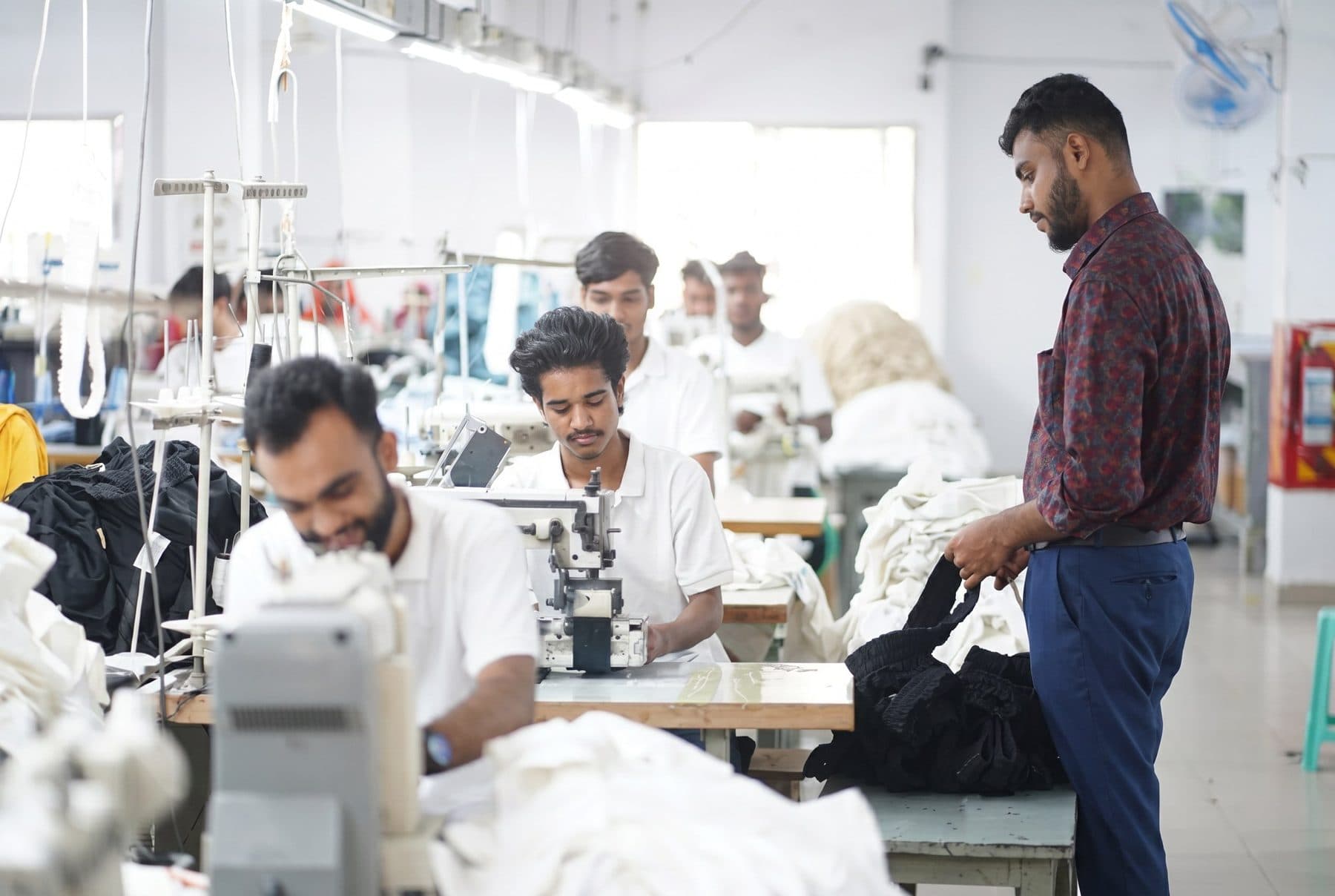
2. Choose the country with trade data, not reputation
Reputations lag the data by years. Two public sources tell you what each country actually ships. UN Comtrade records what each country exports under HS chapter 61 (knitted garments) and chapter 62 (woven garments), and the WTO's value chain profile of the textiles and clothing industry shows how much of each country's exports it makes itself. Read together, they say something specific about what each country is strong at.
| Country | Clothing exports | Knitted (HS 61) share | What the data says |
|---|---|---|---|
| China | US$153.0 billion | 56% | The largest exporter by far, with 89.1% of its export value made at home in 2022: fibre, fabric and garment in one country |
| Bangladesh | US$38.7 billion | 53% | Knit and woven in near-equal measure; the WTO profile groups it with Viet Nam as focused on garment manufacturing rather than fibre |
| Viet Nam | US$30.1 billion (2023) | 49% | The highest share of foreign inputs among the top exporters, 64.2% in 2022: fabric comes in, garments go out |
| Türkiye | US$17.5 billion | 58% | One of Europe's two main exporters with Italy, on the WTO's 2022 profile; knit-led, with the domestic content of its exports rising by an average of 10.9% between 2017 and 2022 |
| India | US$15.5 billion | 48% | Woven-led, with 83.2% domestic content in 2022; India grows cotton and makes synthetic fibre as well as garments |
| Cambodia | US$9.8 billion | 68% | The most knit-heavy of the group, two thirds of exports under chapter 61 |
| Pakistan | US$8.7 billion | 55% | Knit-led, at just over half of exports |
Three things follow. If your product needs a specialist fabric that is not milled locally, a country that imports most of its fabric (Viet Nam, on the WTO's figures) adds fabric transit time that a country with its own mills does not. If your range is knit basics, Bangladesh and Cambodia ship more knit than woven; if it is woven shirts and trousers, India and Viet Nam lean the other way. And Asia as a whole shipped 70.6% of world textile and clothing exports in 2022, up 11.2 points since 2017, so the capacity for a small first order is almost always in Asia, whatever the reputation of nearer countries for speed.
How much of your market's clothing already comes from Bangladesh
The second question is what your own market already buys, because customs brokers, freight forwarders, testing labs and duty rules are all better developed on the lanes that carry volume. Bangladesh's share of clothing imports (HS 61 plus 62) in 2025, from the import data each market reports to UN Comtrade (for the EU, imports from outside the EU only):
- United Kingdom: US$4.75 billion of US$21.3 billion, 22.2%. UK page.
- European Union: US$21.9 billion of US$101.7 billion imported from outside the EU, 21.6% (the EU page gives 10.0% for 2024 because its Eurostat total counts trade between member states as well).
- Canada: US$1.71 billion of US$11.7 billion, 14.6%. Canada page.
- Australia: US$877 million of US$8.1 billion, 10.8%. Australia page.
- New Zealand: US$128 million of US$1.19 billion, 10.8%. New Zealand page.
- United States: US$8.21 billion of US$81.8 billion, 10.0%. US page.
In the UK and the EU, more than a fifth of clothing imports by value comes from Bangladesh, so the paperwork for the duty-free schemes in section 6 is routine on those lanes. In the US, Bangladesh is one supplier among many and pays full duty, so the case for it rests on price and on knit and woven capacity rather than on tariff treatment.
3. Factory direct, buying house or sourcing agent: who you are actually contracting
Whatever the website says, you will be dealing with one of three kinds of company.
- A factory. You contract the company that owns the sewing lines. You get the fewest parties between you and the product and full visibility of the floor, if you can get there. You also get the factory's minimums, set by its line and dye-lot economics rather than your budget, and you carry the sampling, fabric follow-up, inspection and shipping work yourself or pay a third party to do it.
- A buying house. A local company that takes your order, places it in a factory it has audited, and manages sampling, fabric and trim sourcing, production follow-up, inspection and export documents. You pay one price per piece that includes its work. The honest trade-off: you are one step from the factory, so the buying house must name the factory in writing before production and let you check it, or you have gained convenience and lost the visibility you were paying for. CMB Sourcing Ltd. is a buying house in Narayanganj, Dhaka; it does not own sewing lines, and it names the factory making each order in writing before production, with its address, certificates and audit reports.
- A sourcing agent. An individual or small firm paid a commission, usually by the factory, to bring in orders and sometimes to follow them. Often knowledgeable, but the agent's income comes from the factory, so ask who pays them before you rely on their inspection, and expect the factory's terms and minimums to be the ones you sign.
The test that separates them is a single question: which company will produce my order, and will you put its name and address in writing before I pay a deposit? A factory answers with its own name. A good buying house answers with a partner factory's name and its audit reports. An agent, or a trader posing as a factory, changes the subject. Our guide to finding a clothing manufacturer in Bangladesh goes deeper on the three routes for that country.
4. Where to look
Start from lists that prove a company exists and exports, then narrow by product. In Bangladesh, the two trade associations publish their membership. The BGMEA member search lets you search woven, knit and sweater exporters by factory zone, unit name, BGMEA registration number, principal product, number of machines and main export countries, which is more than most factory websites disclose. BKMEA, the knitwear association, puts its membership at about 2,540 knitwear factories. Other countries have equivalents, and the rule is the same everywhere: if a company is missing from its own country's export registers, it is not the factory it says it is.
A trade fair is the one place you can compare fabric, stitching and finish from dozens of suppliers in a day. Texworld Apparel Sourcing Paris, which calls itself the largest fabric and garment sourcing event in Europe, brings together about 1,300 manufacturers from about 35 countries, next from 25 to 27 January 2027 at Paris-Le Bourget. In Bangladesh, the Bangladesh Denim Expo, organised by the Bangladesh Apparel Exchange, holds its 21st edition on 9 and 10 November 2026 at the International Convention City Bashundhara in Dhaka. A stand is not verification: take the legal name and address away and run the checks in section 5.
The fastest shortlist still comes from another brand. Ask a brand in a category that does not compete with yours who makes for them, then ask what broke on their first order and how quickly the supplier fixed it; the second answer tells you more than the first.
Want a factory you can check?
We name the factory that will make your order in writing before production, with its address, certificates and audit reports. Tell us what you want to make.
5. The checks before any deposit
Every check below uses a register run by the body that issued the document, not the copy the supplier sent you. That is where fake and expired certificates fall over. Our step-by-step verification guide covers each register in detail.
- Licence and registration. Ask for the trade licence and export registration, and for the association membership number. Look the factory up by that number in the BGMEA member search or its equivalent; the registered name and address must match the ones on the quote.
- Social audit report, with its audit ID. Ask which scheme, when, and for the report number. amfori BSCI reports live on the amfori Sustainability Platform, where the audit company uploads the report and members linked to the factory can see the result and the validity of the latest monitoring; only the responsible member can request an audit. If you are not an amfori member, ask the factory to export the one-page result summary from the platform and ask the audit company to confirm the report number and date. WRAP publishes a searchable list of certified facilities on its own site, so a WRAP certificate can be checked by anyone. A Sedex SMETA report is uploaded to the Sedex platform and can be shared with several buyers; the supplier has to be a Sedex member for the report to be there at all, so ask for the Sedex site reference.
- Product certificates, in the issuer's database. GOTS keeps a public database of certified suppliers; enter the certification number printed on the certificate, or the company name, and check the company, country and certified products come back. OEKO-TEX runs a Label Check where you enter the label number, which is case sensitive, and see whether the label is genuine. A certificate that is not in its issuer's database does not exist, whatever the PDF looks like.
- Building safety status, for Bangladesh. Factories supplying signatory brands are inspected for fire, electrical and structural safety by the RMG Sustainability Council, and the International Accord publishes the factory list with inspection reports and remediation progress, updated quarterly, most recently to 30 June 2026. Look the factory up before you shortlist it.
- A sample you have paid for. Judge the sample, the questions the supplier asked before making it, and the speed of their replies.
- A quote that states the shipping term. A price per piece means nothing until you know whether it is FOB (goods on the ship, you pay freight and everything after), CIF (freight and insurance to your port included) or DDP (delivered with duty paid). Two quotes on different terms cannot be compared; ask for FOB and DDP side by side.
6. What your goods pay on arrival: duty and tax in six markets
Duty depends on where the goods were made, not on who sold them or where the seller sits. For clothing made in Bangladesh, five of the six markets charge no duty because Bangladesh is on the UN list of least developed countries; the US does not give that preference. Every market except the US then charges a consumption tax at import, which a registered business usually recovers. The table gives the position on 25 September 2026, with the primary source for each row in the list at the end.
| Market | Duty on clothing from Bangladesh | Tax at import | Primary source |
|---|---|---|---|
| United Kingdom | 0% under the Developing Countries Trading Scheme (DCTS): Bangladesh is in the Comprehensive Preferences tier, which gives 0% on all products except arms and ammunition | VAT, standard rate 20% | GOV.UK, DCTS preference tiers; GOV.UK, VAT rates |
| United States | No preference. The normal HTS rate, for example 16.5% on a knitted cotton t-shirt (6109.10.00), plus an additional 10% Section 301 duty on products of Bangladesh entered from 12:01 a.m. eastern time on 24 July 2026, with exemptions listed in the notice's annexes; the notice states that Bangladeshi textiles and apparel pay the 10% until USTR sets up a tariff-rate quota under which a set volume would enter free of it, and no notice establishing that quota had been published by 25 September 2026 | No VAT or GST at the federal level | USITC Harmonized Tariff Schedule; USTR notice, Federal Register, 28 July 2026 |
| Canada | 0% under the Least Developed Country Tariff (LDCT): almost all goods originating in an LDC enter duty free, and Bangladesh is listed for LDCT treatment in the 2026 Customs Tariff | GST 5%, charged on the value for duty plus any duty | CBSA, LDCT page and countries list; CBSA, importing guide; Canada Revenue Agency, GST/HST rates |
| Australia | Free: the Customs Tariff Act 1995 sets the rate for goods of a Least Developed Country at Free unless a specific LDC rate is listed, and Australia gives LDCs including Bangladesh duty-free access on 100% of tariff lines | GST 10%, on the customs value plus duty and the cost of transport and insurance to Australia | Customs Tariff Act 1995, section 16; Bangladesh Customs, DFQF Australia; ATO, GST and imported goods |
| New Zealand | Free: the Working Tariff Document effective 1 April 2026 lists Bangladesh as a Least Developed Country (LLDC), and LLDC rates in the preferential tariff are Free unless otherwise indicated | GST 15% | New Zealand Customs, Working Tariff Document; Inland Revenue, GST |
| European Union | 0% under Everything But Arms (EBA), which removes tariffs and quotas on all goods except arms and ammunition from the listed LDCs, Bangladesh among them. Under the new GSP regulation applying from 1 January 2027, a graduating LDC keeps EBA for three more years, which the Commission puts at least until the end of 2029 | National VAT: each member state sets its own standard rate, which must be at least 15% | European Commission, Access2Markets EBA; DG Trade, new GSP questions and answers; European Commission, VAT rates |
Two dates sit behind the table. Bangladesh is scheduled to leave the UN LDC category on 24 November 2026, and in February 2026 its government asked for the preparatory period to be extended; the UN's Committee for Development Policy said an extension would be appropriate if reforms progress, and the General Assembly has the matter before the November date. The UK's DCTS gives a country that leaves LDC status three years before it moves to the Enhanced Preferences tier, and the EU gives three years of EBA under the new scheme, so on the schemes as published, UK and EU duty on Bangladeshi clothing stays at 0% into 2029 either way. The Canada, Australia and New Zealand pages linked above cover what each of those countries has said about the period after graduation.
A worked line for the arithmetic, using an illustrative invoice value that is not a CMB Sourcing Ltd. price: on US$10,000 of knitted cotton t-shirts entering the US, the duty is US$1,650 at the 16.5% HTS rate plus US$1,000 under Section 301, US$2,650 before fees and freight. The same US$10,000 entering the UK pays no duty and 20% VAT on the customs value, which a VAT-registered brand reclaims on its return. The landed cost calculator runs the same sum for each market with freight added.
7. The first order: process and minimums
A first order with any overseas manufacturer runs through the same gates, and the gates matter more than the calendar. Each one is a sample or a report you approve before the next step starts, which is what keeps a first order from becoming a surprise at the port.
- Brief and quote. Send the same tech pack, quantities per style and colour, target market and shipping term to two or three candidates. Compare quotes only once they are on the same fabric, weight and term.
- Development sample. Paid for. Check fit, fabric hand and construction against the brief, and approve or comment in writing.
- Deposit and fabric. A deposit releases fabric and trims. Before cutting, the bulk fabric should be tested against the swatch you approved; ask to see the test result.
- Pre-production sample. Made from bulk fabric and trims. This is the gate that decides whether the delivery date is still real.
- Production, with checks on the line. Someone should be checking during sewing, not only at the end; ask who, and what they record.
- Final inspection to an AQL level. The report should reach you before the balance is paid and the goods leave. Agree in writing what happens if it fails.
- Shipping and documents. Sea from Chattogram or air from Dhaka for Bangladesh, on the term you agreed, with the commercial invoice, packing list, bill of lading or air waybill and the certificate or statement of origin your market's duty scheme needs.
This is how CMB Sourcing Ltd. runs an order in the named partner factory: sampling, fabric and trim sourcing, production follow-up, bulk fabric tested against the approved swatch before cutting, quality checked on the line, an AQL final inspection with the report sent to you, and export documents and the certificate of origin prepared. You approve a sample or a report at every stage.
Minimums, honestly
Minimums are the point where most first-time searches stall, so here are ours, all per style and per colour. CMB Sourcing Ltd.'s own orders start at 500 pieces. T-shirts start at 1,000 pieces. Denim, jackets, woven shirts, workwear and uniforms start at 2,000 pieces. Underwear starts at 5,000 pieces and socks at 5,000 pairs. Other categories start at the 500-piece floor, with the exact minimum confirmed on the quote. Starting prices are published per category, for a basic style: t-shirts from US$4.50 per piece and hoodies from US$7.90, for example; your price depends on fabric, weight, decoration, quantity and shipping terms. If your first run is below 500 pieces, see our low MOQ manufacturing page, which explains how small runs are handled and by whom.
8. The mistakes that cost the most
- Comparing prices on different shipping terms. An FOB price and a DDP price can differ by the whole of freight, duty and tax. Always ask which term, and for a second quote on the other one.
- Paying a deposit to a company you have not looked up. A trader with a factory's photographs on its website can take a deposit as easily as a factory can. Find the legal name in the register first, and pay the company on the quote, never a personal account.
- Accepting a PDF certificate as proof. The register is the proof; the PDF is a claim. Section 5 gives the register for each scheme.
- Skipping the pre-production sample to save a week. It is the only sample made from your bulk fabric, and the last point at which a problem costs a sample rather than a run.
- Not naming the factory in the contract. If the contract does not name the site, the order can move to a site you never checked. Ask for the name and address in writing, and for a commitment that no part of the order moves without your approval.
- Pricing an order on a duty rate you did not check. The US added a 10% Section 301 duty on most products of Bangladesh, clothing included, on 24 July 2026; an order priced a month earlier was wrong within weeks. Read the rate for your line and entry date from the schedule, not from a sourcing article, this one included.
- Ordering colours you cannot sell. Minimums are per colour, so three colours triple the commitment. Start with the colours you know will sell and add the rest in a repeat order.
CMB Sourcing Ltd. is a buying house in Narayanganj, Dhaka. Orders are made in audited partner factories, and the factory making yours is named in writing before production, with its address, certificates and audit reports. Goods ship FOB, CIF or DDP from Chattogram sea port or Dhaka airport. AB, the founder, is based in Australia; Homaira Jashim, the co-founder, is in Narayanganj. Send your styles, quantities and market for a quote and a founder replies within one working day.
Questions buyers ask.
How do I check an overseas clothing manufacturer's social audit if I am not an amfori or Sedex member?
Treat a report no issuer will confirm as no report; each scheme has its own route. WRAP publishes a searchable list of certified facilities on its own website, so ask for the certificate number and look it up yourself. Sedex SMETA reports sit on the Sedex platform and can be shared with several buyers, but only if the supplier is a member, so ask for its site reference and for the report to be shared through the platform, not emailed. amfori BSCI reports are on the members-only Sustainability Platform, so ask for the audit ID and the audit date and write to the audit company named on the report to confirm both. Then read the PDF for what the register does not show: the site address, which must match the address on the quote, and the auditor's name. A factory that takes weeks to produce a report number, or sends only a rating page, should be priced as unaudited.
Does the country my clothes are made in change the import duty I pay?
Yes, often by more than the difference in factory prices. Duty follows the country of origin, not the seller's address or the port of loading. Clothing made in Bangladesh enters the UK at 0% under the Developing Countries Trading Scheme, the EU at 0% under Everything But Arms, Canada at 0% under the Least Developed Country Tariff, and Australia and New Zealand duty free under their least developed country preferences, because Bangladesh is on the UN list of least developed countries. The same garment made in a country without a preference pays that market's normal rate. The US gives Bangladesh no preference: a knitted cotton t-shirt pays the 16.5% HTS rate plus 10% under Section 301 since 24 July 2026, until the tariff-rate quota that notice promises is set up. Read the rate for your product line and market from the customs schedule before you price an order, then run the landed cost.
What should an overseas manufacturer's quote include before I pay a deposit?
Seven things, all in writing. The price per piece and the currency. The shipping term the price is on, FOB, CIF or DDP, because a price without a term cannot be compared with any other. The fabric, its weight and composition, and the trims and decoration the price covers, so that a cheaper quote cannot hide a lighter fabric. The quantity per style and per colour the price assumes, and what changes below it. The name and address of the factory that will produce the order, which is the single question that separates a factory or a serious buying house from a trader. The approved sample the goods will be judged against, the measurement tolerances, the AQL level for final inspection, and what happens if the inspection fails. And the payment structure: deposit, balance before shipment or a letter of credit, paid to the company on the quote, never a personal account.
Can I find and check an overseas clothing manufacturer without visiting the country?
You can do most of it from your desk, if you use registers rather than websites. Association member searches, such as BGMEA's, give a factory's registered name, address, product type, machine count and main export markets. Social audit schemes, product certification bodies and, for Bangladesh, the International Accord's factory list let you confirm audit reports, certificates and building safety status against the issuer's own record. A paid development sample tells you what the factory can make, and a live video walk of the cutting, sewing and finishing floors tells you where it will be made; ask for live, not a pre-recorded film. What you cannot do remotely is stand on the line during production, so either pay an inspection company with an office in the country, or use a buying house whose inspectors are already there and whose reports you are entitled to see. A visit is worth making once the relationship is real, not before.
Sources
Checked . Rules and figures change, so confirm anything that affects your pricing.
- UN Comtrade (public preview API): imports of HS 61 and 62 in 2025 by the UK, US, Canada, Australia, New Zealand and the EU, from the world and from Bangladesh, read 25 September 2026 (opens in a new tab)
- UN Comtrade (public preview API): exports of HS 61 and 62 in 2024 by China, India, Türkiye, Cambodia and Pakistan, read 25 September 2026 (opens in a new tab)
- UN Comtrade (public preview API): exports of HS 61 and 62 by Viet Nam in 2023, the latest year reported, read 25 September 2026 (opens in a new tab)
- BGMEA: export performance, knit and woven garment exports FY2025-26 and by market (EPB data) (opens in a new tab)
- WTO: Global Value Chains Sectoral Profiles, Textiles and Clothing Industry (2024 edition, 2022 data: Asia 70.6% of world exports, China 89.1% domestic content, Viet Nam 64.2% foreign inputs, India 83.2% domestic content) (opens in a new tab)
- BGMEA: member search (factory zone, unit name, registration number, product type, machines, export countries) (opens in a new tab)
- BKMEA: at a glance (about 2,540 knitwear member factories) (opens in a new tab)
- Texworld Apparel Sourcing Paris: 25 to 27 January 2027, Paris-Le Bourget, 1,300 manufacturers from about 35 countries (opens in a new tab)
- Bangladesh Denim Expo: 21st edition, 9 and 10 November 2026, ICCB Dhaka, organised by the Bangladesh Apparel Exchange (opens in a new tab)
- amfori support: how to request a full audit on the Sustainability Platform (only the RSP holder can request monitoring) (opens in a new tab)
- amfori support: how to download an audit report as a member (result and validity of the latest monitoring; one-page PDF summary) (opens in a new tab)
- WRAP: facilities and monitors, searchable list of certified facilities (opens in a new tab)
- Sedex: SMETA audit (report uploaded to the Sedex platform, supplier must be a member, data shared with multiple buyers) (opens in a new tab)
- GOTS: certified suppliers database (search by company name, certification or CB client number, country, product category and field of operation) (opens in a new tab)
- OEKO-TEX: Label Check (enter the label number, case sensitive) (opens in a new tab)
- International Accord: Bangladesh factory list, inspections implemented by the RMG Sustainability Council, remediation progress to 30 June 2026 (opens in a new tab)
- GOV.UK: Preference tiers under the Developing Countries Trading Scheme (Bangladesh in Comprehensive Preferences; 0% on all products except arms and ammunition; three-year transition after LDC graduation) (opens in a new tab)
- GOV.UK: VAT rates (standard rate 20%) (opens in a new tab)
- USITC: Harmonized Tariff Schedule, 6109.10.00 T-shirts of cotton, General rate 16.5% (opens in a new tab)
- Federal Register, 28 July 2026 (91 FR 47318): USTR notice of actions in Section 301 investigations, 10% additional duty on products of Bangladesh entered from 12:01 a.m. eastern time on 24 July 2026, except as provided in Annex I and Annex II, Parts A and J; the President's memorandum, section 2(c), applies the 10% to Bangladeshi textiles and apparel until tariff-rate quotas are established (opens in a new tab)
- Federal Register API: documents from the Office of the United States Trade Representative published from 29 July 2026 (six notices to 25 September 2026, none establishing the textile tariff-rate quotas) (opens in a new tab)
- CBSA: claim the Least Developed Country Tariff (almost all goods originating in an LDC enter duty free) (opens in a new tab)
- CBSA: Customs Tariff 2026, list of countries and applicable tariff treatments (Bangladesh: MFN, GPT, LDCT) (opens in a new tab)
- CBSA: step-by-step guide to importing commercial goods (GST calculated on the value of the goods plus applicable duties) (opens in a new tab)
- Canada Revenue Agency: GST/HST calculator and rates by province (GST 5%; HST 13% Ontario, 14% Nova Scotia, 15% New Brunswick, Newfoundland and Labrador, Prince Edward Island) (opens in a new tab)
- Federal Register of Legislation (Australia): Customs Tariff Act 1995, section 16(1)(i), goods of a Least Developed Country: Free unless a specific rate is listed (opens in a new tab)
- Bangladesh Customs: Australia's duty-free quota-free access for LDCs including Bangladesh on 100% of tariff lines, and the origin rule (opens in a new tab)
- ATO: GST and imported goods (10% of the value of the taxable importation: customs value plus customs duty, transport and insurance to Australia) (opens in a new tab)
- New Zealand Customs Service: Working Tariff Document effective 1 April 2026, introduction (Bangladesh marked as a Least Developed Country) (opens in a new tab)
- New Zealand Customs Service: Working Tariff Document, Section XI, textiles and textile articles (LLDC rates in the preferential tariff are Free unless otherwise indicated) (opens in a new tab)
- New Zealand Customs Service: Generalised System of Preferences (LDC and LLDC countries) (opens in a new tab)
- Inland Revenue (New Zealand): GST charged at 15%, including on imports (opens in a new tab)
- European Commission, Access2Markets: Everything But Arms (tariffs and quotas removed on all goods except arms and ammunition; Bangladesh listed) (opens in a new tab)
- European Commission, DG Trade: questions and answers on the new EU Generalised Scheme of Preferences (applies from 1 January 2027; graduating LDCs keep EBA for three more years, at least until the end of 2029) (opens in a new tab)
- European Commission: VAT rates (standard rate no less than 15%; each member state sets its own rates) (opens in a new tab)
- UN LDC Portal: Bangladesh graduation status (scheduled 24 November 2026; February 2026 extension request) (opens in a new tab)