In short
A Narayanganj factory, Universal Menswear Ltd, told The Business Standard on 9 October 2026 that it made the Jos. A. Bank suit President Trump wore in Nebraska on 5 October. The brand has not confirmed it. A suit from Bangladesh pays 27.5% to 37.3% US duty, depending on the cloth.
Want a costing for your own style? Send us your enquiry
Probably, but it is one factory’s word so far. On 9 October 2026 The Business Standard reported that Sharif Zahir, managing director of Universal Menswear Ltd in the Adamjee Export Processing Zone, Narayanganj, said his factory made the navy suit President Trump wore at a rally in Nebraska on 5 October. The brand on the label, Jos. A. Bank, has not confirmed where that suit was sewn.
What happened in Nebraska?
On 5 October 2026 President Trump spoke at a rally in Grand Island, Nebraska. As he left the stage he held his jacket open, and press photographs caught the label sewn inside it: Jos. A. Bank, a US menswear chain owned by Tailored Brands, which also owns Men’s Wearhouse.
The menswear writer Derek Guy pointed out online that the chain’s suits are made overseas, typically in countries such as China and Bangladesh, and asked why the President had not chosen the group’s US-made line. The Daily Beast reported this on 6 October and Newsweek followed. Both said they had asked the White House and the company for comment and had no reply when they published.
The reason it travelled so far is the contrast. The speech was about bringing manufacturing back to the United States, and Newsweek noted that the President is better known for Italian suits costing several thousand dollars, while Jos. A. Bank suits start at about US$150.
Who says the suit was made in Bangladesh?
Four days later the story reached Narayanganj. The Business Standard, a Dhaka daily, reported that Sharif Zahir of Universal Menswear Ltd confirmed to the paper that the suit was made at his factory. He said a president choosing an affordable suit made in Bangladesh “speaks volumes about our craftsmanship”.
That is a claim by the maker, reported by one newspaper. The report does not say how the factory identified the suit: it gives no order, style number or label code. Until the brand or an independent source confirms it, the honest wording is that a Narayanganj factory says it made the suit.
| Point | Status | Source |
|---|---|---|
| The suit carried a Jos. A. Bank label | Confirmed by press photographs | The Daily Beast, Newsweek |
| Worn at a rally in Grand Island, Nebraska, on 5 October 2026 | Confirmed | The Daily Beast, Newsweek |
| The chain’s suits are made overseas, typically in China and Bangladesh | Stated by a menswear writer and repeated in press reports | The Daily Beast, Newsweek |
| This suit was made by Universal Menswear Ltd in Narayanganj | Claimed by the factory’s managing director | The Business Standard |
| Jos. A. Bank or Tailored Brands confirms the factory or country | Not confirmed | No statement found on 12 October 2026 |
Who is Universal Menswear Ltd?
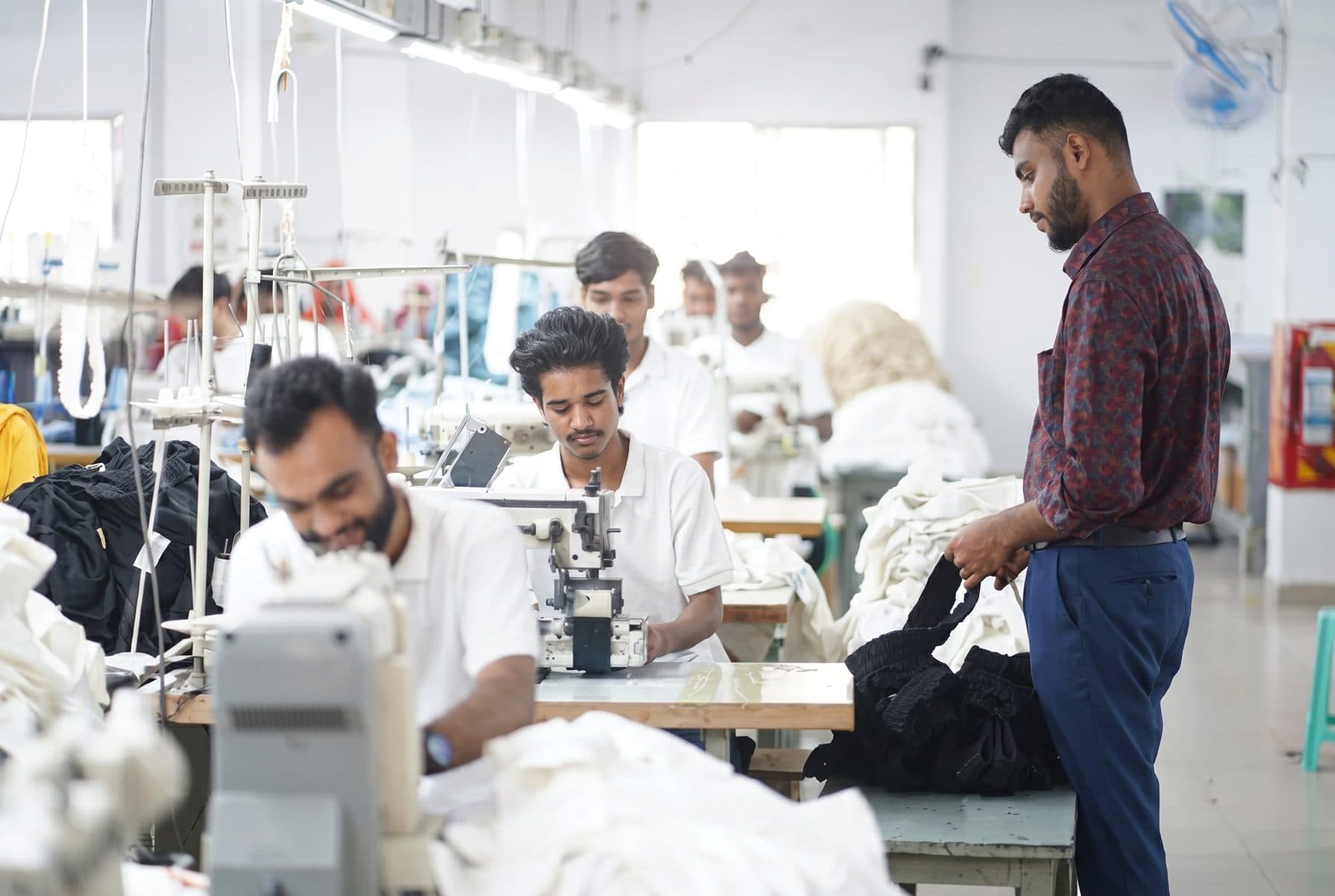
According to The Business Standard, Universal Menswear is a full-service maker of men’s tailored suits, jackets, overcoats and trousers, with 500,000 square feet of floor space, automatic cutting systems and specialised sewing and pressing machines. It operates in the Adamjee Export Processing Zone in Narayanganj, one of the fenced export zones where factories produce only for foreign buyers.
Tailoring is a small part of what Bangladesh sews, and a demanding one. A structured jacket has a canvas or fused front, set-in sleeves, linings and pressing at almost every step, which is why a suit factory is built around it and makes little else. Our guide to garment factories in Bangladesh explains how the country’s factories divide by district and product; Narayanganj is the historic textile centre, better known for knitwear than for suits.
Why would an American brand make suits in Bangladesh?
Because that is where a large share of the world’s clothing is made, at every price. Bangladesh is the second-largest clothing exporter after China, and the United States is its largest single-country market: it took about a fifth of Bangladesh’s garment exports, US$7.74 billion, in the 2025–26 fiscal year. The figures and their sources are in our Bangladesh garment export statistics.
A retail chain does not own these factories. It designs or selects the styles, sets the specification and price, and places orders with contract manufacturers, often several in different countries for the same product. The same pattern holds for sportswear: our guide to where big brands make their clothes works through Nike, lululemon and Gymshark from their own reports.
Want a factory you can check?
We name the factory that will make your order in writing before production, with its address, certificates and audit reports. Tell us what you want to make.
What US duty does a suit from Bangladesh pay?
More than many readers of the story would guess. A suit from Bangladesh entering the United States pays the normal duty for its tariff line plus the 10% Section 301 tariff that has applied to Bangladeshi goods since 24 July 2026. The normal rate depends on the cloth, and we do not know the cloth of the suit in the photographs, so these are examples from the US tariff schedule.
| Garment | HTS line | Normal rate | Section 301 | Total |
|---|---|---|---|---|
| Men’s suit, wool | 6203.11.90 | 17.5% | 10% | 27.5% |
| Men’s suit, synthetic fibre | 6203.12.20 | 27.3% | 10% | 37.3% |
| Men’s suit jacket, wool | 6203.31.90 | 17.5% | 10% | 27.5% |
| Men’s suit jacket, synthetic fibre | 6203.33.20 | 27.3% | 10% | 37.3% |
The duty is charged on the price the importer paid the factory, not on the shop price. Our guide to US tariffs on clothing from Bangladesh gives the rates for T-shirts, hoodies, shirts and jeans and explains how the rate has changed since April 2025.
Why does the label have to name the country?
Because US law requires it. Under the Textile and Wool Acts, enforced by the Federal Trade Commission, most clothing sold in the United States must carry a label stating the fibre content, the country of origin and the identity of the manufacturer or another business responsible for the product. That is why a jacket’s inside label can settle an argument that a press release cannot.
The photographs published so far show the brand label. None of the reports we read shows the country-of-origin label of this suit. The rules for the United States, the United Kingdom and the European Union are compared in our guide to clothing label requirements by law.
What does this mean if you are sourcing clothing?
The label was treated as an embarrassment. For anyone who buys clothing for a living it is ordinary: an overseas label is the norm, and the country on it tells you little about the garment. Three questions tell you more.
- Which factory, by name and address? A country is not a supplier. You should know the factory before production starts.
- Who checked it? Ask for the factory’s current audit report and the inspection report on your own order, not a certificate logo.
- Is the factory built for your product? A suit maker and a T-shirt maker are different businesses, even when they are in the same city.
Our guide to verifying factory certificates in Bangladesh shows how to check each document against its public register.
Our connection to the story
None, except the city. CMB Sourcing Ltd. is a buying house in Narayanganj, Dhaka. Universal Menswear is not one of our partner factories, we had no part in this order, and we have no link to Jos. A. Bank, Tailored Brands or the President. We do not place tailored suits. We place T-shirts, hoodies, denim, jackets, woven shirts, workwear and other categories with audited partner factories, and we name the factory to you in writing before production starts.
We will update this page if the brand confirms or corrects the factory’s account.
Questions buyers ask.
Was Trump’s suit really made in Bangladesh?
A factory says so, and nobody has confirmed it independently. On 9 October 2026 The Business Standard reported that Sharif Zahir, managing director of Universal Menswear Ltd in the Adamjee Export Processing Zone in Narayanganj, confirmed to the paper that the navy suit President Trump wore at a rally in Grand Island, Nebraska, on 5 October was made at his factory. The report does not say how the factory identified the suit, and it gives no order or style number. Jos. A. Bank and its owner, Tailored Brands, had not said where the suit was made when we checked on 12 October 2026. Earlier reports said only that the chain’s suits are made overseas, typically in China and Bangladesh. So the accurate statement is that a Narayanganj factory says it made the suit, not that it has been proved.
Who made Trump’s Jos. A. Bank suit?
The brand on the label is Jos. A. Bank, a US menswear chain owned by Tailored Brands. A chain like this does not sew its own suits: it sets the style, specification and price and places orders with contract manufacturers. The only company that has claimed this order is Universal Menswear Ltd, a maker of men’s tailored suits, jackets, overcoats and trousers in the Adamjee Export Processing Zone in Narayanganj, Bangladesh, whose managing director spoke to The Business Standard. Neither the brand nor the White House has commented on that claim in the reports we read. CMB Sourcing Ltd. has no connection to the factory, the brand or the order.
How much US import duty does a suit made in Bangladesh pay?
Between 27.5% and 37.3% on the examples we checked, depending on the cloth. The United States charges the normal duty for the tariff line plus a 10% Section 301 tariff that has applied to products of Bangladesh since 24 July 2026. In the Harmonized Tariff Schedule on 12 October 2026, a men’s wool suit under line 6203.11.90 carried 17.5%, giving 27.5% in total, and a men’s synthetic-fibre suit under 6203.12.20 carried 27.3%, giving 37.3%. Suit jackets sold separately follow the same pattern under 6203.31.90 and 6203.33.20. The duty is charged on the price the importer paid the factory, without international freight, not on the retail price. The correct line depends on the fibre content, so keep the fabric test report for each style.
Does CMB Sourcing make suits like this one?
No. CMB Sourcing Ltd. is a buying house in Narayanganj, Dhaka, and we do not place tailored suits. Structured tailoring needs a factory built for it, with its own cutting, fusing and pressing lines, and it is not among our categories. We place T-shirts, hoodies, polo shirts, denim, jackets and outerwear, woven shirts, workwear and uniforms, and other categories with audited partner factories, and we name the factory to you in writing before production starts. Our own orders start at 500 pieces per style and colour, and at 2,000 for denim, jackets, woven shirts, workwear and uniforms. Universal Menswear Ltd, the factory in this story, is not one of our partner factories.
Sources
Checked . Rules and figures change, so confirm anything that affects your pricing.
- The Business Standard — Was Trump’s viral suit made in Bangladesh? (9 October 2026): the managing director of Universal Menswear Ltd says the factory made the suit; factory description (opens in a new tab)
- The Daily Beast — Trump’s suit tag reveals his Jos. A. Bank suit (6 October 2026): the label, the rally, the menswear writer’s comment, no reply from the White House or the company (opens in a new tab)
- Newsweek — Donald Trump’s rally suit under scrutiny: Jos. A. Bank prices, Tailored Brands as owner, where the chain’s suits are made (opens in a new tab)
- USITC — Harmonized Tariff Schedule, lines 6203.11.90, 6203.12.20, 6203.31.90 and 6203.33.20 (checked 12 October 2026) (opens in a new tab)
- USTR, Federal Register 2026-15181 (28 July 2026): Section 301 tariffs from 24 July 2026, 10% on products of Bangladesh (opens in a new tab)
- Federal Trade Commission — Threading your way through the labeling requirements under the Textile and Wool Acts (fibre content, country of origin, manufacturer identity) (opens in a new tab)