Fabric sourcing is the work of finding, specifying, sampling, testing and approving the cloth your garments are cut from, before a single piece is sewn. For a clothing line it follows five steps: decide knit or woven, write a fabric specification, choose how to buy (a mill making to order, a converter or agent, or stock and greige fabric), approve colour and quality on samples, then check the bulk fabric against those approved samples before cutting. Fabric usually decides both the minimum you can order and the date you can ship, so it is worth getting right first.
Start with the garment: knit or woven
Every fabric decision sits inside one of two families, and the family decides which mills, which tests and which minimums apply.
- Knit fabric is made from one yarn looped into rows. It stretches without added elastane and is what t-shirts, polos, hoodies, joggers, underwear and most activewear are made from. Knits are sold and costed by weight, usually in kilograms, and specified by grams per square metre (GSM).
- Woven fabric is made by interlacing two sets of yarn at right angles, the warp and the weft. It is stable and does not stretch unless elastane is woven in. Shirts, trousers, denim, jackets, dresses and workwear are woven. Wovens are sold by the metre or yard at a stated width.
The two are made on different machines, often by different companies. Decide the family for each style in your range before you ask anyone for fabric.
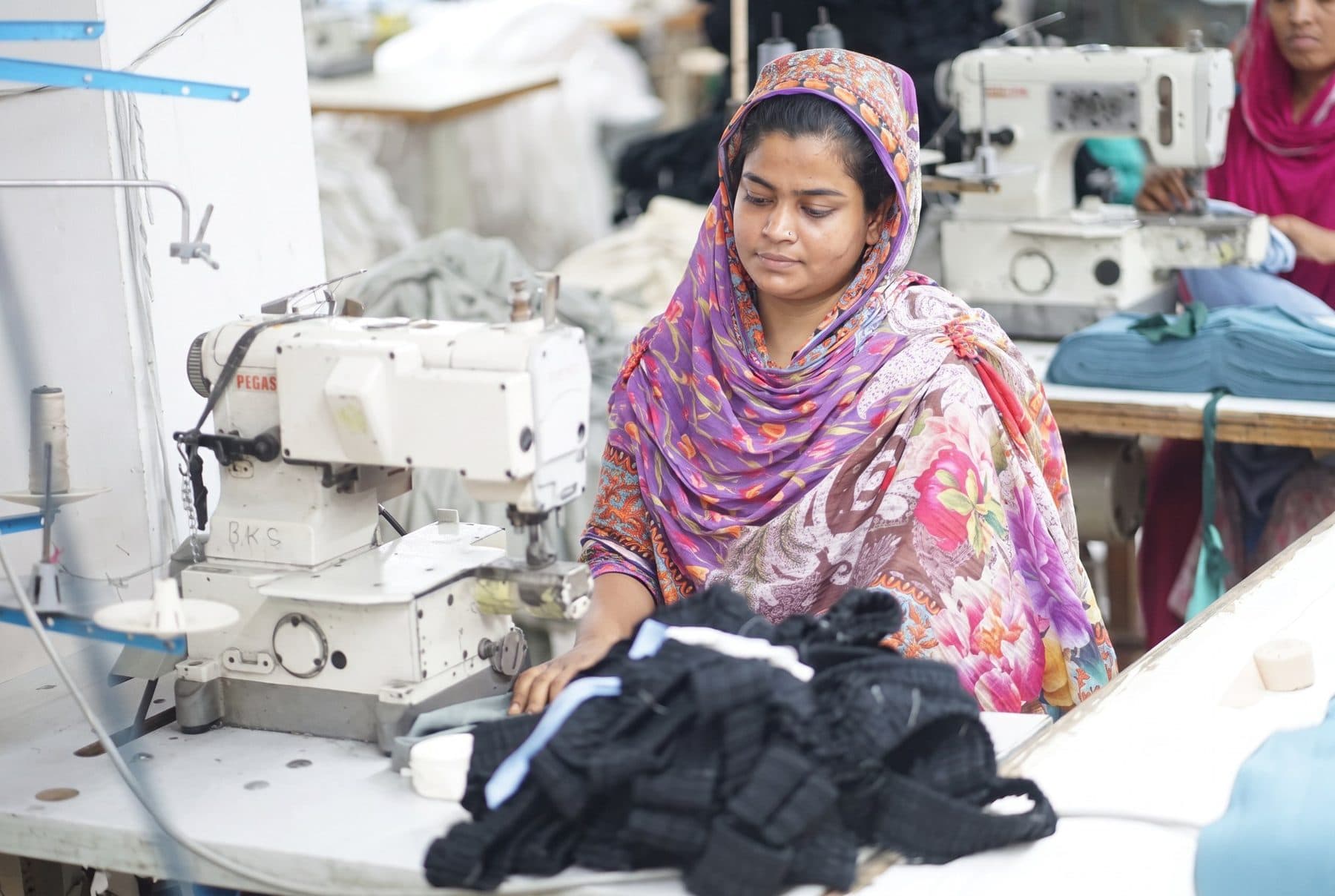
Write the fabric specification
A fabric request without a specification gets you whatever the supplier has on the shelf. A specification has four parts, and each one changes the price and the look.
- Fibre content. The fibres and their percentages, for example 100% cotton or 95% cotton and 5% elastane. For cotton, also say whether the yarn is combed, carded or ring-spun.
- Construction. For a knit, the structure (single jersey, rib, interlock, piqué, fleece, French terry) and the yarn count. For a woven, the weave (plain, twill, satin, oxford), the yarn counts and the number of warp and weft threads per centimetre or inch.
- Weight and width. GSM for knits, weight per square metre or ounces per square yard for wovens, and the usable width. Width matters because it decides how many pieces fit across the fabric, and so how much fabric each garment uses. Our fabric and GSM guide for knitwear gives weights by product.
- Finish and colour. Dyed, printed, yarn-dyed, garment-dyed or left undyed; plus any finish such as brushing, peaching, enzyme wash, silicone softener or water repellency. Colour is given as a reference standard (a physical swatch or a named colour system reference), never as a word like "navy".
Put the specification in your tech pack, on a page of its own for each fabric, so it travels with the style. Our guide on how to write a tech pack shows where it goes. If you only have a garment you like, send it: a supplier can analyse the fabric and propose a specification for you to confirm.
Three ways to buy fabric
Once you know what you want, there are three routes to buying it. Most ranges use more than one.
A mill making to order. The mill knits or weaves, dyes and finishes the fabric to your specification. You get exactly what you asked for, in your colour, with a record of every lot. In exchange you meet the mill's minimum per colour and wait for production.
A converter or agent. A converter buys unfinished fabric from mills and has it dyed, printed and finished for sale, while an agent represents one or more mills and sells their ranges. Either can offer a wider choice of qualities than one mill and may accept smaller quantities, usually at a higher price per metre or kilo. The trade-off is distance: the person you talk to may not control the dye house, so ask who does and whether you can get the mill's own test reports.
Stock or greige fabric. Stock fabric is already made, dyed and sitting in a warehouse; you buy what is there. Greige (also written grey) fabric is woven or knitted but not yet dyed or finished, and it can be dyed to your colour in a smaller lot than a full production run. Stock is fastest, but when it is gone you may not find the same lot again, so check the quantity covers any repeat you plan.
| What matters | Mill making to order | Converter or agent | Stock or greige fabric |
|---|---|---|---|
| Fit to your specification | Exact: made to your spec | Close: chosen from their range, then dyed or finished | Stock: what exists. Greige: your colour on their base cloth |
| Minimum per colour | Highest, set by the mill's machines | Usually lower than a mill | Lowest for stock; greige depends on the dye house |
| Price per metre or kilo | Lowest at volume | Higher, the converter adds a margin | Varies; clearance stock can be cheap |
| Time to fabric | Longest: knitting or weaving, dyeing, finishing, testing | Medium | Shortest |
| Repeat orders | Reliable: same construction, new dye lot | Usually possible if the base quality stays in their range | Not guaranteed |
| Traceability and test reports | Direct from the mill | Ask for them; may be second hand | Often limited, ask before buying |
Why fabric has its own minimums
Garment minimums and fabric minimums are two different numbers, and the fabric one is often the one that bites. A mill or dye house quotes its minimum per fabric, per colour, because dyeing is done in batches. Below a certain batch size a machine cannot hold a shade consistently and the cost per kilo rises. Minimums vary by mill, construction and colour, and are higher for special yarns and finishes, so there is no single figure to plan with: ask for the number on each fabric in each colour.
Colour is also why fabric arrives in dye lots. Each batch dyed is one lot, and two lots of the same colour can differ slightly. Cloth from different lots should not be mixed within one garment or one carton, or a sleeve can come out visibly lighter than the body.
To see whether your order clears a fabric minimum, divide the minimum by the fabric each garment uses, including cutting waste. If the result is more pieces than you are ordering in that colour, you have four options: drop the colour, use the same fabric and colour across several styles so they share one lot, move that colour to stock or greige fabric, or ask the mill whether it will run a smaller lot and what that does to the price. Sharing one fabric colour across a t-shirt, a long sleeve and a hoodie is often the simplest fix.
Our own garment minimums start at 500 pieces per style and colour (t-shirts 1,000; denim, jackets, woven shirts, workwear and uniforms 2,000). How garment minimums work in Bangladesh, and what smaller runs involve, is covered in our guide to minimum order quantities.
Lab dips and strike-offs
Colour and print are approved on small trials before any bulk fabric is dyed or printed.
- Lab dip. The mill dyes a small swatch of your actual fabric to match your colour standard, often in two or three slightly different versions. You compare them with the standard under an agreed light source, approve one or ask for another round, and the approved dip becomes the reference for bulk. Judge the dip on the real fabric, because the same dye looks different on jersey and on twill.
- Strike-off. For printed fabric, the printer runs a short length of your artwork on the actual fabric in the actual colours. You check the colours, the scale and the repeat of the pattern, and how it lines up at the edges. An approved strike-off is signed and kept as the print standard.
Keep a signed, dated half of every approved dip and strike-off and send the other half back. Without a physical standard on both sides, a later dispute about colour becomes one person's memory against another's. Lab dips and strike-offs run alongside your garment samples, and the order in which the proto, fit, size set and pre-production samples come in shows when fabric needs to be approved.
Test the fabric before bulk
A fabric can look right and still fail in the wash. Ask for test results on the fabric you will actually use, from a recognised lab, before the bulk order is cut. The core tests for most clothing are these:
| Test | What it tells you | A standard often used |
|---|---|---|
| Dimensional change (shrinkage) | How much the fabric or garment shrinks or grows after washing and drying | ISO 5077 |
| Colour fastness to washing | Whether the colour fades or stains other fabrics in the wash | ISO 105-C06 |
| Mass per unit area (GSM) | Whether the fabric weight matches your specification | EN 12127 |
| Pilling, fuzzing and matting | Whether the surface forms balls of fibre or goes fuzzy with wear | ISO 12945-2 |
Other tests depend on the product: colour fastness to rubbing, light, perspiration or chlorinated water for swimwear, tear strength for wovens, seam slippage for fine shirting. Agree the test methods and the pass levels in writing before the fabric is ordered, not after it arrives. Our guides to fabric shrinkage and colour fastness testing explain the methods, grades and pass levels in detail, and the market you sell into may add its own chemical rules, which your testing lab can confirm for your products.
Approve the bulk fabric against the sample
The fabric that arrives for production has to match what you approved: the lab dip, the strike-off, the tested quality and the handle of the sample garment. Bulk approval is a separate step, and it is where many problems are caught cheaply, while the fabric is still on the roll.
- Shade check. Cut a swatch from each dye lot and compare it with the approved lab dip under the agreed light. Group rolls by shade so that panels for one garment come from the same group.
- Weight and width. Weigh a sample of known area and measure the usable width. A fabric that is lighter or narrower than specified changes both the garment and the fabric consumption.
- Roll inspection. Inspect a share of the rolls on a lit table for holes, slubs, stains, barré (horizontal stripes in knits) and uneven dyeing, and record faults per roll.
- Bulk test report. Ask for shrinkage and colour fastness results on the bulk lot itself, not only on the development sample. Shrinkage in bulk decides the pattern allowance the factory uses.
- A signed bulk swatch card. The approved bulk fabric, with its lot numbers, is signed and kept alongside the sample for the final inspection to check against.
Only then should cutting start. A fault found on the roll costs a replacement roll; the same fault found after sewing costs the garments.
Check sustainability claims with the right document
If you plan to say your garment is organic or recycled, you need proof for the fabric in your order, not a certificate on a supplier's wall. The main textile standards separate two documents.
- A scope certificate says a company is certified to handle certain products under the standard. According to GOTS, it does not prove that a particular shipment is certified.
- A transaction certificate is issued by the supplier's certification body for a specific shipment. It lists the products, the shipment details and the buyer, and it is what proves the goods themselves are certified.
For GOTS, look the supplier up by name or licence number in the GOTS public database of certified suppliers, and ask the certifier to confirm a transaction certificate if you have any doubt. GOTS states that every operator in the processing and manufacturing chain must be certified for the final product to be sold or labelled as GOTS certified, so the garment factory needs certification too, not just the mill. Products labelled "organic" under GOTS need at least 95% certified organic fibre, and "made with organic" at least 70%.
For the Textile Exchange standards, the Organic Content Standard (OCS) and the Global Recycled Standard (GRS), use Textile Exchange's certified company search for scope certificates and its online tool to authenticate transaction certificates, which covers certificates issued by active certification bodies from October 2022. If a certificate is not found, Textile Exchange tells you to ask the certification body. Under GRS, a product needs at least 50% recycled content for consumer-facing labelling. Our guide to verifying factory certificates walks through the look-ups step by step.
Where Bangladesh stands on fabric
Bangladesh's garment industry does not source fabric evenly across the two families. The US Department of Agriculture's Foreign Agricultural Service reported in April 2026 that the country's spinning and textile mills produce 85% of the yarn needed for knitwear but only 40% of the fabric used in woven garments, and that the garment sector imported about $8 billion of fabric in the 2024/25 marketing year. Its December 2025 report quoted the Bangladesh Textile Mills Association putting local mills at around 85% of knit fabric demand and 40% of woven fabric demand. A 2021 study for the United Nations Committee for Development Policy described the knitwear subsector as predominantly supplied from domestic sources, with domestic sourcing of woven fabric at 35 to 40%.
In practice this means cotton knits such as jersey, rib and fleece are usually made close to the factory, which makes colour trials and repeat orders simpler. Many woven fabrics, especially specialised qualities, may come from abroad, which adds shipping time before production can start. Ask at the quoting stage where each fabric in your range will come from, because it affects the timeline more than the sewing does. Our fabric and trim sourcing page sets out what is made locally and what is usually imported.
What to send when you ask for fabric
A complete request gets an accurate price and a realistic minimum the first time. Send:
- The garment type and whether each fabric is knit or woven
- Fibre content, with yarn type if it matters to you
- Construction, weight (GSM or oz) and the width you need, if known
- Colour standards for every colour, as physical swatches or named references
- Print artwork with colour references, if the fabric is printed
- Finishes: brushing, peaching, washes, softeners or performance finishes
- Quantity per colour, in garments, so fabric can be calculated from consumption
- Tests and pass levels you require, and the market you sell into
- Any certification claim you plan to make (GOTS, OCS, GRS) and whether you need transaction certificates
- A reference garment or fabric swatch, if you have one
- Your target delivery date and whether stock fabric is acceptable for any colour
What to do next
If you would rather not buy fabric yourself, full package production puts fabric, trims and sewing into one garment order with one supplier. We are a buying house in Narayanganj, Dhaka, and we do not own sewing lines: orders are made in audited partner factories, and we name the factory making yours in writing, with its address, certificates and audit reports, before production starts. We check quality on the line and run an AQL final inspection. Our full package production page explains how it runs. Otherwise, send us your fabric specification and quantities per colour and we will reply within one working day.
Questions buyers ask.
Where should a new clothing brand source fabric?
Start from your quantities, not from a list of suppliers. If each colour of each fabric will run to a few hundred garments, a mill making fabric to order may not accept it, so a converter, an agent or stock fabric is usually the realistic route for a first collection. Greige fabric dyed to your colour sits in between: your shade, on a base cloth that already exists, in a smaller lot. As your volumes grow and a colour repeats season after season, moving that fabric to a mill making to order gives you a lower price per metre or kilo, a consistent construction and test reports straight from the source. Whatever the route, ask for a swatch and a test report before you commit, and check that the supplier can supply the same quality again if the style sells. A fabric you cannot repeat turns a best-seller into a one-off.
Can I buy fabric myself and send it to a garment factory?
Yes. Supplying your own fabric turns the order into cut, make and trim (CMT) for that part of the work: the factory cuts and sews, and you carry the risk on the cloth. That risk has several parts. You must order enough, which means knowing the fabric consumption per garment from the factory's marker and adding an allowance for cutting waste and shrinkage. You must arrange shipping, import clearance and any bonded warehouse paperwork the factory needs, so ask the factory and your customs broker what applies to your case. If the fabric arrives short, faulty or in two dye lots, the delay is yours to solve. For these reasons many brands buy their own fabric only when it is a signature quality from one mill, and let the manufacturer buy everything else. If you do supply fabric, send the specification and test reports with it.
How do I work out how much fabric an order needs?
Ask the factory for the fabric consumption of each style: the weight in kilograms for knits, or the length in metres at a stated width for wovens, per garment, taken from the cutting marker for your size ratio. Multiply that by the number of pieces in each colour, then add an allowance for cutting waste, shrinkage and any fabric set aside for testing and shade checks. The factory should tell you the allowance it uses and why. Do the sum separately for each colour, because the fabric minimum applies per colour, and separately for each fabric in a garment, such as a body fabric and a rib collar. Compare the total with the mill's minimum for that colour. If you fall short, you can share the colour across styles, move it to stock fabric, or ask the mill for a price on a smaller lot.
Sources
Checked . Rules and figures change, so confirm anything that affects your pricing.
- USDA Foreign Agricultural Service: Bangladesh Cotton and Products Annual, April 2026 (mills make 85% of knitwear yarn and 40% of woven garment fabric; $8 billion of fabric imported in 2024/25) (opens in a new tab)
- United Nations Committee for Development Policy (M. A. Razzaque, 2021): Bangladesh en route to LDC graduation, knitwear sourced mainly at home, woven fabric 35 to 40% domestic (opens in a new tab)
- GOTS: Frequently asked questions (scope vs transaction certificates, every processing stage certified, 70% and 95% organic label grades) (opens in a new tab)
- GOTS: Certified suppliers public database (opens in a new tab)
- Textile Exchange: Authenticate a transaction certificate (covers certificates from active certification bodies from October 2022) (opens in a new tab)
- Textile Exchange: Find a certified company (scope certificate data from certification bodies) (opens in a new tab)
- Textile Exchange: Organic Content Standard, third-party certification of organic material and chain of custody (opens in a new tab)
- Textile Exchange: Recycled Claim and Global Recycled Standard (50% recycled content for consumer-facing GRS labelling) (opens in a new tab)
- ISO 5077:2007 (preview): Textiles, determination of dimensional change in washing and drying (opens in a new tab)
- BSI: BS EN ISO 105-C06:2010, colour fastness to domestic and commercial laundering (opens in a new tab)
- BSI: BS EN 12127:1998, mass per unit area of woven and knitted fabrics using small samples (opens in a new tab)
- BSI: BS EN ISO 12945-2:2020, fabric pilling, fuzzing and matting by the modified Martindale method (opens in a new tab)
- USDA Foreign Agricultural Service: Cotton and Products Update, Bangladesh, BG2025-0013 (2 December 2025), BTMA knit and woven fabric shares (opens in a new tab)