In short
Bangladesh exported US$38.70 billion of garments in the year to June 2026, 80.62% of its goods exports (EPB data). The WTO ranks it second to China, with 6.76% of world clothing exports in 2025. Mapped in Bangladesh counted 3,315 export factories in June 2025; its earlier report put workers at about 3 million. The entry wage is Tk 12,500 monthly.
Want a costing for your own style? Send us your enquiry
Bangladesh shipped US$38.70 billion of ready-made garments in the fiscal year that ended on 30 June 2026, and those garments made up 80.62% of everything the country exported. That comes from Export Promotion Bureau (EPB) data, published by the garment exporters’ association BGMEA. The WTO ranks Bangladesh second among single countries for clothing exports in 2025, with 6.76% of the world total. Every number below carries its period and a primary source, checked on 23 September 2026. Many statistics pages that rank for these searches still repeat figures that are years old or were never right, so where sources disagree, we show both and explain the difference.
The fact sheet: the key numbers, dated and sourced
The table gathers the figures most often searched for. The sections that follow explain each one, and the full list of sources sits at the end of the page.
| Measure | Figure | Period | Source |
|---|---|---|---|
| Garment exports | US$38.70 billion, down 1.64% | FY2025-26 (July 2025 to June 2026) | EPB data via BGMEA |
| Garments as a share of all goods exports | 80.62% | FY2025-26 | EPB data via BGMEA |
| Garment exports, calendar year | US$38.82 billion | 2025 | EPB data via BGMEA; WTO |
| Share of world clothing exports | 6.76%, second after China | 2025 | WTO Statistical Tables 2026 |
| Largest market | European Union, 49.25% | FY2025-26 | EPB data via BGMEA |
| United States share | 20.01% | FY2025-26 | EPB data via BGMEA |
| United Kingdom share | 11.34% | FY2025-26 | EPB data via BGMEA |
| Knitwear share of garment exports | 53.3% | FY2025-26 | EPB data via BGMEA |
| Export-oriented garment factories | 3,315 | June 2025 | Mapped in Bangladesh |
| Workers in export garment factories | About 3 million | Impact report, 2022 to 2024 | Mapped in Bangladesh |
| Legal minimum wage, entry grade | Tk 12,500 a month, about US$102 | In force since 1 December 2023 | Minimum Wage Board; Bangladesh Bank |
| LEED-certified green garment factories | 291 | Stated on 23 September 2026 | BGMEA |
| Least developed country (LDC) graduation | Scheduled for 24 November 2026; extension request pending | Status on 23 September 2026 | UN LDC Portal |
| US tariff position | Normal duty plus a 10% Section 301 tariff | Goods entered from 24 July 2026 | USTR notice, Federal Register |
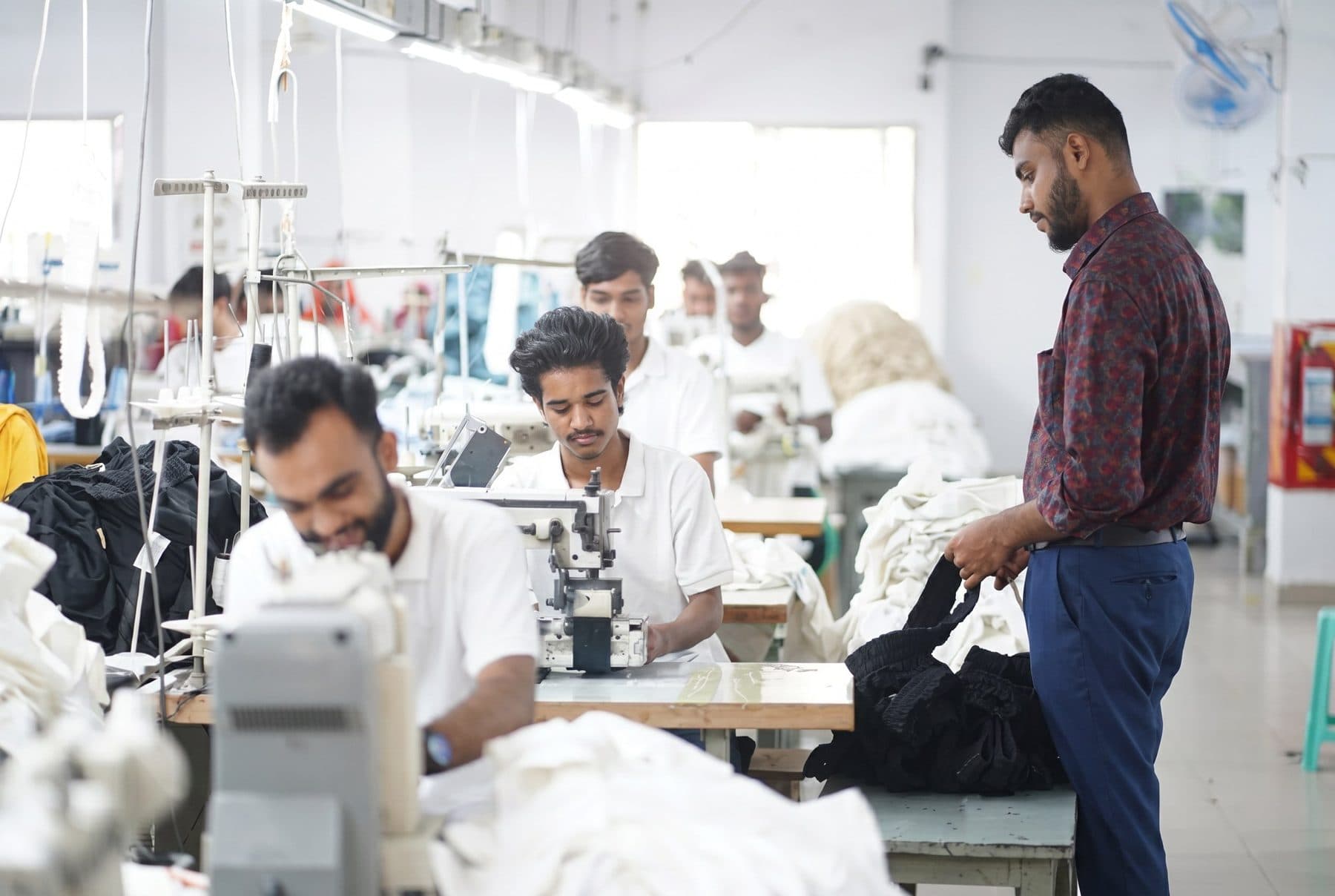
Exports and their weight in the economy
Bangladesh counts its fiscal year from July to June, so FY2025-26 means 1 July 2025 to 30 June 2026. The table uses the EPB series as BGMEA publishes it. Compare years within this one series rather than mixing in totals from other publishers, which may use a different basis or an older release.
| Fiscal year | Garments (US$ bn) | Change on year | All goods (US$ bn) | Garments’ share |
|---|---|---|---|---|
| FY2022-23 | 38.14 | n/a | 46.43 | 82.15% |
| FY2023-24 | 36.15 | -5.22% | 44.47 | 81.29% |
| FY2024-25 | 39.35 | +8.84% | 48.28 | 81.49% |
| FY2025-26 | 38.70 | -1.64% | 48.00 | 80.62% |
On a calendar-year basis the same source gives US$35.89 billion for 2023, US$38.48 billion for 2024 and US$38.82 billion for 2025. The 2025 figure matches the value in the WTO’s world ranking.
The long view shows how far garments have come to dominate Bangladesh’s trade. In FY1983-84, garments earned US$31.57 million, just 3.89% of exports. Their share passed half in FY1990-91 (50.47%) and has stayed above 74% in every fiscal year since FY1998-99. In the last four years the total has moved sideways, between US$36 billion and US$40 billion.
Against the size of the economy, the World Bank puts Bangladesh’s 2025 GDP at US$456.3 billion. Garment exports equal about 8.6% of that if you use the FY2024-25 total, or 8.5% with calendar 2025. That is our arithmetic, and it compares gross export sales with GDP, which measures value added. Imported yarn, fabric and trims are inside the export value, so the industry’s own contribution to GDP is smaller than the ratio suggests. Any line saying garments are a given percentage of GDP should say which measure it used.
World rank, markets and products in brief
World rank. The WTO’s Statistical Tables 2026 (Table 22) put Bangladesh’s 2025 clothing exports at US$38.82 billion, second among single countries after China, with 6.76% of the world total, against 4.22% in 2010. The WTO also lists the European Union as one exporter, but that total includes trade between member states, so Bangladesh’s rank is quoted among single countries. Viet Nam, in third place, finished about US$1.3 billion behind. How the four big Asian producers compare for a buyer is covered in our guide to Bangladesh vs Vietnam vs China vs India.
Markets. In FY2025-26 the EU took 49.25% of Bangladesh’s garment exports, the United States 20.01% and the United Kingdom 11.34%, according to EPB data. Values by market, the largest EU buyers and the view from the importing side are in our deeper guide to Bangladesh garment exports, so we do not repeat them here.
Products. Knitwear (customs chapter 61) earned 53.3% of garment export value in FY2025-26 and woven garments (chapter 62) 46.7%. BGMEA’s five main product families, led by trousers, t-shirts and sweaters, made up about 80% of the total. The same exports guide breaks the figures down by four-digit HS heading.
Factories and workers: why every source gives a different number
The most detailed public count comes from Mapped in Bangladesh (MiB), a project of BRAC University’s Centre for Entrepreneurship Development that builds its list by surveying factories on the ground. Its 2025 booklet, with data as of June 2025, records:
- 3,315 export-oriented garment factories in 20 districts.
- By type: 1,308 knit, 1,008 woven, 560 sweater and 439 making both knit and woven.
- By membership: 2,053 in BGMEA, 739 in BKMEA, 807 in neither, and 284 counted in both associations.
The 2025 booklet gives no worker total. The workforce figure comes from an earlier publication: MiB’s impact report for 2022 to 2024, when its map listed 3,722 factories, put the workforce in export-oriented garment factories at about 3 million. The report says the map tracks new factories as well as those that stop operating, which is why its total moves: on 23 September 2026 the live map showed 3,320 factories.
Other counts answer different questions. An association’s member list counts members, and the MiB split shows why that differs from a factory census: some factories belong to both associations and hundreds to neither. A national labour figure may also include textile mills, subcontractors and informal work. Before you rely on a number, check three things: whether it covers export garment factories only, whether it counts factories that are still operating, and its date. Where the factories cluster and how to check one are covered in our guide to garment factories in Bangladesh, and the two associations in BGMEA vs BKMEA.
Comparing Bangladesh with another country?
Send us the same tech pack you send elsewhere. Our costing states the shipping term, so you can compare like with like.
The legal minimum wage in taka, dollars, euros and pounds
The Minimum Wage Board’s list of declared rates, updated in September 2026, gives the garment sector’s rate under a gazette of 20 December 2023, in force from 1 December 2023. An entry-grade worker must receive at least Tk 12,500 a month: basic pay of Tk 6,700, house rent of Tk 3,350, and fixed allowances of Tk 750 for medical care, Tk 450 for transport and Tk 1,250 for food. The list also sets an annual increment of 9% of basic pay, which on the entry-grade basic of Tk 6,700 is Tk 603 a month at the first increment (our arithmetic).
Bangladesh Bank’s rate page for 23 September 2026 gives a weighted average of Tk 122.99 to the US dollar. At that rate Tk 12,500 is about US$102 a month, and at the bank’s cross rates for the same day it is about €89 or £76. These are floors, not typical pay: higher grades, the increment and overtime all sit on top. Grade-by-grade rates, wages inside export processing zones, living-wage estimates and the next wage review are in our guide to garment worker wages.
Green factories: 291 LEED buildings and how to check one
BGMEA’s environment page stated on 23 September 2026 that Bangladesh has 291 LEED-certified green garment factories, certified by the U.S. Green Building Council (USGBC), and that 53 of the world’s top 100 green garment factories are in the country. Check the date behind any count you see, because a total without one cannot be compared with this figure.
LEED certifies a building project: its design, energy and water performance, and materials. It is not a social audit and says nothing about wages, hours or chemical management, so treat it as one line in a supplier file, next to the audit reports. You can check any claim yourself in the USGBC LEED project directory, which is public: search the factory name, filter by country, and confirm that the certified site matches the address on your purchase order, because a certificate for one building does not cover a sister unit elsewhere. Our guide to verifying factory certificates covers the other registers a buyer can search.
Trade status: LDC graduation and the US tariff
LDC graduation. According to the UN LDC Portal, Bangladesh is scheduled to leave the least developed country category on 24 November 2026. On 18 February 2026 the UN Committee for Development Policy received the government’s request to consider extending the preparatory period. The committee concluded that an extension by the General Assembly would be appropriate, provided Bangladesh makes significant progress on domestic reforms, and on 21 July 2026 the Economic and Social Council recommended that the General Assembly act before 24 November 2026. As of 23 September 2026 no decision had been published, so the scheduled date stands. What graduation would change for duty in the EU, UK and other markets is set out in our guide to LDC graduation and duty-free apparel.
United States. A USTR notice published in the Federal Register on 28 July 2026 imposes a 10% Section 301 tariff on goods of Bangladesh entered on or after 12:01 a.m. eastern time on 24 July 2026, with listed exemptions. For Bangladesh the 10% is charged on top of the normal duty, not netted against it as it is for a few other economies. The notice also says tariff-rate quotas for Bangladesh, linked to its imports of US cotton and textile inputs, will be set up when feasible. Separately, on 20 February 2026 the US Supreme Court held that the International Emergency Economic Powers Act, the law used for the 2025 reciprocal tariffs, does not authorise the President to impose tariffs. Confirm the full duty on your own HTS code with your customs broker; our page for US brands covers the rest of the import process, and our guide to US tariffs on clothing from Bangladesh works through the duty by product.
Numbers still repeated online, and what the sources say
These figures appear on statistics and sourcing pages that rank for the searches above. We describe the claim, not the page, and give the primary figure that replaces it. Claims about duty, tariffs and origin rules are checked the same way in our Bangladesh clothing sourcing myths and facts guide.
| Claim you may see | What the primary source says |
|---|---|
| Garment exports of US$47 billion or more a year | US$39.35 billion in FY2024-25 and US$38.70 billion in FY2025-26 (EPB). About US$48 billion is the total for all goods. |
| Garments are under half of Bangladesh’s exports | 80.62% in FY2025-26, and above 74% every fiscal year since FY1998-99 (EPB). |
| The US buys around a third of the garments | The EU took 49.25% and the US 20.01% in FY2025-26 (EPB). |
| Most output is woven | Knitwear was 53.3% of garment exports in FY2025-26 (EPB). |
| About 4% of world clothing exports | 6.76% in 2025; 4.22% was the share in 2010 (WTO). |
| A minimum wage of Tk 8,000, Tk 9,200 or Tk 15,625 | Tk 12,500 for the entry grade since 1 December 2023, the rate on the Minimum Wage Board’s current list. |
| An entry wage worth US$130 or more | About US$102 at Bangladesh Bank’s rate for 23 September 2026. |
| Around 135 LEED green factories | 291, as BGMEA stated on 23 September 2026. |
| A 19% US reciprocal tariff | The reciprocal tariffs rested on a law the Supreme Court ruled out for tariffs on 20 February 2026; a 10% Section 301 tariff applies from 24 July 2026. |
| Graduation in November 2026 as a settled fact | Scheduled, with an extension request before the UN General Assembly as of 23 September 2026. |
What to do next
For a buyer the numbers point to three practical conclusions. Bangladesh is a volume specialist in knitwear, trousers and sweaters; the EU and UK together take about 60% of its garments; and trade terms are in motion in the US and after LDC graduation, so price on landed cost, not ex-factory cost alone. Our why Bangladesh page sets out the wider case.
CMB Sourcing Ltd. is a buying house in Narayanganj, Dhaka. We do not own sewing lines: orders are made in audited partner factories, and we name the factory in writing before production, with its address, certificates and audit reports, so you can check it against the registers above yourself. Our full package production page explains how an order runs, from sampling and fabric to inspection and shipment. Our own orders start at 500 pieces per style and colour, with higher minimums for some categories, such as 1,000 for t-shirts and 2,000 for denim. Send us your product list or tech pack for a quote, and a founder will reply within one working day.
Questions buyers ask.
How big is the garment industry in Bangladesh?
Measured by exports, Bangladesh sold US$38.70 billion of garments in the year to June 2026 and US$38.82 billion in calendar 2025, the periods used by the EPB and the WTO. That makes it the second-largest clothing exporter among single countries, behind China, with 6.76% of world clothing exports. Clothing also dominates the country’s trade: it was 80.62% of all goods shipped abroad in FY2025-26. Set against the World Bank’s 2025 GDP of US$456.3 billion, garment exports are worth roughly 8.5% to 8.6%, though that ratio compares gross sales with value added and so overstates the sector’s own share of GDP. On the ground, Mapped in Bangladesh counted 3,315 export-oriented factories in June 2025; its 2022 to 2024 impact report, when the map listed 3,722 factories, put the workforce at about 3 million. The trend is flat rather than rising: annual exports have stayed between US$36 billion and US$40 billion since FY2022-23.
How many garment workers are there in Bangladesh?
The best-supported figure is about 3 million workers in export-oriented garment factories, from the 2022 to 2024 impact report of Mapped in Bangladesh, a BRAC University project that surveys factories rather than relying on membership lists. Treat any single number with care. The definition changes the answer: counting textile mills, subcontractors and informal workers as well as export garment factories gives a larger total. The date matters too, since factories open and close and the MiB map is updated as they do. Association figures count member factories, and one factory can belong to both BGMEA and BKMEA, or to neither. For a buyer the useful check is at factory level: the headcount a supplier quotes should match its latest social audit and the capacity it claims for your order. The legal floor for those workers is Tk 12,500 a month at the entry grade, in force since 1 December 2023, plus an annual increment of 9% of basic pay.
How many green garment factories are there in Bangladesh?
BGMEA, the main garment exporters’ association, stated on 23 September 2026 that Bangladesh has 291 garment factories certified under LEED, the green building system run by the U.S. Green Building Council, and that 53 of the world’s top 100 green garment factories are in the country. Some older pages give totals well below that, so always look for the date behind a figure. Two cautions apply before you use the label in a sourcing decision. LEED rates a building’s environmental design and performance; it does not audit wages, working hours or chemicals, so it complements a social audit rather than replacing one. And a claim is simple to verify: search the factory in USGBC’s public LEED project directory, filter by country, and make sure the certified site is the same address as the one on your purchase order, not a sister unit.
Sources
Checked . Rules and figures change, so confirm anything that affects your pricing.
- BGMEA: Export performance, garment and total exports by fiscal and calendar year, knit and woven split, market shares and main product groups (EPB data) (opens in a new tab)
- World Trade Organization: World Trade Statistics, Statistical Tables 2026, Table 22, top clothing exporters and importers in 2025 (opens in a new tab)
- World Bank: GDP (current US$), Bangladesh, 2025 (opens in a new tab)
- Minimum Wage Board, Bangladesh: list of declared minimum wage rates, garments row (gazette 20 December 2023, in force 1 December 2023, 9% annual increment on basic pay) (opens in a new tab)
- Bangladesh Bank: exchange rate of taka, 23 September 2026 (USD weighted average rate and cross rates) (opens in a new tab)
- BGMEA: Environment, 291 LEED-certified green garment factories and 53 of the world’s top 100 (opens in a new tab)
- U.S. Green Building Council: LEED project directory (public search of certified projects by name and country) (opens in a new tab)
- BRAC University CED, Mapped in Bangladesh: 2025 booklet, 3,315 export-oriented factories as of June 2025, by type and membership (opens in a new tab)
- BRAC University CED, Mapped in Bangladesh: impact report 2022 to 2024, about 3 million workers in the export-oriented garment industry, alongside 3,722 factories on the map (opens in a new tab)
- Mapped in Bangladesh: live map of export-oriented garment factories, 3,320 factories shown on 23 September 2026 (opens in a new tab)
- UN LDC Portal: Bangladesh graduation status (scheduled 24 November 2026; ECOSOC decision of 21 July 2026 on the extension request) (opens in a new tab)
- Federal Register 2026-15181: USTR notice of actions in Section 301 investigations, 10% tariff on goods of Bangladesh from 24 July 2026 (opens in a new tab)
- Supreme Court of the United States: Learning Resources, Inc. v. Trump (decided 20 February 2026), IEEPA does not authorise tariffs (opens in a new tab)